Community Corner
Ever Wonder About the Jellies that Takeover the Harbor in Summer?
We did. Writer Helen O'Neil did a little investigating and found some info on the history and present-day effects of the moon jelly.

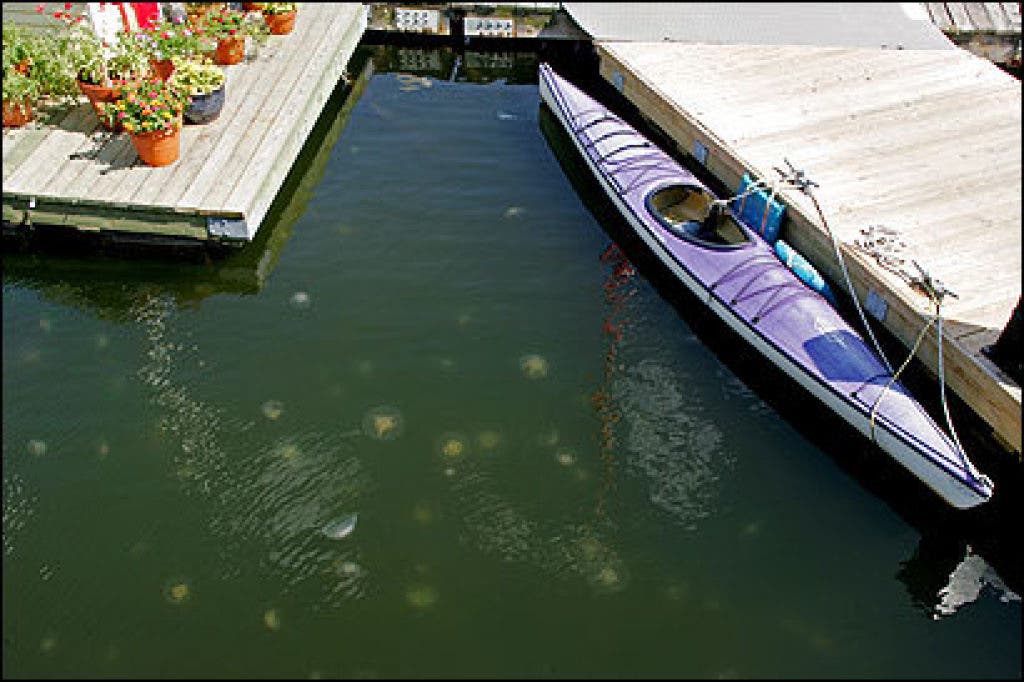

Each year Boston Harbor gets clogged with jelly fish. Thousands of moon jellies, with the lovely scientific name aurelia, congregate in the bay at the Charlestown Marina and can wreak havoc infesting water intake systems of the boats docked there.
The moons seem to stay for a few weeks, float around, either charming or repelling onlookers -- depending on how you feel about jellies -- and then they’re gone.
The on-line Encyclopedia of Life reports that moon jellies can be the size of a small fist or as large as a dinner plate. The "bell," a circular umbrella covers their tentacles and is transparent, so that it is possible to see right through, to a set of four gonads that look like horseshoes.
Unlike the Portuguese Man of War and other poisonous jelly fish, the moon jelly is not poisonous, but it may sting if contacted. The simplest remedy is household vinegar. A less simple remedy is urine. In any case it would probably be a good idea to seek medical attention if you think you have been stung.
Jellies don’t seem to really know where they are going and cannot exactly affect the direction in which they travel. The tides carry them. They can propel themselves, in only one direction, with a kind of muscle, which causes the jelly to pulsate and move, according to the Long Beach Island Journal.
Jellyfish are not fish at all but are invertebrates (no backbone) with no brain, no heart and no blood. They are composed of about 95 percent water. (Humans are about 65 percent) They are one of the oldest living creatures -- they first appeared about 500 million years ago.
Where do the moon jellies go?
An e-mail from Steve Bailey, curator at the New England Aquarium, answered the question. Moon jellies don’t migrate, Bailey wrote. "Our Boston Harbor moons are always here, in one stage or another."
He explained that the moons were probably brought here from Europe, centuries ago, adhered to the side of boats. Now they are permanent residents. "Moons may move back and forth in the harbor a bit on the tides," he said, "but migrating would take too much energy, and they aren’t really built for that."
The jellyfish might be compared to a butterfly, Tony LaCasse, media relations director at the aquarium has said. The medusa, the ‘bell’ has a short life, maybe just a few weeks. When the medusa spawns, its eggs float to the bottom of the harbor or attach themselves to hard surfaces, like pilings on the piers. A few more stages follow until the following spring when ‘saucer-like’ jellies emerge, eat like crazy, and become the ‘bells’ floating around in the harbor.
Is there an increase in jellyfish population?
It seems the jellyfish population overall is on the rise. The August 2010 issue of Smithsonian Magazine named the jelly as one the top 40 things we are going to have to worry about in the years ahead. There are 200 known species but scientists estimate there are probably closer to 2,000 species.
Their survival tenacity seems to put them on a par with the cockroach, another prehistoric creature. Jellyfish can survive in polluted water, as their need for oxygen is low. When food supply is limited, their body mass simply shrinks as they adapt to getting along with less.
It is also speculated that rising sea temperatures caused by climate change may contribute to an increase in jellyfish blooms, since jellyfish are usually better able to survive in warmer waters than other sea life. It is also speculated that the rise in population might also be due to the decrease in fish stocks. When fish are plentiful they feel on jellyfish larva. With the decrease in fish supply more jellyfish eggs are allowed to bloom. A single jellyfish can release 45,000 eggs in a single day. (National Science Foundation)
The damage jellies can cause
One of the most dramatic instances of jelly fish infestation occurred in Manila, the Philippines. In 1999 jellyfish swarms great enough ‘to fill 50 trucks’ clogged the intake pipes of a power plant there, plunging 40 million people into darkness and starting rumors of a coup d’etat.
The jellies haven’t yet arrived in Charlestown this summer. Peter Davidoff, co-owner of Constitution Marina said there are a few but they might be bigger and more plentiful when the weather, and the ocean, warm up.
Davidoff said the best thing for boat owners to do, when the jellies come, is to turn off their power, if possible. When the jellies clog the pump, turning off the power allows them to fall out again and back into the water. Davidoff said boat owners should at least use a screen on the intake pump.
Find out what's happening in Charlestownfor free with the latest updates from Patch.
When they do arrive in the harbor, Davidoff says “they seem to stay 2-3 weeks. They’re part of life."
Information for this article was compiled from the following:http://www.eol.org/pages/203484; http://www.smithsonianmag.com/specialsections/40th-anniversary/Jellyfish... http://www.time.com/time/magazine/article/0,9171,1931659,00.html#ixzz1Ov... www.longbeachislandjournal.com/animals/moon-jellyfish; http://www.thebostonchannel.com/news/13622035/detail.html and e-mail interview.