Community Corner
The Mystery Man- Robert Bulkeley Emerson
Taking a walk through history in Sleepy Hollow Cemetery.


The following is part 10 of the Sleepy Hollow series.
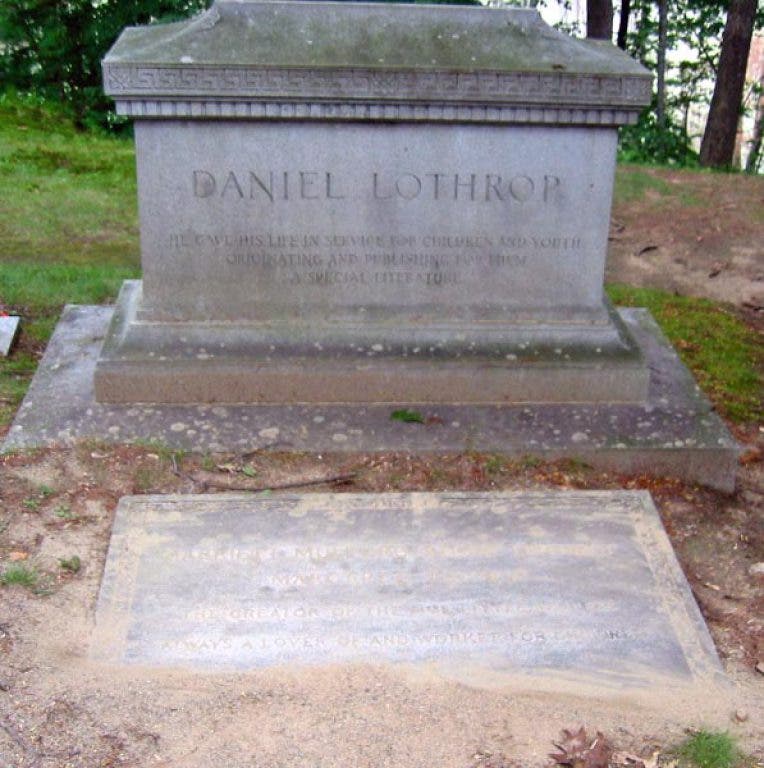
Leaving the grave of John Shepard Keyes and Marths L, Prescott, we continue walking on Hillside Ave. atop Authors Ridge several yards until Hillside peels off on our right [Photo 1]. We continue straight ahead on the dirt Ridge Path. In another 25 yards we come to the graves of Daniel and Harriet Lothrop on our left. [Photos 2 & 3 (Harriet's stone is partially obscured by sand.)]
Daniel, after running several successful bookshops, found his true vocation as publisher. He published an array of periodicals and books, most directed at children, most stressing "right living" and the development of better citizenship. Harriet, under the penname Margaret Sidney, wrote a great many children's books, including The Five Little Peppers and How They Grew.
Find out what's happening in Concordfor free with the latest updates from Patch.
A high point of Daniel's and Harriet's lives came in 1883, when they bought and moved into The Wayside on Lexington Road, a house with an impressive history. In 1775, at the start of the American Revolution, The Wayside was home to the Muster Master of the Concord Minutemen, Samuel Whitney, his wife, twelve children and at least two slaves. In the 19th century, it housed the Alcott family and then the Hawthornes.
The Lothrops, with their daughter Margaret, took on the task of restoring and preserving the house, eventually having it declared a National Historic Landmark. The Wayside is now a part of Minute Man National Historical Park, owned by us U.S. taxpayers. It's well worth visiting.
Find out what's happening in Concordfor free with the latest updates from Patch.
Directly across the Ridge Path from the Lothrops is the large plot of the Emersons. [Photo 4] The most prominent gravestone, that five-foot tall chunk of rose quartz, marks the resting place of Ralph Waldo Emerson, often called Waldo, whom we'll discuss in our next tale.
Today, let's focus on the more modest stone second from the northeast corner of the plot, the corner closest to the Lothrops. [Photo 5] It marks the resting place of Robert Bulkeley Emerson, born in Boston, 11 April 1807, died in Littleton, 27 May 1859. Most visitors who notice (and are able to discern) the epitaph on the stone find it most puzzling: "Thou has been faithful over a few things." A few things! Who was this man and what had he done to deserve such faint praise?
Robert Bulkeley Emerson was one of Waldo's two younger brothers, four years his junior. The name Bulkeley, by which he was usually called, came from the Rev. Peter Bulkeley, a Puritan minister, one of Concord's founders, and Bulkeley's and Waldo's maternal ancestors in the seventh generation before their own. Biographers write that Bulkeley was what is now called "retarded." Some write that he was also "emotionally unstable" and "periodically deranged." Today he might be given a dual diagnosis -- mental retardation and mental illness.
Bulkeley was reportedly easily irritated and "notably garrulous," with a "loud voice and unruly ways." During Waldo's Harvard commencement, Waldo's and Bulkeley's mother, Ruth Emerson, took Bulkeley to Newton to stay with her sister so that he would not "spoil the day for Ralph."
Several times during his life, Bulkeley was admitted to McLean Asylum, a psychiatric facility in Boston (now McLean Hospital in Belmont, Mass). (Waldo's and Bulkeley's brother, Edward Emerson, also spent time in McLean with mental or emotional problems.)
Bulkeley sometimes displayed ingenuity, initiative, and adaptive skills that raise questions regarding his diagnosis. Once, at age 20, he slipped away from his caretakers for a two-week ramble that led him to Mont Vernon, New Hampshire. There he made door to door calls bearing a roughly-written paper that said he was organizing a singing school. He had lined up some fifteen gullible subscribers before the village leaders found him out and sent him back home.
During most of his adult years, Bulkeley boarded with two farm families in Chelmsford and Littleton, Mass., where he helped with simple farm chores. He often visited Waldo on holidays, staying a week or so, and Waldo shared in the cost of keeping his brother. Biographers note that Waldo was always charitable in his attitude toward Bulkeley, recognizing that "the law of compensation had not functioned" for Bulkeley. Henry David Thoreau also looked after Bulkeley on occasion. In 1853, when Ruth Emerson died, Thoreau brought Bulkeley home and acted as his tender guardian throughout the funeral period.
When Bulkeley died in Littleton in 1859, Thoreau took charge of the funeral in Concord. "His face was not much changed by death," Waldo said, "but sadly changed by life from the comely boy I can well remember."
But what of that cryptic inscription on his gravestone? Readers who know the bible may have recognized in the epitaph words of the evangelist Matthew. According to Matthew, Jesus preached that the kingdom of heaven will be like a man going on a journey, who called together his servants and entrusted his property to them. To one he gave five talents of money, to another two talents, and to another one talent, each according to his ability. Then he went on his journey. The man who had received five talents put his money to work and gained five more. So also, the man with two talents gained two more. But the man who had received one talent went off, dug a hole in the ground, and hid his master's money.
After a while, the master returned to settle accounts with his servants. The master was most displeased with the miserly servant who had buried his one talent, and ordered that he be cast out into the darkness. But to each of the servants who had made good use of the talents he was given the master said: "Well done, good and faithful servant! You have been faithful with a few things. I will put you in charge of many things. Come and share your master's happiness."
Far from disparaging Bulkeley, the epitaph, likely chosen by Waldo (a former minister), is a loving tribute to a man who had used well the few talents he had been given, and would now be put "in charge of many things" -- would be welcomed into heaven to share his master's happiness.
You can read more about Robert Bulkeley Emerson in Bulkeley, The Other Emerson, by H.A. Beyer, 4(1) Journal of Religion, Disability & Health 81 (2000).
-----------------
Harry Beyer, a licensed town guide, has lived and walked in Concord since 1966.