Neighbor News
Board of Health To Hear Concerns on Pipeline
On Monday, June 29th at 6:30 PM, the Dedham Board of Health will hold a meeting to discuss the Dedham West Roxbury Lateral Pipeline
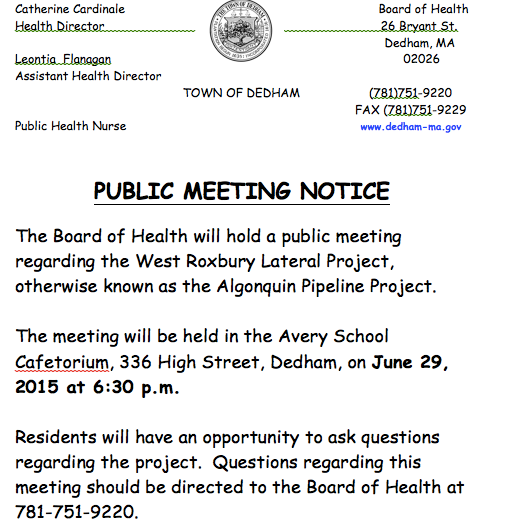
On Monday, June 29th, residents of Dedham are prepared to ask that the Dedham Board of Health to take a stand on the health of the proposed high-pressured transmission gas pipeline that will run through town. Join residents at 6:30 PM at the Avery Caferorium at this important meeting.
Residents will ask that the Dedham Board of Health rule in favor of a resolution that states that the installation of a high pressured transmission gas pipeline represents an unreasonable risk to the health and lives of the residents of the Town of Dedham and thus ORDERS that Spectra Energy and its subsidiaries cease from carrying on any activities in Dedham associated with said pipeline.
Health Impacts
Find out what's happening in Dedhamfor free with the latest updates from Patch.
Health impacts reported by community members living 50 feet to 2 miles from gas metering stations along gas transmission pipelines include various respiratory alignments and nervous system disorders. Residents of Dedham will fall within the radius of the metering station to be built in West Roxbury less than a mile outside of our borders. Unsafe emissions can occur up to a mile or more from the stations. Such pipeline components also leak methane, which can convert to formaldehyde when exposed to sunlight.
Studies are suggesting that people near pipelines suffer more health problems. Some pipeline neighbors experience symptoms like sudden nosebleeds, because breathing in formaldehyde is like “pickling your nose.” The gas in the pipeline is reported to be “odorless.” Residents would not even be aware of any leaks and potential health and safety risks.
Find out what's happening in Dedhamfor free with the latest updates from Patch.
The pipeline being installed will run through Gonzalez Field, a soccer field used by hundreds of children everyday. The soccer field is known to have “unknown hazardous waste” buried underneath. Specifically, it is believed that arsenic is buried in the field, as the field had previously been used as an MBTA train depot. Arsenic was used to maintain the railroad tracks. Digging up this field for the installation of this pipeline, puts a whole community at risk of having these toxins dispelled into the air in the middle of our town and in close proximity of a school, playground, and a residential neighborhood.
Pipeline Safety Concerns
In 2014 alone, transmission gas pipelines were associated with 132 incidents that resulted in 1 fatality and 1 injury with $46 million dollars in property damage. Since most transmission lines have run through rural areas, the number of fatalities and injuries may not seem significant. One can imagine the impact an incident in Dedham would have on our town.
Spectra Energy’s Poor Safety Record
Spectra Energy safety record has been poor. From 2002-2015, Spectra Energy has had 2 enforcement orders by Pipeline and Hazardous Materials Safety Administration (PHMSA), 3 warning letter cases by PHMSA, 2 probable violations by PHMSA, and 2 civil penalties. It has been fined $154,700 by PHMSA and paid $20,000,000 in civil penalties through the U.S. Department of Justice. In contrast, Kinder-Morgan had only 5 minor “corrective” orders in the same period and paid but $5,000 in penalties.
Spectra Energy’s history includes several major accidents. As recently as June 2, 2015, a Spectra gas pipeline ruptured east of I-30 bridge in Little Rock AK, closing two miles of Arkansas River. Then, just a few days later, in Cuneo Texas a Spectra Gas Pipeline exploded. The inspectors found that Spectra’s plans and procedures were inadequate in a number of areas, including:
- continuing pipeline surveillance,
- emergency plans, and
- welding procedures.
In September 2010, a high pressure gas pipeline exploded in San Bruno, CA, a suburb of San Francisco. The blast destroyed 38 homes and damaged 120 homes. Eight people died and many were injured. Ten acres of brush also burned. It was later revealed that this pipeline had recorded 26 leaks between 1951 to 2009.
In 2004, explosions at a Spectra gas storage facility at Moss Bluff, Texas sparked a fire that burned for 6 1/2 days. Six billion cubic feet of gas were released. Residents within three miles were forced to evacuate.
Several years earlier, in 1987, Texas Eastern, a division of Spectra, was fined $15 million by the Environmental Protection Agency for discharging highly toxic polychlorinated biphenyl (PCBs) at 89 sites along 9,000 miles of pipeline stretching from Texas. The fine ranks among the highest in the EPA’s history.
Spectra Energy itself gives fair warning about the safety of its pipelines. The corporate website warns residents living near pipelines to “take care in tilling and plowing not to damage the pipeline” and that “burning anything within the pipeline right-of-way could impact the integrity of the pipeline facilities.”
Jim Hall, former chairman of the National Transportation Safety Board under President Clinton, put it this way: “All of these underground pipelines are potential bombs.”
Nevertheless, the permits necessary to build the pipeline have been granted by the Dedham Board of Selectmen. However, residents trust that the Dedham Board of Health will immediately resolve to order Spectra Energy to immediately cease all construction of the West Roxbury Lateral in Dedham due to considerable health and safety risks to its residents.