Politics & Government
Easton Resident Challenges “Changing” Role of Rail Task Force
Kyla Bennett Speaks out at meeting which announces new technical assistance grants, including $10,000 to Easton.
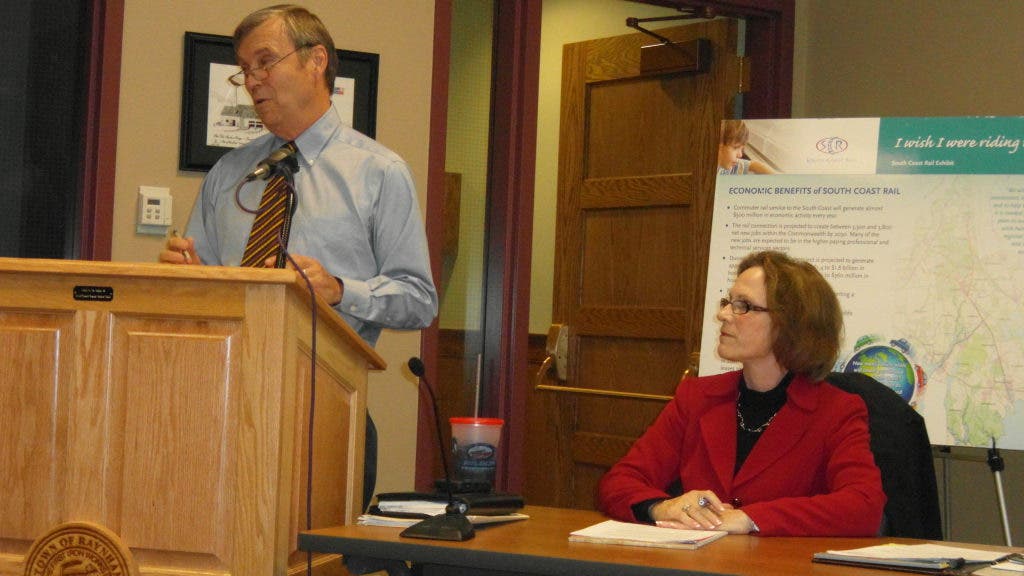

Southeastern Massachusetts Commuter Rail Task Force member, Kyla Bennett threatened to resign Tuesday, saying she was distressed with comments made by a former project official about the mission of her task force, and by an editorial, written by the task force’s chairman, in support of the project. She said the task force was not formed to support the project, but to give feedback about its impact, and she fears that officials are misunderstanding the function of her group.
The statement was made during a task force meeting which announced new technical assistance grants given to 18 communities that lie along the proposed South Coast rail line, slated to provide service from Boston to New Bedford and Fall River. Locally, Easton, Stoughton and Mansfield will be getting technical assistance worth $10,000, $15,000, and $7,000 respectively.
Bennett, who is an Easton resident and is the New England director of the non-profit watchdog agency PEER (Public Employees for Environmental Responsibility), reacted after hearing a speech by Jean Fox, a Freetown Selectwoman, who is the new Project Manager of the South Coast Rail project. Fox said that former Project Manager Kristina Egan described the task force as the “engine that drives this train.”
Find out what's happening in Eastonfor free with the latest updates from Patch.
Bennett said the statement was completely contradictory to what she thought her task force’s mission was.
“My understanding was that we were brought together to help the communities that would be affected by this rail’s impact. We are not here as supporters of this project or any particular route,” she said.
Find out what's happening in Eastonfor free with the latest updates from Patch.
Bennett, , said she also was upset by a recent joint editorial by Southeastern Regional Planning and Economic Development Executive Director Stephen Smith and the Task Force’s Chairperson John Bullard, of New Bedford, in support of the rail project.
The editorial, published in the Boston Globe this July, criticized the Environmental Protection Agency because the agency has threatened to veto the project due to its potential impact on the Hockomock Swamp in Easton and the Pine Swamp in Raynham.
The editorial reproved the EPA for failing to appreciate the project’s positive affect on global warming, and said the EPA needed to take a broader approach on the issue, focusing on the “trees rather than the forest.”
Bennett, who is a former EPA employee, said she was “extremely disturbed” that Bullard had criticized the EPA in the article. She said he should not have identified himself as the chairperson of the task force.
Though Bullard was not present at the meeting, Stephen Smith said Bullard was not speaking for the task force, but for himself, in the editorial. He also said that Bullard has been very fair listening to a wide range of opinions about the project, and has never “shut people off.”
Smith also defended Egan, saying she had described the group as the “engine that drove the train,” because it gave her a connection with the public.
“She used this task force to put her in touch with citizens of the towns she was servicing, and as a representative group for issues she had to deal with in the region…
For better or for worse, that’s what the task force has become, and I think the task force has served that role effectively, and people have used the task force as a vehicle to find out more about the project,” he said.
But Smith also said that he thought that the task force “supported” the project, even though it did not take an “advocacy position” on the different aspects of it.
According to the South Coast Rail website, the task force was formed in 2004 to help the region prepare for the impacts of the re-introduction of passenger rail to the South Coast. Its membership includes representatives from cities and towns and non-governmental organizations, including business associations and environmental groups.
Note: John Bullard could not be reached for comment.
In other meeting news:
The state announced that 18 communities will receive technical assistance awards, worth $5,000 to $25,000. They include:
Easton -- $10,000 in technical assistance to improve bicycle and pedestrian connections. The Old Colony Planning Council will assist the town with a plan for roadway and intersection improvements that will improve safety for bicyclists and enhance driver sensitivity.
Stoughton – $15,000 in technical assistance for assistance with a downtown economic development analysis ($5,000) and assistance to review development in the Park Street, Route 27 and surrounding neighborhoods ($10,000).
Mansfield -- $7,000 in technical assistance with rezoning efforts.
New Project Manager Jean Fox said that the project is still estimated to cost between $1.4 and $1.8 billion, and is not going to shrink.
Greg Bialecki, Secretary of the Executive Office of Housing and Economic Development, said the state will work on encouraging towns to develop prompt and predictable permitting processes to encourage business and industrial growth in appropriate areas along the South Coast Rail line.