Business & Tech
Langwater Farm is Teeming With Crops
After first year, owners say they are working hard to make business a success.
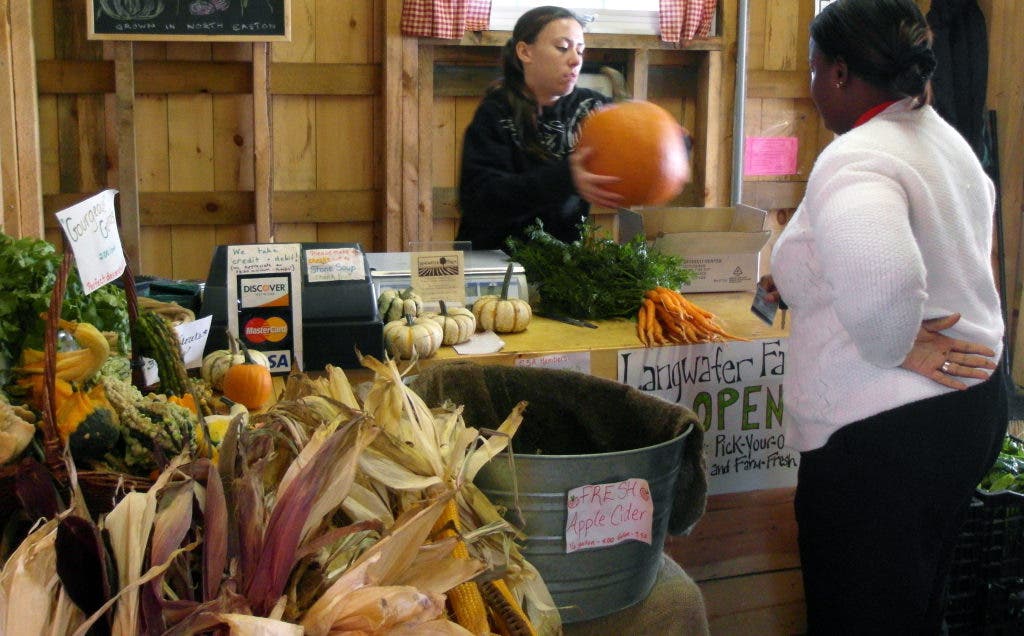


Bright orange pumpkins and assorted mums are a captivating sight these days, while driving by on Washington Street. And fortunately, the year has been a kind one for the farm, according to one of its owners, Rory O’Dwyer.
O’Dwyer, who owns the business with her partner, Alida Cantor, and her brother and sister-in-law, Kevin and Kate O’Dwyer, said the growing season has been successful, with ample sun and the right amount of rain.
“The crops are really in good shape - we’ve had a really good season,” she said.
Find out what's happening in Eastonfor free with the latest updates from Patch.
The farm, which sells certified organic produce, is completing its second growing year and has expanded its offerings. This year, the farmers planted corn for the first time, and a lot more tomatoes and pumpkins. It also has a slew of vegetables including lettuce (grown through the fall), winter squash, potatoes, broccoli, spinach, arugula, beets, chard carrots, as well as fruits and flowers.
Unusual crops include finger potatoes, which are creamier than the conventional types, purple potatoes, kohlrabi, and Japanese turnips.
Find out what's happening in Eastonfor free with the latest updates from Patch.
O’Dwyer, who grew up in Sharon and learned about agriculture working as an apprentice in California, said she and her partners have learned a lot about local farming in the two years they’ve started their business. Through trial and error, they’ve learned which crops can thrive on local land without pesticides and synthetic fertilizers, and which ones are not worth growing. They’ll continue to introduce new varieties of crops next year.
They tried to grow organic corn this year because it is so popular with customers, but found that they couldn’t keep worms away. The worms ate the tips of the corn, so they simply cut off the tips and sold them.
Though they were delicious, they ended up being really expensive because of the reduced volume of the crop.
“I’m not sure if the money worked out on that, but people liked the taste,” she said.
O’Dwyer said her food is more expensive than the grocery stores because it costs more to produce. Not only have they lost more crops than non-organic growers but they’ve also paid their workers more. Larger farms often use undocumented workers, she said, but she has hired all legal workers (from six to eight this past season) and has paid them fair wages.
She said her food is healthier, however, because it doesn’t have all the chemical additives and it is fresher than grocery store produce.
“Everything you’re getting is a peak of freshness. Nutrients break down over time, so you have fewer nutrients in that head of lettuce you buy in the grocery store that comes from California,” she said.
Despite the more costly production, O’Dwyer said they managed to break even last growing season. She’s not sure about this year; she says she’s been so busy that she hasn’t had time to focus on bookkeeping.
She said she has been working 75 to 80 hours a week to run the business, and her brother is working from 90 to 100 hours. They’re going to keep their roadside stand open until Christmas Eve, and then take a week off before they start working on next year’s crops.
The local farmers are leasing the property until 2014 from the Ames family, and they hope to renew that lease. They are working on 80 acres, which border Washington, Main, and Elm streets. About 30 acres are arable, but they are not yet farming all of that. They started working with just five acres the first year, and have expanded to 18 - 20 aces this year.
Part of their business includes a Community Supported Agriculture (CSA) plan, in which customers pay in advance for a selection of weekly produce. The customers can pick up assorted produce weekly for less money than if they bought it at their retail farm stand.
Over 100 people are participating, O’Dwyer said, and the numbers continue to grow. This season, they are also offering a November/December program, for $175, which will include greens, root vegetables and winter squash.
Though the work has definitely been challenging, O’Dwyer said that they are happy with this year’s season and they encourage locals to come by and check them out. Besides all the fruits and vegetables, they are offering hayrides on the weekends (and Columbus Day Monday), which bring customers down to the pumpkin patches.
“People can jump off and pick their own pumpkins,” she said.