Neighbor News
Characterisation of wind farm infrasound and low-frequency noise
Health effects due to low-frequency components in noise are more severe than for community noises in general - World Health Organization
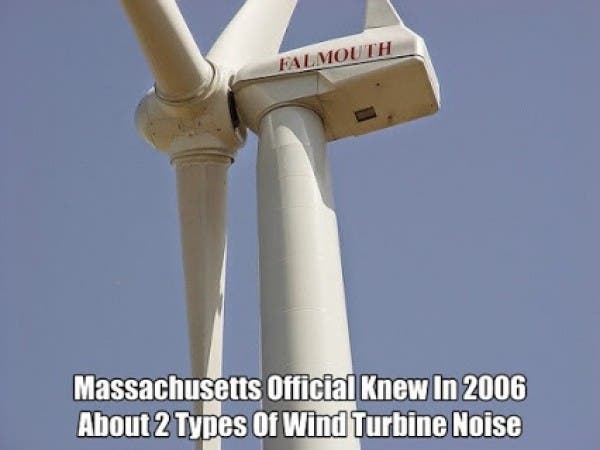
Wind turbines generate a broad spectrum of noise including low frequency noise and infrasound which may be audible or inaudible. It is widely affirmed that exposure to audible low frequency noise can cause adverse health effects in humans.
Low frequency noise can cause “…immense suffering to those who are unfortunate to be sensitive to low frequency noise and who plead for recognition of their circumstances.”
Peer reviewed articles and other references acknowledge annoyance to be an adverse health effect
Find out what's happening in Falmouthfor free with the latest updates from Patch.
Find out what's happening in Falmouthfor free with the latest updates from Patch.
Credit : Author: Zajamšek, Branko; Hansen, Kristy; Doolan, Con; and Hansen, Colin
This paper seeks to characterise infrasound and low-frequency noise (ILFN) from a wind farm, which contains distinct tonal components with distinguishable blade-pass frequency and higher harmonics.
Acoustic measurements were conducted at dwellings in the vicinity of the wind farm and meteorological measurements were taken at the wind farm location and dwellings.
Wind farm ILFN was measured frequently under stable and very stable atmospheric conditions and was also found to be dependent on the time of year.
For noise character assessment, wind farm ILFN was compared with several hearing thresholds and also with the spectra obtained when the wind farm was not operating.
Wind farm ILFN was found to exceed the audibility threshold at distances up to 4 km from the wind farm and to undergo large variations in magnitude with time.
Branko Zajamšek, Con J. Doolan
University of New South Wales, Sydney, Australia
Kristy L. Hansen
Flinders University, Adelaide, Australia
Colin H. Hansen
University of Adelaide, Adelaide, Australia
Journal of Sound and Vibration 370 (2016) 176–190
doi: 10.1016/j.jsv.2016.02.001