Community Corner
Endangered Right Whale Spotted Near Cape Cod, Death 'All But Certain'
Snow Cone, one of the last remaining right whales, was spotted near Cape Cod recently. Her health is deteriorating after rope entanglement.


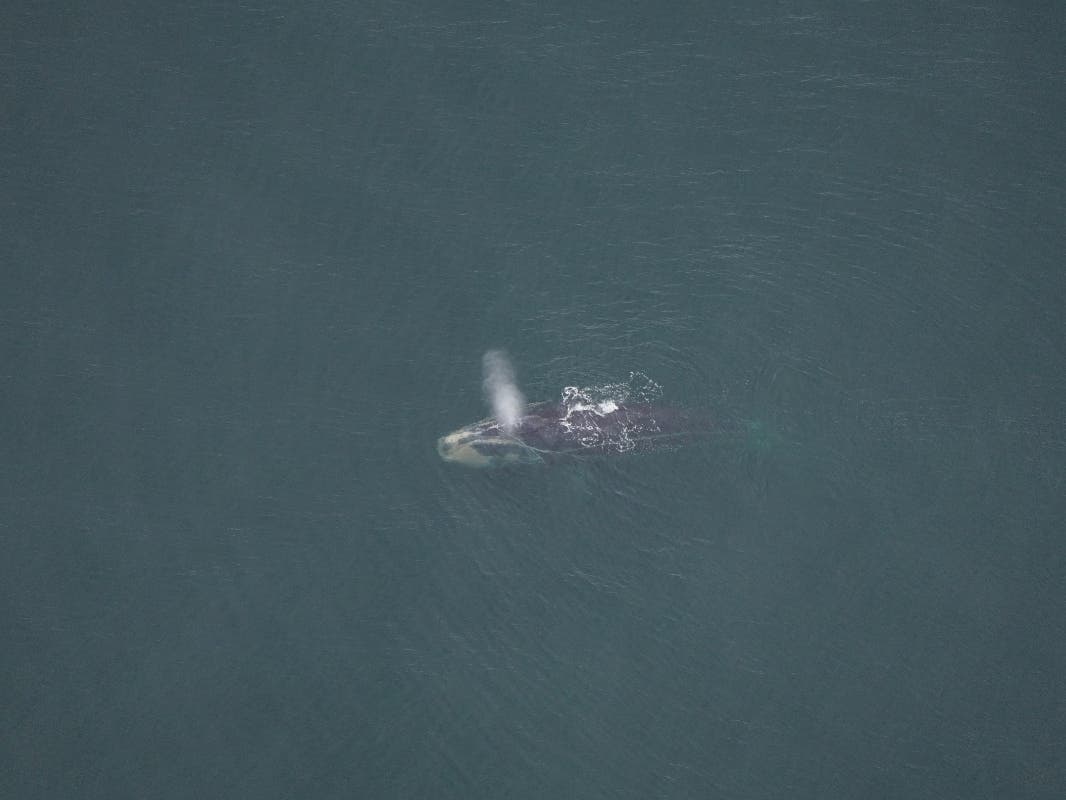
NANTUCKET, MA — Recent photographs of Snow Cone, one of the last remaining North Atlantic right whales known to scientists and researchers, show a dire situation.
Aerial photos taken by the New England Aquarium team show the whale entangled in heavy fishing gear, her fifth such entanglement. Those same aerial photos show that Snow Cone is still carrying fishing gear from a previous entanglement, her fourth.
The aquarium said what's happening to Snow Cone "magnifies the urgent need for dramatic changes to fixed gear fisheries," but also probably means there will be one less right whale — an already endangered species — in the very near future.
Find out what's happening in Falmouthfor free with the latest updates from Patch.
Snow Cone was last spotted in the Gulf of St. Lawrence, Canada, in July 2022, the aquarium said. Since, her health has "deteriorated rapidly" and researchers stated that "her death is all but certain."
Research Assistants Sharon Hsu and Katherine McKenna documented the whale on Sept. 21 about 15 miles south of Nantucket, according to a news release. Hsu had previously photographed Snow Cone during the previous entanglement in March 2021 and was disheartened by what she saw last week.
Find out what's happening in Falmouthfor free with the latest updates from Patch.
"Eighteen months ago, there was hope that disentanglement efforts could remove enough of the gear and that would allow her to survive. Now, she’s covered in orange cyamids [whale lice]. She was moving so slowly, she couldn’t dive, she just sunk. She’s suffering. There is no longer hope for her survival," Hsu said, in a statement.
The National Oceanic and Atmospheric Administration (NOAA) reports that there are fewer than 350 North Atlantic right whales left. So far this year, the agency has identified only 15 living calves — baby whales — during the 2022 calving season.
Since 2017, the whales have been experiencing what NOAA is calling an "Unusual Mortality Event", resulting in nearly 15 percent of the population either dying or being seriously injured. The primary causes, the agency says, are entanglements in fishing gear and collisions with boats and ships.
To put it simply, every female North Atlantic right whale and its calves are crucial to the continued survival of the species, but are dying faster than they can reproduce.
Snow Cone, unfortunately, is a perfect illustration of the current situation.
According to aquarium scientists, Snow Cone's current entanglement is her fifth. Her expected death will also mean the "likely loss of her lineage," researchers say. Snow Cone's first calf was killed by a boat. Her second calf, born while she was entangled, hasn't been seen since April.
Not only is the reality of the situation grave for Snow Cone, but it's also torturous, according to scientists.
"Bearing witness to the pain and suffering of this whale is gut wrenching," said Senior Scientist Philip Hamilton, in a statement.
"Even worse is the realization that, with her imminent death, we will have lost the potential of as many as 30 future right whales being added to the species. We know several right whale family lines that have produced 25 to 30 progeny so far (calves, grand calves, great grand calves). The impacts of the loss of a single reproductive female gets amplified through time."
Aquarium officials said they've alerted the Center for Coastal Studies’ disentanglement team. However, response efforts were on hold due to weather as of Sept. 22.
Get more local news delivered straight to your inbox. Sign up for free Patch newsletters and alerts.