Neighbor News
Falmouth Chamber Players Orchestra Spring Concerts March 28 and 29
The Falmouth Chamber Players Orchestra will perform Beethoven's Symphony No. 3, "Eroica," and works by Mozart and Telemann this weekend.
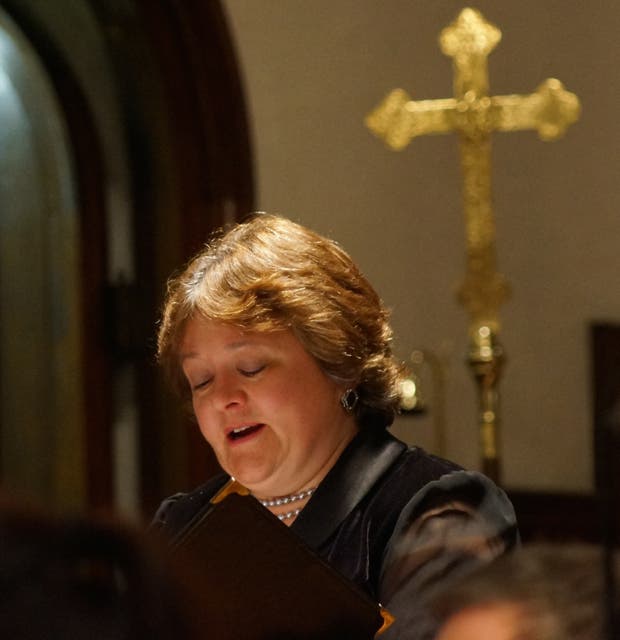
Photo caption: Soprano Joan Kirchner will sing Mozart’s “Regina Coeli,” K. 108 with the Falmouth Chamber Chorale and the Falmouth Chamber Players Orchestra at the orchestra’s spring concerts, Saturday, March 28, 4 PM, and Sunday, March 29, at 3 PM, at John Wesley United Methodist Church in Falmouth. Photo by Janet Murphy Robertson.
The Falmouth Chamber Players Orchestra, under the direction of John Yankee, presents its spring concerts on Saturday, March 28, at 4 PM, and Sunday, March 29, at 3 PM, at John Wesley United Methodist Church in Falmouth.
Soprano Joan Kirchner and the Falmouth Chamber Chorale are featured in the orchestra’s performance of Wolfgang Amadeus Mozart’s “Regina Coeli,” K. 108. Jan Elliott and Molly Johnston will play recorder and viola da gamba, respectively, in Georg Philipp Telemann’s Concerto in A Minor for Recorder and Viola Da Gamba.
Find out what's happening in Falmouthfor free with the latest updates from Patch.
The program will conclude with a performance of Ludwig van Beethoven’s Symphony No. 3 in E Flat Minor “Eroica,” considered one of Beethoven’s most influential works.
Joan Kirchner is the featured soloist in the orchestra’s performance of “Regina Coeli” (Queen of Heaven), Mozart’s setting for the Catholic prayers of the Virgin Mary sung during the Easter season. Praised for the beauty and clarity of her voice and her charismatic stage presence, Kirchner brings a special passion for classical music associated with the church.
Find out what's happening in Falmouthfor free with the latest updates from Patch.
“Mozart’s ‘Regina Coeli’ promises to be thrilling,” said John Yankee. “Joan Kirchner is wonderful. Her solo aria in the third movement, ‘Ora pro nobis,’ is especially moving.”
Kirchner has performed with many of the top musical groups in the region, including Boston’s Handel and Haydn Society, Toronto’s Tafelmusik Chamber Choir, the Masterworks Chorale, Chorus North Shore, the Woods Hole Cantata Consort, the Chatham Chorale, and Joan sings regularly with I Musicisti, a group of musicians from the Cape and greater Boston area whose mission is to educate and continue the performance of classical music.
The Falmouth Chamber Chorale, a smaller component of the Falmouth Chorale, both of which Yankee also directs, will also sing.
“The Falmouth Chamber Chorale is very excited and preparing the work splendidly,” said Yankee. “Their sound and musical delivery will be very effective.”
Recent performances by the Falmouth Chamber Chorale include “S’Wonderful” at Highfield Hall, “Opera’s Greatest Moments” with the Cape Symphony, and “Messiah Sing” at the First Congregational Church of Falmouth with the Falmouth Chamber Players Orchestra.
“The Telemann concerto brings back Jan Elliott, who soloed on a Telemann concerto at our very first concert back in November 2008,” said Yankee. “Joining her is Molly Johnston, who is equally skilled, knowledgeable, and delightful to work with.”
“The Telemann concerto, written in about 1730, a typical high Baroque sonata in four movements,” said Molly Johnston, “though it is written with a view forward, in the galant style. That is to say, there are a lot of nice melodies.”
Recorder and viola da gamba share the melodies, often handing them back and forth. The concerto also features a dotted rhythm characteristic of the Galant style called the Lombard rhythm or Scottish snap, as well as the use of triplets, giving the piece a light quality.
“The concerto begins with a slow movement, very much in the French style,” said Johnston. “When the theme returns at the end of the movement, it actually comes back in the wrong key for a few measures. It’s a little inside joke, I think, on Telemann’s part.”
The second movement is an allegro, “with wonderful characteristic string writing—but very hard for the recorder, with lots of double tonguing,” said Johnston.
“The third movement is very pastoral; it reminds me of fields and flowers and birds, the kind of writing often associated with the recorder,” said Johnston. The movement is performed only by the two solo instruments, plus basso continuo, which includes harpsichord, played by Debbe Carlisle, and cello, played by Winn Johnson.
“The last movement is a rondo, in which the theme returns several times,” said Johnston. “But unlike the typical Baroque rondo form, in which theme comes back in the same key, this one comes back in different keys, thus looking ahead to the sonata form of the classical period.”
“Again, it has a lot of nice back-and-forth writing for the gamba and recorder—almost like ‘anything you can do, I can do better,’” said Johnston.
Elliott and Johnston perform together in the early music ensemble Passacaglia and other groups. Elliott plays recorder and other early instruments and has performed and taught music and dance for many years. She earned a BA in music from Wesleyan University and an MA in dance ethnology from UCLA, taught music education at Boston University and studied ethnomusicology at the University of London.
Johnston holds degrees in music history from Wellesley College and Yale University and has taught music history at Duke University. She has performed with and directed numerous early music ensembles.
“The Eroica is the biggest, toughest work we’ve taken on to date,” said Yankee. “Though we have lost hours of rehearsal time due to weather cancellations, we have made up for lost time and will be able to perform this masterpiece with the interpretive nuances, musical understanding, and ensemble awareness that has become our standard.”
“At the time it was written (1804), it was the biggest, longest symphony that had ever been written,” said Laura Sonnichsen, concertmaster and vice-president of the orchestra. “It’s a major work for our orchestra to take on; the parts are very challenging. Dynamics and phrasing, always very important, are essential in this piece to convey its full beauty and expressiveness.”
Sonnichsen, like Yankee, believes that the FCPO is ready for the challenge. “The orchestra has matured over the years, and we feel confident taking on this formidable work,” she said.
Beethoven originally dedicated his third symphony to Napoleon Bonaparte, who, he felt, embodied democratic ideals. When Napoleon crowned himself emperor, Beethoven scratched out his name so vigorously that he left holes in the title page. He retitled retitled the work “Sinfonia eroica,” or Heroic Symphony.
The work, said Sonnichsen, “explores what it means to be human. The hero of the symphony is not Napoleon, but Beethoven himself.”
Beethoven’s growing deafness and consequent isolation posed enormous challenges for the composer, but he chose to continue to make music—and to take music in new directions—thus embracing the heroic in himself and in all people. The work marked a milestone in music history with its huge emotional range and the introduction of the idea that a symphony can convey ideas, as well as emotions.
“The first movement is profound and extensive, longer than most symphonies of the time,” said Yankee, “with presentation, unwinding, and development of a simple triadic motif.” It explores life in all its aspects: the hope and joy, frustration and confusion, and celebration, all with great energy.
“The second movement,” said Yankee, “is the famous funeral march.” Here, Beethoven reflects on grief: the French horn expressing a public grief, and the oboe, a more private grief, introspective and fraught with tension. It is said that this movement reflects Beethoven’s own anguish over the loss of his hearing and the terror of loneliness.
The funeral march gives way to hope, joy, and a burst of creativity. “The third movement is the thrilling, almost frenetic scherzo, featuring our three French horns in the trio,” said Yankee.
In the triumphant fourth movement, Beethoven celebrates the hero and life itself, including his own and that of all people. “It’s completely different, featuring a theme and variations, at first rollicking, then suddenly gentle and reminiscent,” said Yankee. “Finally, it takes off to a fun and festive conclusion—a great way to finish our concert season.”
The concert will be held at John Wesley United Methodist Church at 270 Gifford Street in Falmouth. Admission at the door is by donation. Suggested donation is $20 for adults and $5 for students. For more information, call Fritz Sonnichsen, president of the orchestra, at 508-274-2632, or visit www.falmouthchamberplayers.org.
IF YOU GO:
What: Falmouth Chamber Players Orchestra, spring concerts: “Regina Coeli,” K. 108, by Mozart, featuring Joan Kirchner and the Falmouth Chamber Chorale; Concerto in A Minor for Recorder and Viola Da Gamba; Symphony No. 3 in E Flat Minor “Eroica,” by Beethoven
When: Saturday, March 28, at 4 PM, and Sunday, March 29, at 3 PM
Where: John Wesley United Methodist Church, 270 Gifford Street, Falmouth.
Admission: By donation. Suggested: $20 for adults, $5 for students
For More Information: Fritz Sonnichsen, 508-274-2632, or www.falmouthchamberplayers.org