Neighbor News
Falmouth Wind Turbine Noise
Wind turbine study finds possible correlation between noise and residents' complaints, researcher says
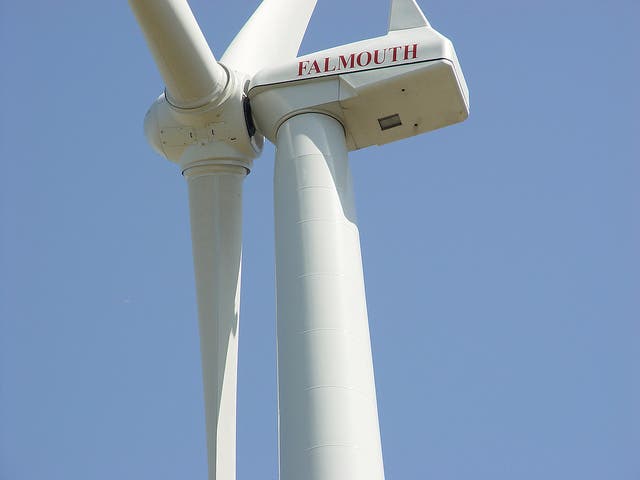
Wind turbine study finds possible correlation between noise and residents’ complaints, researcher says
By Jessica Tapp
Posted about 10 hours agoTue 20 Jan 2015, 9:55pm
Find out what's happening in Falmouthfor free with the latest updates from Patch.
A pilot study into wind farm noise and residents’ reactions to it has identified a special noise signature that could give new insights for medical research, the study’s lead author says.
Find out what's happening in Falmouthfor free with the latest updates from Patch.
Researchers, commissioned by Pacific Hydro, took sound measurements near the company’s Cape Bridgewater wind farm, in south-west Victoria, which has been operating for six years.
Six people living in three nearby houses had complained about headaches, ringing ears and chest pressure they said was caused by the 29 turbines.
Acoustic engineer Steven Cooper said the study conducted noise measurements of both audible sounds and infrasound, using special microphones, amplifiers and detection equipment.
“This was conducted at three houses for a period of eight weeks, one house had an extensive array of microphones and vibration detectors both inside and outside the house,” Mr Cooper said.
He said the study, which had unprecedented access to the wind turbines, discovered noise patterns that had not been previously accounted for, which could help future medical research into residents’ issues.
The researchers tested how the wind turbines operated under different wind directions and speed, and when the power was off, Mr Cooper said.
At the same time, residents were asked to keep an hourly diary noting noise, vibrations and the sensations they felt, such as pressure in the head, eyes, throat or chest, headaches or pulsing of the ears.
Mr Cooper said while the study was too small to provide scientific proof, a correlation was recorded between the noise made by the turbine and the sensations felt by residents.
“When we started putting the diary information together with the wind farm operation and the noise information, we found there were certain conditions of the operation of the wind farm that correlated or agreed with the observations where they recorded high sensation levels,” he said.
He said it was the first time reactions like this had been included in a wind farm study.
“There have never been sensations included in questionnaires,” Mr Cooper said.
“What we found was that previously they were complaining about the noise, but it wasn’t really the noise, it was sensations.”
Study finds special noise signature
Mr Cooper said the study was testing for how residents reacted to the noise, rather than health impacts related to wind turbines.
He said the study discovered a previously unaccounted for noise “signature”.
“What is really exciting is that we found a pattern in a special signature that exists when the turbines are operating and does not exist when the turbines are off,” Mr Cooper said.
“You can use that signature to commence the medical studies.”
The study said better equipment was needed to look at the different types of sound produced by the turbines, and that measurements should be used to record sound levels from several points on and near the turbines.
“There has not been the link to show in a scientific term what the wind farm is doing,” Mr Cooper said.
“The general DBA level that’s used for community noise doesn’t work with wind farms.
“So if you didn’t have the link to provide the relationship between the wind farm and the community, you actually can’t do the medical studies.”
But he said the study provides the foundation for future medical studies which could look at the health impact of wind farm noise.
“So Pacific Hydro are correct we don’t have a correlation in terms of medical and I agree with that 100 per cent,” he said.
“But we have uncovered a tool which can now lead the next step to be done, because you couldn’t do the medical studies without the acoustic information saying what was going on.”
[truncated due to possible copyright] click url to continue reading