Community Corner
Microclimates: Planting Beyond Your Hardiness Zone
Crape myrtle, camellias and edible figs are denizens of warmer areas, although some lucky gardeners on Cape Cod can grow them.


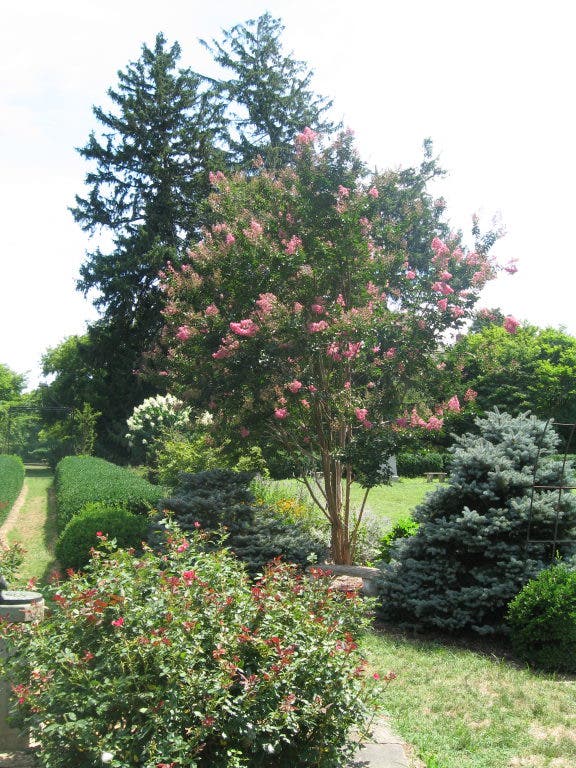

Crape myrtle is a flowering tree grown in the South, with large pink or white flowers hanging from the ends of its branches in midsummer. For years, a deep pink crape myrtle grew on the corner of Worcester Court and Route 28, in front of what is now TD Bank. Granted, it was more shrub than tree, yet it was always a reliable sign of August.
Sadly, the last time I checked, it was gone. Perhaps it's still there, and I've missed it, or it succumbed to the cold one winter. No matter, I know crape myrtle can survive on Cape Cod.
Camellias can live here, too, even reaching the size of trees. A customer at the garden center where I worked grew them on his property in Brewster, adding to his collection by buying the camellia varieties we sold as house plants. Some years, he said, they'd get battered by the cold, their evergreen leaves sporadically brown from frostbite, yet they still survived and bloomed.
Find out what's happening in Falmouthfor free with the latest updates from Patch.
I've heard rumors about edible figs and pampas grass, although I haven't seen them with my own eyes.
The reason some southern plants make it through the winter has to do with the Cape's propensity for microclimates. A peninsula surrounded by water, such as ours, experiences more moderate temperatures than inland areas. Factor in the proximity to the ocean and a yard two streets away from the water can have crape myrtle while a yard a block away cannot.
Find out what's happening in Falmouthfor free with the latest updates from Patch.
Further, microclimates have no defined size; they can be as small as the area next to a house—ideal for tender perennials such as verbena to winter over.
Whatever the area, a microclimate flies in the face of a location's designated hardiness zone.
Cape Cod and the Islands are shaded a light pink on the USDA Plant Hardiness Zone Map, translating to Zone 7a on the key. It may be hard to spot this fact on the colored swirls spanning the United States and Canada, but 7a it is. Our lowest temperatures, according to the map, range from 0 to 5 degrees Fahrenheit. Parts of Maryland, Virginia and North Carolina are in the same bracket.
I don't know about where you live, but at my house it's been 10 below many winters, which answers the question why the camellia I planted one year didn't make it.
Crape myrtle is hardy from Zone 7a through Zone 9, as are camellias and edible figs. Shouldn't these plants be reliably hardy on the Cape? Why don't we see more of them here?
Having seen crape myrtles everywhere in Baltimore and a couple of mature edible figs growing near the Chesapeake Bay, I can tell the difference. The crape myrtles there are at least 10 feet tall and used in the landscape in the same manner we use rose of Sharon. The edible figs look as established as old rhododendrons.
Perhaps the difference has to do with latitude. South means hotter summers and more moderate winters than the Cape experiences. Crape myrtles are glorious during the hottest months of the year. The figs were bearing ripening fruit.
According to the National Arboretum in Washington, DC, an established crape myrtle can die back to the ground during a cold winter, then leaf out again from the base like a perennial, or the tree can die altogether. This may have happened to the crape myrtle in Falmouth.
Despite the risk, perhaps southern plants are worth a try. The National Arboretum lists hardier varieties of camellias and crape myrtles. Figs will probably need to be brought inside. And pampas grass? I think the Cape isn't hot enough.
Global warming is said to be changing hardiness zones. I won't attempt to discuss such a complicated subject. Let's just say Florida still can't grow tulips without providing an artificial winter and we can't grow palms, although I've heard there's a hardy banana. You never know what the garden can hold.
For more information, click here.