Neighbor News
US Knew About Wind Turbine Noise 1982
A Methodology for Assessment of Wind Turbine Noise Generation 1982
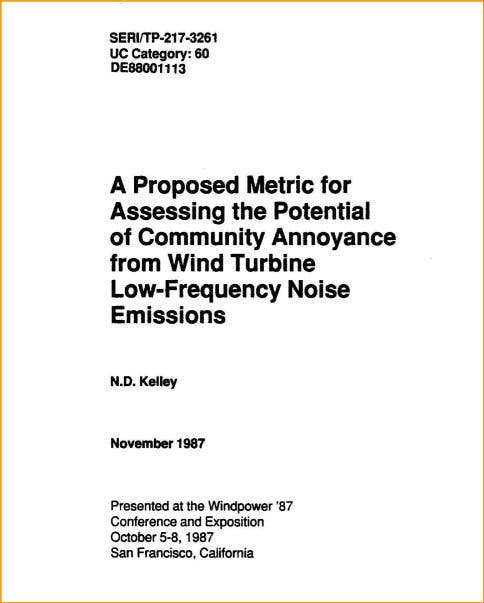
United States Knew About Wind Turbine Noise In 1982
A Methodology for Assessment of Wind Turbine Noise Generation
Abstract:
Find out what's happening in Falmouthfor free with the latest updates from Patch.
The detailed analysis of a series of acoustic measurements taken near several large wind turbines (100 kWand above) has identified the maximum acoustic energy as being concentrated in the low-frequency audible and subaudible ranges, usually less than 100 Hz.
These measurements have also shown any reported community annoyance associated with turbine operations has often been related to the degree of coherent impulsiveness present and the subsequent harmonic coupling of acoustic energy to residential structures.
Find out what's happening in Falmouthfor free with the latest updates from Patch.
Thus, one technique to assess the annoyance potential of a given wind turbine design is to develop a method which quantifies this degree of impulsiveness or coherency in the radiated acoustic energy spectrum under a wide range of operating conditions.
Experience has also shown the presence of annoying conditions is highly time dependent and nonstationary, and, therefore, any attempts to quantify or at least classify wind turbine designs in terms of their noise annoyance potential must be handled within the proper probabilistic framework.
A technique is described which employs multidimensional, joint probability analysis to establish the expected coincidence of acoustic energy levels in a contiguous sequence of octave frequency bands which have been chosen because of their relationship to common structural resonant frequencies in residential buildings.
Evidence is presented to justify the choice of these particular bands.
Comparisons of the acoustic performance and an estimate of the annoyance potential of several large wind turbine designs using this technique is also discussed.
More Info: N. D. Kelley, R. R. Hemphill, H. E. McKenna
Publisher: American Society of Mechanical Engineering
Publication Date: May 1982
Publication Name:Transactions of the ASME, Vol. 104, pp 112-12