Neighbor News
Wind Turbine Advocates Refer To Victims As Indians
Native American adage about making decisions advised using earplugs, and to "grow up, pull our pants up, and go forward"
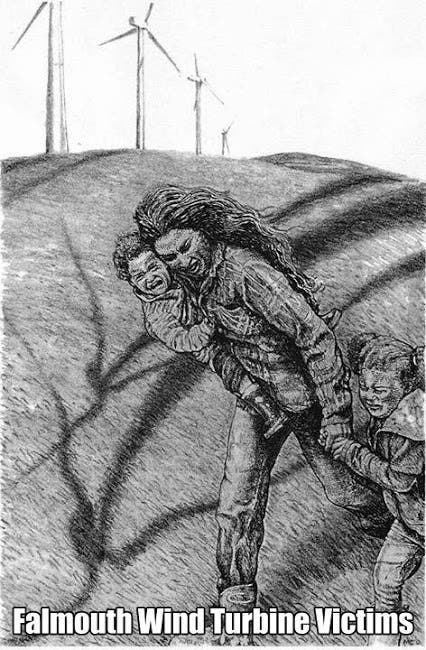
Falmouth Residents Compare Wind Turbine Victims To Indians
For hundreds of years atrocities and policies of discrimination has devastated the Native American population. Massachusetts has declared an actual war on its own citizens placing commercial megawatt wind turbines in residential communities.
The neighbors to the turbines describe the noise as torture due to lack of sleep.
Find out what's happening in Falmouthfor free with the latest updates from Patch.
Chairman Putnam summarized the status of the issue thus: “That despite the concern that some people feel that money takes precedence over health”
Falmouth Massachusetts Selectmen’s Meeting Minutes 9/16/13
Find out what's happening in Falmouthfor free with the latest updates from Patch.
Excerpts from Falmouth SelectBoard Meeting -- Edited To Show Only Those In Favor Of Operating The Wind Turbines
“John Goldman, Woods Hole—cited examples of the many noises he hears on a regular basis, saying that he doesn’t complain—said he thought the comments were supposed to be specific to the recommendations—said some comments he has heard have been patronizing and divisive—said that like it or not, the world is changing—referred to the Native American adage about making decisions considering the needs of 7 generations from your own—advised using earplugs, and to “grow up, pull our pants up, and go forward”—thanked the BOS for hard work”
Wind Turbine Mitigation Alternatives Public Comment Discussion and Vote
Julian Suso and Heather Harper, in turn, reviewed a slide presentation of the 3-page Wind Turbine Alternatives Report #3, consisting of a bulleted lists and a financial information chart. Both Mr. Suso and Ms. Harper carefully read through the content of the text on the slides and explained the recommended actions regarding wind turbine operation options.
A representative from Cape Cod Broadcasting (name unintelligible) asked to record portions of the audio. John Carlton-Foss asked to record portions of audio-video. The chairman next established the format that the public comment session would follow.
Public Comment:
Bob Frosh – provided list of relevant scientific and professional credentials—said he has worked on big things and helped formulate major policies—said he is not used to dithering—advocated putting a local group of scientists together—questioned the DEP measurements—suggested the presence of a low-frequency phenomenon—said to use science to find out what is happening before doing anything final
Courtney Barbour, Falmouth Heights – said he wants the turbines on 24/7—also wants to mitigate neighbors situations where there is scientific proof of need—spoke about the need to wake up to the ills of climate change and the world we are creating—wants to set an example for other communities
Kathy Driscoll, (unintelligible) Shore Drive—thanks BOS for its work—summarized process up to this point—said the WTOP group did not move mitigation idea forward—wants full operation of the turbines—advocated for smart operation taking wind direction, sound, and pressure into account—acknowledges the reality of climate change and that this would be one step toward addressing it
John Tudor—said that the reported symptoms do not fit a pattern of disease—compared the situation to a “sick building syndrome”—referred to the BOH letter—said the turbines create a condition that causes people to be uncomfortable—cautioned against putting too much emphasis on the sleep disruption argument, and gave reason why
George Woodwell, Woods Hole--said that the most urgent important issue before all governments is climatic disruption caused by trapping heat from burning fossil fuels—said that leadership on the issue is critical to avoid climate disruption—said that we must amplify our foray into renewable energy, and cited examples
Bill Golden, West Falmouth—cited background dealing with complex issues at many different levels, some in government—acknowledged the wide spectrum of opinion on the issue—expressed concern over the limitations of the BOS in what it could do—advocated creating the largest possible course of action—suggested full turbine operation, which would create the largest revenue fund for mitigation and the greatest flexibility re: use—felt that the issue would be decided best in an adjudicatory setting, which would be the appropriate body to formulate an appropriate result
Nicole Goldman, Precinct 1—wanted to lend support to 24/7 operation
Chris Dunne, Lowry Rd.—spoke about travel and all the turbines seen in other places—supports 24/7 operation—supports action that preserves the most options
Edward Schmitt, Falmouth Wood Rd.—suggested a voluntary buy-out of the neighbors’ property—supported 24/7 operation—said that if he were in a similar situation, he would be looking for mitigation—said that moving to a new home is a positive experience—advocated offering the neighbors a fair price for their homes and then they could move on
Linda Davis—said that she finally “got it”--that it was all about the money and expediency, so run them all the time and in all forms of weather—said that the BOS should vote unanimously because “when the final chapter is written and the turbines fall, all of you should go.”
Dan Webb, Precinct 6—re: the “do no harm” phrase, said that no harm should be done regarding climate change either—said that the turbines were cited according to state codes/bylaws, and provided those details—said that other towns have installed turbines with no problems, and cited examples—said that there is skepticism about the medical evidence of regarding claims of harm—cited personal examples of proximity to the Notus turbine with no ill effects—supported maximum operation to maximize the mitigation fund
Ron Zweig, Woods Hole—advocated using science to determine the facts regarding the health studies—referred to various guidelines and measurements—said that an Australian study in May 2013 revealed no adverse impact—said there has been no reported adverse impact regarding home values—said that the same small percentage of neighbors has spoken out again and again—supported full operation and mitigating the approximately 20 households
Hilde Maingay, Hatchville—cited numerous examples in The Netherlands of turbines situated near homes with no negative effects—said that if the effects were that bad, it wouldn’t continue to be done—said that the time is now to address climate change and the resultant sea level rise—said that the only option is to run them at full operation for our future health
John Goldman, Woods Hole—cited examples of the many noises he hears on a regular basis, saying that he doesn’t complain—said he thought the comments were supposed to be specific to the recommendations—said some comments he has heard have been patronizing and divisive—said that like it or not, the world is changing—referred to the Native American adage about making decisions considering the needs of 7 generations from your own—advised using earplugs, and to “grow up, pull our pants up, and go forward”—thanked the BOS for hard work
Jed Goldstone, BOH Chairman, Precinct 4—said that from the BOH perspective, this is a matter of epidemiology—said that there is a significant lack of data/information, which impedes making a decision with respect to public health—said that a BOS decision to change the operation of the turbines will cause them to re-open their deliberations—said that the BOH will be happy to continued dialogue with the Selectmen
Chairman Putnam summarized the status of the issue thus: That despite the concern that some people feel that money takes precedence over health, under the current plan, the turbines are losing money. The money has got to come from somewhere. There are no funds to take them down, and we can’t leave them up and not running. We are between a rock an a hard place, the chairman said.
The Board then began its deliberations with each member offering his/her current thinking on the issue following the input from the public. Below are the highlights of each Selectman’s stated position:
Kevin Murphy:
• That new information can bring about change
• That the Board cannot act unilaterally without a funding source
• The interpretation of nighttime operation as the time between the hours of midnight and 4:00 a.m.
• That mitigation can come in the form of payments or noise easements, or in another form, such as curtailed operation, which might provide for a break-even
• That the challenge for the Board is to try to determine what the ramifications of the ballot result really are
• That mitigation does not have to be only an established fund
Doug Jones:
• The request that the Board still consider the option to run the turbines below the 80% threshold
• That the state might not consider forgiveness of the RECs with a lower operation, in which case, the BOS would have to reconsider
• The proposal to run both turbines at 16 hours, understanding that there would be a loss for 4 years, which would be a compromise for both sides (68 % of maximum)
Rebecca Moffitt:
• Restatement of support for full operation (24/7) of both turbines
• That the turbines bring the Town needed revenues
Mary Pat Flynn:
• That the BOS cannot vote to create a deficit—that for whatever is voted, the money has to be there
• That any operating plan has to fund the running of the turbines themselves
Selectmen’s Meeting Minutes 9/16/13
The minutes have been edited and [truncated due to possible copyright]
Please click on the link to see the entire minutes below
http://www.falmouthmass.us/meeting.php?depkey=selectmen&number=5895