Neighbor News
Wind Turbine Safety Setbacks Now Exceeding 3000 Feet
One Falmouth Massachusetts 110 Db Wind Turbine Requires Almost 3000 Feet
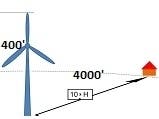
Setbacks must be measured from a non-participant’s property line. The only proven safety measure is a safe setback.
The Wall Street Journal published a scathing editorial on the experience of Falmouth, Massachusetts, which spent $10 million on wind turbines, and it’s been a disaster.
The Massachusetts courts shut down both town owned wind turbines named Famouth Wind I and II both identical Vestas V-82 type wind turbines in June of 2017.
Find out what's happening in Falmouthfor free with the latest updates from Patch.
These turbines have no permits and are a nuisance.
Falmouth Town Meeting voted 2.5 million to take down and put the 15 years old gear driven turbines in storage.
Find out what's happening in Falmouthfor free with the latest updates from Patch.
The town was warned prior to installation the turbines generate 110 decibels of noise each but even today has never disclosed the Vestas warning letter to the public.
In Falmouth, Massachusetts an acoustician requires the distance to meet the 40-decibel threshold for Wind II, a Vestas V82 with a sound power level of 110 decibels, which is approximately 891 meters or 2923 feet.
Wind II has a tower height of two hundred sixty-two (262') feet, a rotor diameter of two hundred sixty-nine (269') feet and overall height to the topmost blade extension of three hundred ninety-seven (397') feet.
A setback measured from a dwelling limits the non-participating landowner’s use of their property and greatly reduces protections for non-participants from noise pollution and its proven ill effects, shadow flicker, property devaluation, and potential property damage from blade failure, ice or fire.
All landowners should have the right to do with their land what they choose as long as it doesn’t harm or impede a neighboring landowner. A setback for safety reasons, regardless of its distance, must be maintained.
Any zoning that allows a wind turbine to be built next to a non-participant’s property line eliminates that property owner from safely using that land.
It creates an easement over the neighboring, non-participating property that eliminates the owner from any further developments. This amounts to an uncompensated taking of private property rights.
Because of widespread concerns about health and safety, many jurisdictions scattered around the United States and Canada have adopted larger setbacks in recent years.
Government Entities Examples of Setbacks Over 3000 Feet
Catarunk, Maine 7,920 ft.
Moscow, Maine 7,920 ft.
Haut-Saint-Laurent, Montérégie, Québéc 6,562 ft.
Fayette County, Pennsylvania 6,000 ft.
Carteret County, North Carolina 5,280 ft.
Frankfort, Maine 5,280 ft. from property line
Umatilla County, Oregon 5,280 ft. from “unincorporated community”
Mason County, Kentucky 5,280 ft. from property line
Trempealeau County, Wisconsin 5,280 ft. from inhabited structures
Hillsdale County, Michigan 5,280 ft. from residences
Sumner, Maine 5,280 ft. from property line
Newport, North Carolina 5,000 ft. from neighboring property lines
Ellis County, Kansas 4,921 ft. from rural residences
Rumford, Maine 4,000 ft. from property line
Clifton, Maine 4,000 ft. from occupied structures
San Diego, California 3,937 ft. from residences
Halifax, Nova Scotia 3,281 ft. from habitable building