Kids & Family
Woods Hole Library Hosts Science Lecture
Dr. Seymour Cohen discussed two important figures in the study of the history of science.
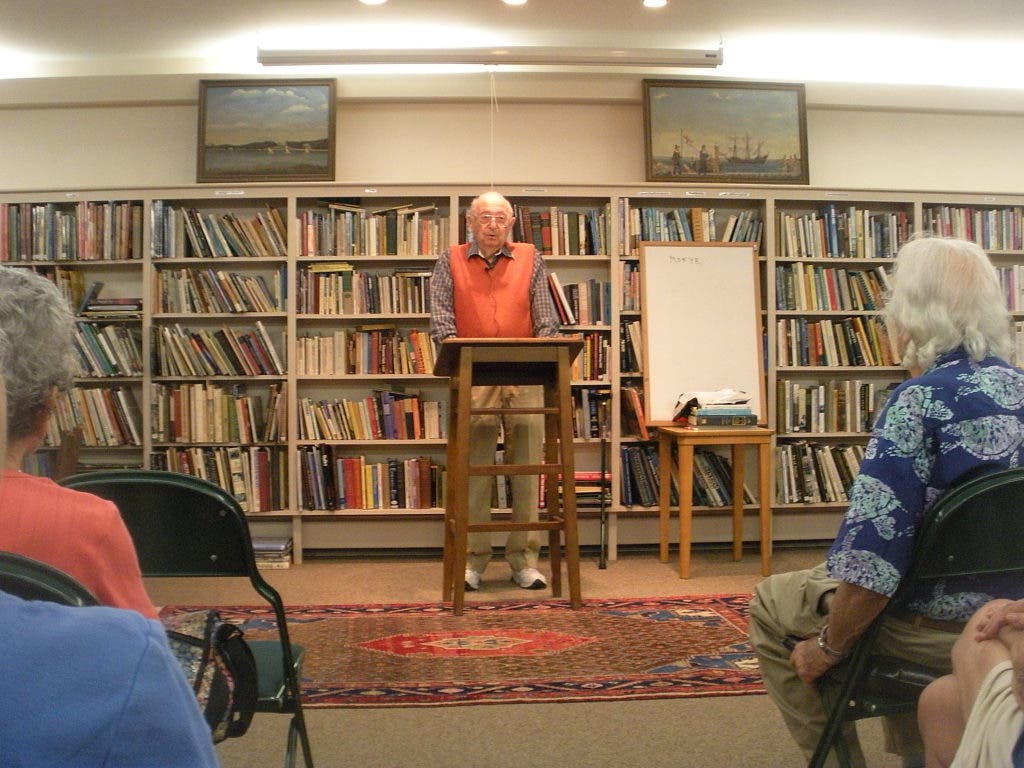
On Monday afternoon, the hosted by Dr. Seymour Cohen, retired biochemist, bacteriologist, and virologist. Dr. Cohen discussed two major figures in the study of the history of modern science.
Joel Mokyr, professor of economics at Northwestern University, is an expert on the economic history of Europe. Charles Gillispie, professor emeritus at Princeton University and editor of the Dictionary of Scientific Biology, was recently awarded an honorary doctorate from Princeton, an acknowledgment of his status as “a recognized expert in scientific technological activity in 18th-century France.”
Mokyr sees the history of science as a continuous process, rather than a series of discrete periods, as many earlier historians of science have tended to view it. He argues that science was a major factor in advancing the industrial revolution, though some have criticized that view, claiming that many of the innovations driving the economic transformation were made by amateur engineers with no scientific background or training.
Find out what's happening in Falmouthfor free with the latest updates from Patch.
Gillispie, whose work in the 1950s and 60s helped to create and legitimize scientific history as an area of study, focuses much of his thought on the Industrial Revolution in France, including the period of the French Revolution. He uses the extreme example of the state of French science at the time to draw attention to more universal aspects of the search for knowledge.
According to Gillispie, prior to the French Revolution, science was conducted mainly buy the aristocracy. Like many members of that elevated stratum, Gillispie argues, the scientific community became isolated and insulated from the rest of society, to the extent that one leading light, Antoine Lavoisier, was guillotined.
Find out what's happening in Falmouthfor free with the latest updates from Patch.
Cohen warned that such tendencies toward isolation from the larger population are still evident among scientists today. He told the audience that, while such isolation may be understandable, it should not always prevail.
“It may be just a more comfortable way to work,” Cohen said. “However, there are phenomena going on that require that you reach out.”