Politics & Government
Framingham Council Finance Leaders Ignore Moody's Bond Rating Warning
The King/Cannon tax approach weakens the city's financial position, accelerates infrastructure damage and undermines the schools.

The City Council Finance Subcommittee, under the leadership of George King (Chair) and Mike Cannon (Vice-Chair), is holding a series of meetings to review the Mayor’s FY24 budget submission. In a prior article, concerns were already raised about the direction in which this budget takes us:
One of the primary worries was that the Mayor had not paid sufficient attention to the warning Moody’s Investors Service issued to the city, when it downgraded its bond rating by adding ‘negative outlook’ to its basic Aa2 assignment. Remarkably, The City Council Finance Subcommittee leadership is acting to make this bad situation worse.
Find out what's happening in Framinghamfor free with the latest updates from Patch.
Moody’s warning which accompanied the bond rating downgrade reads:
“The negative outlook reflects the recent decline in the financial position due to a greater use of reserves and limited property tax revenue increases that have resulted in a structural operating imbalance.”
Find out what's happening in Framinghamfor free with the latest updates from Patch.
What that means in layperson’s terms is that the city is running short of money and needs to stop drawing down reserves and should ramp up city property tax increases to address the revenue shortfall.
The data which supports the Moody’s conclusion can be found in the state Municipal Databank at:
https://www.mass.gov/service-details/municipal-finance-trend-dashboard
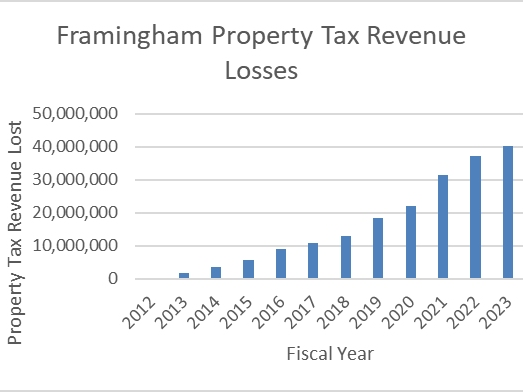
The chart above, generated from Municipal Databank information, shows the property tax revenue lost by taxing below the Proposition 2 ½ levy limit for the past 12 years. When Framingham became a city, tax revenue loss accelerated substantially, jumping from $12.9 million/year in 2018 to $40.1 million/year in 2023. The Municipal Databank also shows that in the last 4 years, city certified cash reserves dropped from $16 million to $6 million and city debt rose to $255 million, its highest level ever, and the city has almost maxed out its borrowing capacity, which is currently regulated by a city policy which requires that debt service not exceed 5% of the city annual budget.
Every key financial parameter is currently trending negative.
The Mayor has proposed a 1.9% property tax revenue increase, which is sufficiently below the nominal 2.5% increase, employed by most cities and towns across the Commonwealth, to generate serious concern, as it runs contrary to Moody’s advice. Amazingly, George King and Mike Cannon are calling for that to be reduced further, to a 0.9% increase.
When one is in a financial hole, the general advice is to stop digging, but that rule seems to hold no weight for George King and Mike Cannon.
Not only has the decline in the city’s financial position been poorly advertised, but the community is also largely unaware of major problems in the 3 additional areas: school roof replacements, education, and cityside infrastructure, all caused by the shortage in property tax revenue Moody’s has flagged.
Late school buses and a rising pothole count have come into view, but they are the tip of the iceberg.
We have $90 million in deferred school roof replacements catching up with us, starting with the $5.3 million Farley emergency roof replacement this summer. Dunning and McCarthy will be done next year for a total of $11.1 million, although Barbieri and Juniper Hill have the most serious leaks and may have to jump the queue. Almost all school roofs will have to be replaced in the next 5 years at a cost of $90 million. More details can be found at:
To address the roofing crisis, the Mayor has pulled $10 million/year from city funding of the Framingham Public Schools budget. The downside of that move is that it steals away the very funding needed to solve the 3 most important problems facing the school district: late school buses, a severe shortage of classroom aides who provide vital support for special needs and English language learner students, and a very damaging lack of pre-K education access for low-income 4-year-olds who are largely Hispanic/Latino and don’t speak English at home.
Increasing school bus driver pay from $29/hour to $34/hour will cost $400,000/year. Classroom aides currently get paid even less than school bus drivers and boosting their pay by 20% to fill more than 100 vacancies and stop the 25% annual turnover will cost about $2.5 million/year. Boosting pre-K capacity from 300 students to 900 students will require additional staff to the tune of about $7 million/year. More details can be found at:
So, solving the roof replacement problem has come at the expense of deferring solutions to late school buses, classroom aide shortages and inadequate pre-K capacity. We have already seen deferred action on the school bus driver pay issue almost cause chaos, with a threatened school bus driver strike.
To complete the trifecta of problems, we have a mountain of deferred maintenance in city infrastructure.
Our roads are deteriorating at a steady clip due to maintenance being funded at about $2 million/year, rather than the required $8.5 million/year. The road maintenance backlog is now more than $94 million. More details on that can be found at:
We also have a water & sewer maintenance backlog of $200 million or more. For more details, see:
The City Council Finance Subcommittee leadership appears to be blind to all these problems.
Having viewed all the recent City Council Finance Subcommittee meetings, it is clear that both George King and Mike Cannon are of the opinion that “we are swimming in money”. They also appear to think that the school district budget offers a bulging reservoir of money for them to further tap to fund their accelerated property tax breaks. In the 4 meetings held so far to review the proposed city FY24 budget, they have made no mention of the challenges we face in school roof replacements, education, and city infrastructure.
In particular, both George and Mike seem to be unaware of the rapidly changing local student population demographics, which triggered the recent large increases in state Chapter 70 aid designed to provide much needed additional support for low-income students, special needs students, and English language learner students, whose first language is not English. They seem to think that the state has thrown too much money at the problem and their job is to remedy that, in the name of efficiency. The fact that the 4-year-old population is rapidly shifting to be dominantly low income and non-English speaking, and that demands urgent expansion of free, pre-K capacity, seems entirely lost on them, as they seek to further cut the city’s investment in the public school system.
The other 3 members of the Finance Subcommittee: John Stefanini, Adam Steiner and Noval Alexander, seem to have a much more realistic view of the challenges the city faces. John worries about potholes and the pre-K problem, Adam worries about the lack of city progress on solar installations and Noval is strongly protective of the schools. All three seem to have far less enthusiasm for the low taxes, small government approach of King/Cannon.
The Framingham community also, through its voting record on property tax increases, has shown that it wants to invest in Framingham’s future. It voted YES on operating overrides in 1993 and 2003, Fuller in 2018 and the CPA in 2021.
Only one central issue remains for the full City Council to resolve.
Will it follow the ill-advised King/Cannon ‘tax breaks no matter the consequences’ approach, or will it align with community values and start to address the problems Moody’s warning flagged?
Will it make sure the city has a sufficiently robust property tax revenue stream to reverse the erosion of city infrastructure, accelerate school roof replacements before we get another emergency like Farley, and press ahead much faster than a 5-7 year timeframe for free pre-K education for all our 4-year-olds, especially for those who don’t speak English at home, so they don’t continue to suffer irreversible educational damage before they enter kindergarten?