Politics & Government
Lecture: Poisonous Plant, Invasive Species and Natural Habitats
Ted Elliman of the New England Wildflower Society gave a presentation on the Natural Habitats of New England at the main Framingham Library.
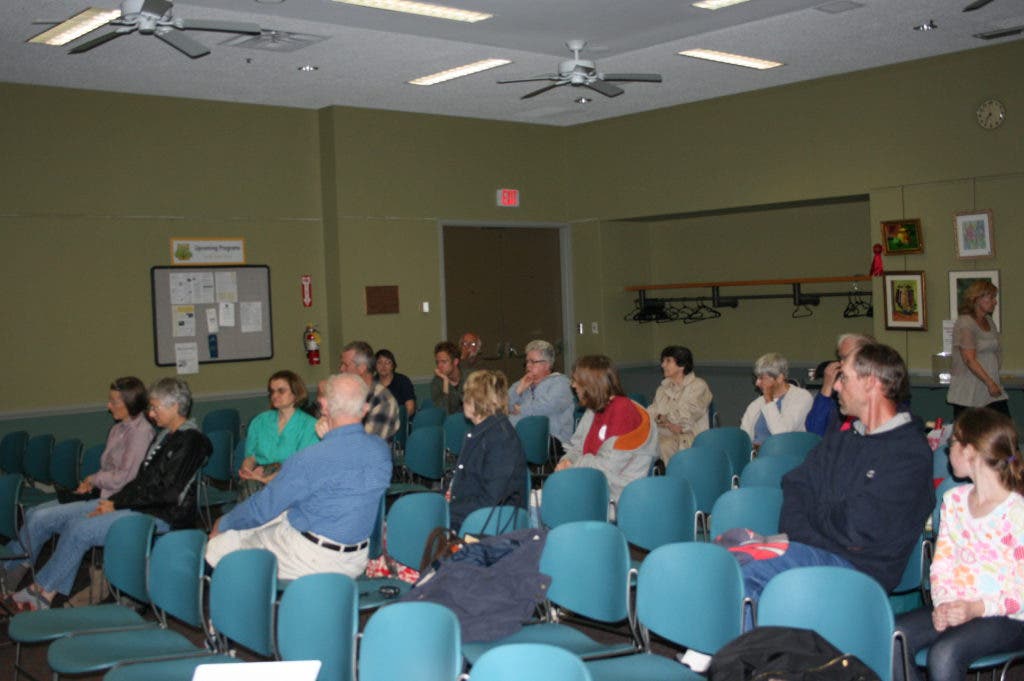


About 30 wildflower enthusiasts gathered at the Framingham Library for a presentation entitled Natural Habitats of New England.
Presented by Ted Elliman, vegetation management coordinator at the New England Wildflower Society, he discussed trees, shrubs and wildflowers found in a variety of biomes or plant communities.
Describing himself as a plant ecologist, Ellison told Framingham Patch, "I always wanted to work outdoors... I have a brother who was into birds so I figured that I should get into something else."
Find out what's happening in Framinghamfor free with the latest updates from Patch.
In his 20s, Elliman earned a Masters degree in environmental science from the Yale School of Forestry and Environmental Sciences. He spends most of his time doing field studies of native and more recently invasive pants in New England.
Three weeks ago, Elliman returned from leading a wildflower tour of the Sichuan province in western China. Fluent in Mandarin, thanks to living in China for two years during the 1980s, Elliman has been leading these tours since 1995. Twenty-three people from the Society and the Wellesley College Friends of Horticulture participated.
Find out what's happening in Framinghamfor free with the latest updates from Patch.
Members of the trip to China were fascinated to see that some of our plants are invasive in China.
"We tend to think of this as a one way street. A number of our species are invasive in China – Golden rod, black locust, and some cacti species," he added.
As for species that are invasive here, Ellison said in China you see one vine of kudzu, rather than masses.
"It's interesting to see these invasive species behave correctly... There, insects or natural disease keep the population in check," he said.
Ellison's presentation, Natural Habitats of New England was an extensive review of New England plant communities. From the spruce fir, to the northern hardwoods, to the pitch pine, to the oak eco-region of the Cape, Ellison showed the depth of his plant knowledge throughout the presentation.
Bunchberry, red baneberry, teaberry and winterberry were among the shrubs described by Ellison. He noted the water hemlock, which grows in swamps, is the most poisonous plant in Northern America. According to Ellison, "Socrates ingested a closely-related hemlock."
Ellison described the differences between bogs and fens. Bogs have a low pH, while fen's have a high pH. Only specialized plants can grow in the highly acidic bogs.
Threats to species, including ginseng, American chestnut, and hemlock were discussed.
"The woolly adelgid beetle that attaches the hemlock is definitely here," he said.
Ellison described the trailing-arbutus, Massachusetts' State Flower, which grows in the oak-hickory forest. It has a fragrant bloom in late April. Ellison said he wasn't sure why this was the state flower.
Ellison's presentation was followed by some questions about where to find particular species.
Don Johnson from Clinton, who works at Trader Joe’s in Framingham, saw a sign about the talk on the store's bulletin board.
"I've been landscaping for 30 years. I'm interested in restoring indigenous habitat for native plants and animals," he said. "The talk was great. I've been to a lot of the places that were mentioned."
Ellison said last year the Society organized a number of volunteers in Framingham who surveyed invasive plants.
If anyone is interested in continuing this effort, please contact Elliman by email at Telliman@newsfs.