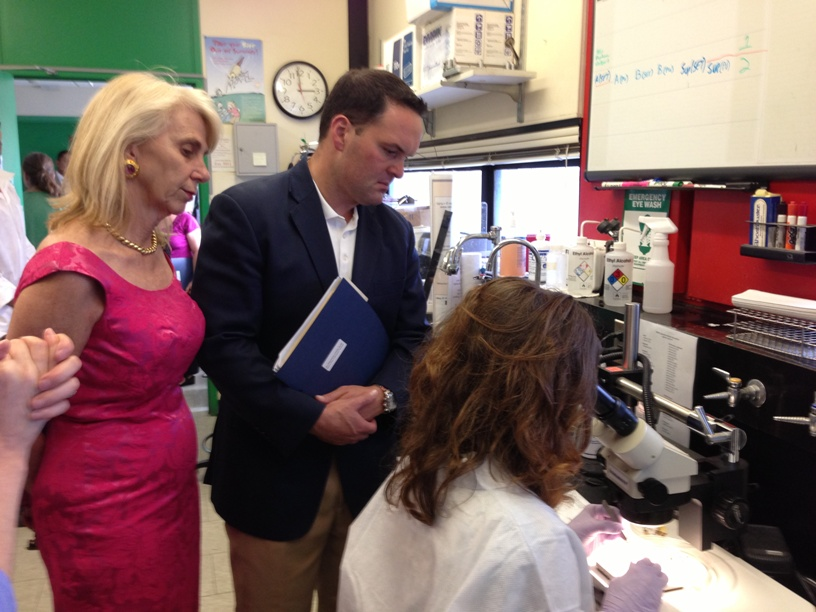
(State House) – State Rep. Garrett Bradley, D-Hingham, announced on August 26th that the first human case of West Nile virus (WNV) this year had infected a local resident in his 70s who was diagnosed with WNV in late August and remains hospitalized, but is recovering. State Department of Public Health (DPH) officials also told Rep. Bradley on Monday that two mosquito samples from Hingham had tested positive for Eastern Equine Encephalitis (EEE). Coincidentally, the news came just days after Bradley visited the Hinton State Laboratory in Jamaica Plain, where mosquito samples are tested, to meet with DPH Commissioner Cheryl Bartlett and several staff members to discuss current and future funding priorities. The tour took place August 22nd.
“This new WNV case, the finding of EEE in tests in Hingham, together with the recent reported EEE death in another local town, underscores the serious nature of the threat, and I encourage residents to check the Department’s website which is updated daily with mosquito results and risk levels,” said Bradley. “I want to make sure that the public sees the same information as local health officials, to know whether there might be an increased risk of exposure in their town.”
Rep. Bradley thanked Commissioner Bartlett for inviting him to tour the facility and learn more about the vital functions it provides for the Commonwealth, the region and nation as well.
Find out what's happening in Hinghamfor free with the latest updates from Patch.
“I was impressed by the scope and quality of research and testing which takes place at the facility, often under less than ideal conditions. The staff and equipment appear to be outgrowing the current facility, but these dedicated professionals continue to work hard to accomplish their tasks,” said Rep. Bradley.
Later in the tour, Rep. Bradley was shown a small room where technicians process mosquito samples to determine whether the insects have been infected with West Nile Virus or Eastern Equine Encephalitis. He told Commissioner Bartlett and staff members that his district has been affected by outbreaks of mosquitoes, and mentioned the recent death from EEE of a local Massachusetts woman.
Find out what's happening in Hinghamfor free with the latest updates from Patch.
Commissioner Bartlett said, "DPH and our staff at the Hinton State Laboratory Institute work hard to protect our Commonwealth's residents from mosquito-borne infection. We appreciate the Representative's dedicated leadership in support of this important public health issue and look forward to continuing our partnership with the Legislature moving forward."
According to the DPH, in 2012, 33 cases of West Nile Virus were detected in Massachusetts residents. While WNV can infect people of all ages, people over the age of 50 are at higher risk for severe disease. WNV is usually transmitted to humans through the bite of an infected mosquito. Most people infected with WNV will have no symptoms, which tend to include fever and flu-like illness. In rare cases, more severe illness can occur. In 20 percent of cases, patients will experience headache, sore throat, fatigue, muscle and joint aches, and moderate to high fever. The symptoms of EEE include abrupt onset fever, chills, headache, muscle aches, nausea and vomiting, seizures, and even coma. The disease tends to affect children disproportionately, has a nearly 50 percent mortality rate, and 80 percent of survivors have residual neurological deficits.
The lab consists of four bureaus employing 278 staff, and conducts more than 225,000 tests each year for EEE, West Nile Virus, Rabies, chemical threats, blood lead, food-borne disease, STDs, tuberculosis, influenza, and other bio-agents, to name a few examples. Other core functions of the facility include environmental health and protection, disease prevention, control and surveillance, training and education. The lab operates separately from the Executive Office of Public Safety’s crime testing facility.
Bureau of Laboratory Sciences Director Dr. Michael Pentella told Rep. Bradley during a presentation that the lab is supported by a combination of state funding and federal grants. Pentella said current and future needs include maintaining adequate staffing levels, plus improving technology and the infrastructure that supports it. Space is limited, and some computer equipment is kept in closets.
The information collected by the state lab is shared with health officials throughout the state and the country, as well as the federal Centers for Disease Control, as part of a large integrated network of testing facilities. In addition, the facility conducts regular air sample testing at various locations and shares the information with the Department of Homeland Security, to monitor for potential airborne pathogens.