Business & Tech
Angell Animal Medical Center
One of the oldest and best animal hospitals in the world is right here in JP.
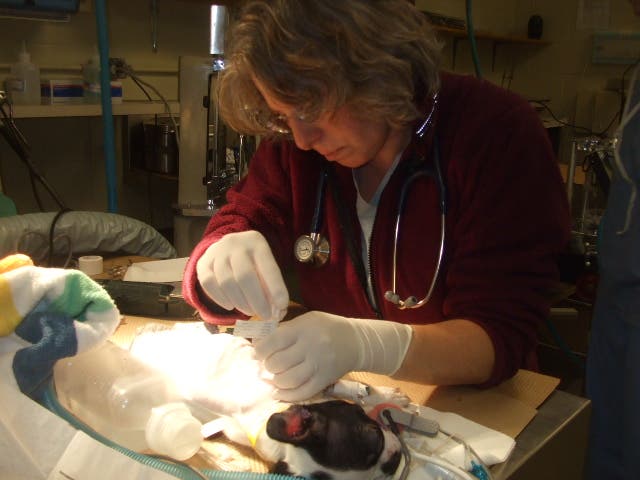


Though you probably pass by it every day, you may never have considered that one of the foremost medical facilities in the world is right here in JP. lives up to its name, providing live-saving healthcare for furry, feathered and four-legged patients and sanctuary for orphans.
I had been to Angell once, years ago, when the beloved cat of a former roommate fell ill with leukemia. Since then, the organization has completed a major renovation and addition. Brian Adams, Angell's senior manager of media and community relations, took me on an eye-opening tour of the medical center's still shiny state-of-the-art facility.
What services does Angell provide?
Find out what's happening in Jamaica Plainfor free with the latest updates from Patch.
Adams: Pets can be seen for regular check-ups and treatment. In emergencies, pets should be brought to the emergency counter. Check-in for both is located just inside the main entrance to the hospital at the back of the facility, as is the pharmacy. Pet food for various cats, dogs, birds and exotics can be purchased there or at the store, located inside the adoption center entrance.
Financial services are available to assist care-takers, with up to half the cost of services waived depending on income.
Find out what's happening in Jamaica Plainfor free with the latest updates from Patch.
The large size of the facility and our status as a center for families around the region and beyond allows us to employ specialists in dermatology, oncology, cardiology, neurology, surgery, even dentistry.
The new building offers a divided general waiting area to keep things peaceful by keeping species separate, a dedicated oncology waiting area, more than 20 examination rooms, surgical suites, state-of-the-art equipment for testing and treatment including an animal-specific MRI, a CT scan, a linear accelerator for pinpoint radiation of tumors, a sophisticated pathology lab and more.
Because behavioral issues are a leading cause people cite for surrendering or abandoning dogs, we offer variety of dog training classes, open to all.
The new building also houses the Animal Care and Adoption Center and the Shalit-Glazer Clinic, where low-cost spaying and neutering, shots and other services are provided for low-income families. [These will be explored in more detail in a subsequent article.]
What sets Angell apart from other animal care facilities?
Adams: Everything is together in one place. Our pathology department is right downstairs, so doctors get results much more quickly than a stand-alone veterinarian could. That time savings can mean the difference between life and death for an animal.
We try to use the least invasive measures when possible. For example, we restrain pets to take samples rather than sedating them routinely.
We have 68 doctors and residents (plus a dozen interns), including some of the best veterinary minds in the country.
When there was that rash of animal illnesses and deaths from contaminated pet food several years back, Angell spear-headed the efforts to determine the cause. Then when human infant formula was similarly contaminated, doctors from across the globe consulted with Angell veterinarians!
What is the history of the organization?
Adams: MSPCA/Angell is the second-oldest humane society in the United States It was founded in 1868 by George Thorndike Angell with the backing of Emily Appleton and the support of John Quincy Adams and Ralph Waldo Emerson. The catalyst for George Angell had been an incident in which two horses were raced to death—literally— and from the beginning Angell advocated for anticruelty statutes with great success. Within three years of the MSPCA's founding, there were similar societies in 24 cities and animal protection laws across the country.
In 1915, the MSPCA's second president, Francis H. Rowley, a veterinarian and minister, opened the Angell Memorial Animal Hospital (originally located in the Longwood Medical Area) and the organization's first shelter on Nevins Farm in Methuen.
In the 1920's MSPCA opened additional facilities, adding a small animal shelter at Nevins Farm, an animal hospital in Springfield and a humane-care facility in Fez, Morocco. With Fez, the MSPCA had developed its international arm—now known as the World Society for the Protection of Animals.
MSPCA played a major role in the enactment of the Animal Welfare Act and the Endangered Species Act. During the 1980s the crisis in pet overpopulation led to the establishment of the low-cost spay and neuter clinic for low-income families, the Animal Disaster Relief Fund, the Center for Animal Laboratory Welfare and Phinney's Friends—a program that assists HIV/AIDS patients with pet care. New shelter/hospital complexes were built in Brockton, Martha's Vineyard, Nantucket and Springfield.
Since 2003, the organization has been known as MSPCA-Angell and the seven regional animal shelters have been called Animal Care and Adoption Centers. Like the Boston facility, the Nantucket veterinary center is now called Angell Animal Medical Center. The new Boston facility opened in 2006.
As a result of the economic downturn and a loss of 25 percent of the organization's endowment, MSPCA-Angell ceased administering operations at the Springfield, Martha's Vineyard and Brockton facilities in 2009. The buildings in Brockton and on Martha's Vineyard are leased to the local humane societies at no cost. The facility in Springfield was sold to the Dakin Pioneer Valley Humane Society. Similarly, Phinney's Friends is no longer part of MSPCA-Angell, but the program continues under volunteer leadership.
Why is JP a good home for Angell?
JP is a fantastic place to be situated. It has allowed us room to expand as we have but also offers the vibrancy of an urban area. It would have been hard to find the space we need elsewhere in the city. People are incredibly supportive. The melting pot character of JP helps us reach many different audiences.
What is the best thing Angell has done for JP?
We've been there when residents needed help with their animals. People from all over come to JP for Angell's services. When they do, they become familiar with JP and patronize businesses here. Actually, working here has opened my own eyes to all JP has to offer!
[Editor's note: A few aspects of this story have been corrected since the initial posting — to show that some services are low-cost instead of free and to correctly characterize the disposition of several buildings.]