Sports
Celebrate Jackie Robinson Day at Cary Library
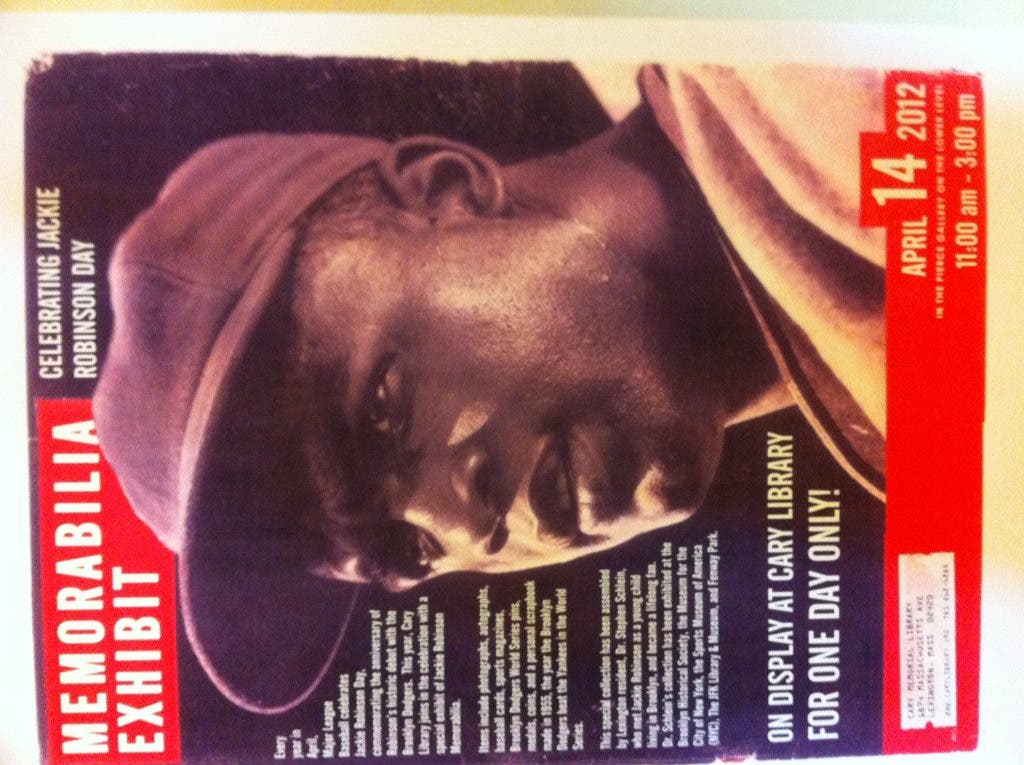
"Jackie Robinson: A Memorabilia Exhibit" is a special one-day exhibit from 11 a.m. to 3 p.m. tomorrow at Cary Memorial Library, featuring photo, autographs, cards, magazines and more from the collection of Lexington resident Stephen Schlein.


It’s like a scene straight out of a PG movie or some soda commercial: 1950s ballplayer leaves the stadium and walks with adoring young fans for a few blocks to the subway, where he stops, puts his hand on the shoulder of a boy barely older than 10 and says, “How’d you like the game, kid?”
Insert jersey toss and exit stage left.
Except only this was real life. The ballplayer was Jackie Robinson. And the boy, he grew up, moved to Lexington and became a Sox fan.
Find out what's happening in Lexingtonfor free with the latest updates from Patch.
The above memory and more will be on display at from 11 a.m. to 3 p.m. tomorrow, April 14, in a special memorabilia exhibit celebrating Jackie Robinson Day.
This , who grew up in Brooklyn, just 20 minutes from Ebbets Field.
Find out what's happening in Lexingtonfor free with the latest updates from Patch.
Schlein was 10 when Jack Roosevelt Robinson joined the Dodgers, and he knew right away that this was a special player, unlike anyone he’d ever seen before – or since for that matter. It was the second baseman's play on the field that got Schlein’s attention at first, and only later did he realize that by breaking into the bigs, Robinson also broke Major League Baseball’s color barrier.
“He was an electrifying player, dazzling. Hit .300, and base-running was just mindboggling,” Schlein said by phone today while en route to Fenway Park for the Red Sox home opener. “It became clear as I became older that Jackie Robinson was really someone special.”
It’s not hard to see why, as a kid, Schlein did not understand the social significance of Robinson’s joining the Dodgers. Those were the days before steel gates, before players parked their SUVs inside the ballpark.
“The players had to come out of the dressing room, right into the street," said Schlein. "It was like a stage door at the theatre, and they had to face the fans."
Back then, players didn’t always sign autographs on the spot, but would collect self-addressed cards to sign and mail at a later date. After home games, Robinson got so many requests he would be outside Ebbetts field with a cardboard box for fans to drop their cards into, according to Schlein, who said fans would walk with the players to the subway or parking lots several blocks away.
“One time, and I swear this is like something from a movie like ‘The Natural,’” Schlein said, “He put his hand on my shoulder and said something like, ‘How’d you like the game, kid?’ And then he became my favorite player.”
With the World Series featuring at least one team from New York for much of the first few years of Schlein’s fandom. One of those teams was the 1955 Brooklyn Dodgers, and Schlein followed the team by scrap-booking together pictures and press clippings in a binder like a student might keep for school.
That binder is one of the more popular items among Schlein’s collection of Brooklyn Dodgers memorabilia when he has previously exhibited at the Brooklyn Historical Society, the Museum for the City of New York, the Sports Museum of America (NYC), The JFK Library & Museum and Fenway Park.
“I love telling stories about the items that I have,” Schlein said. “At the exhibits I have had at Fenway Park, the kids will come in with their fathers, and they’ll come up to me and ask about players, and steals and batting averages. It’s exhilarating.”
Now a Red Sox fan—after quitting on baseball when the Dodgers moved to LA, but getting pulled back in by Fred Lynn, Louis Tiant and the 1975 Red Sox—Schlein began collecting memorabilia in the 1980s.
With a focus on his favorite team from childhood, Schlein has amassed photos, World Series pins and old magazines to go along with some of his old autographs, the binder and a baseball he caught once during batting practice. And when he exhibits, Schlein tries to both share stories about the player and team he marveled at as a boy and discuss the bigger picture he did not completely understand at the time.
“I became a fanatic baseball fan. I was growing up in Brooklyn when the Dodgers were in the World Series almost every year, but I didn’t understand the social significance,” said Scheiln. “But you’ve got to realize, this was before Rosa Parks sat on that bus. He was an electrifying player, but is life was threatened. His family was threatened. And he did this stuff before the Civil Rights stuff ever happened.”
Get more local news delivered straight to your inbox. Sign up for free Patch newsletters and alerts.