Community Corner
Lexington Resident Anne Grady Honored By State, Town
Massachusetts Historical Commission and Lexington Board of Selectmen honor Anne Grady for her work with historical structures.
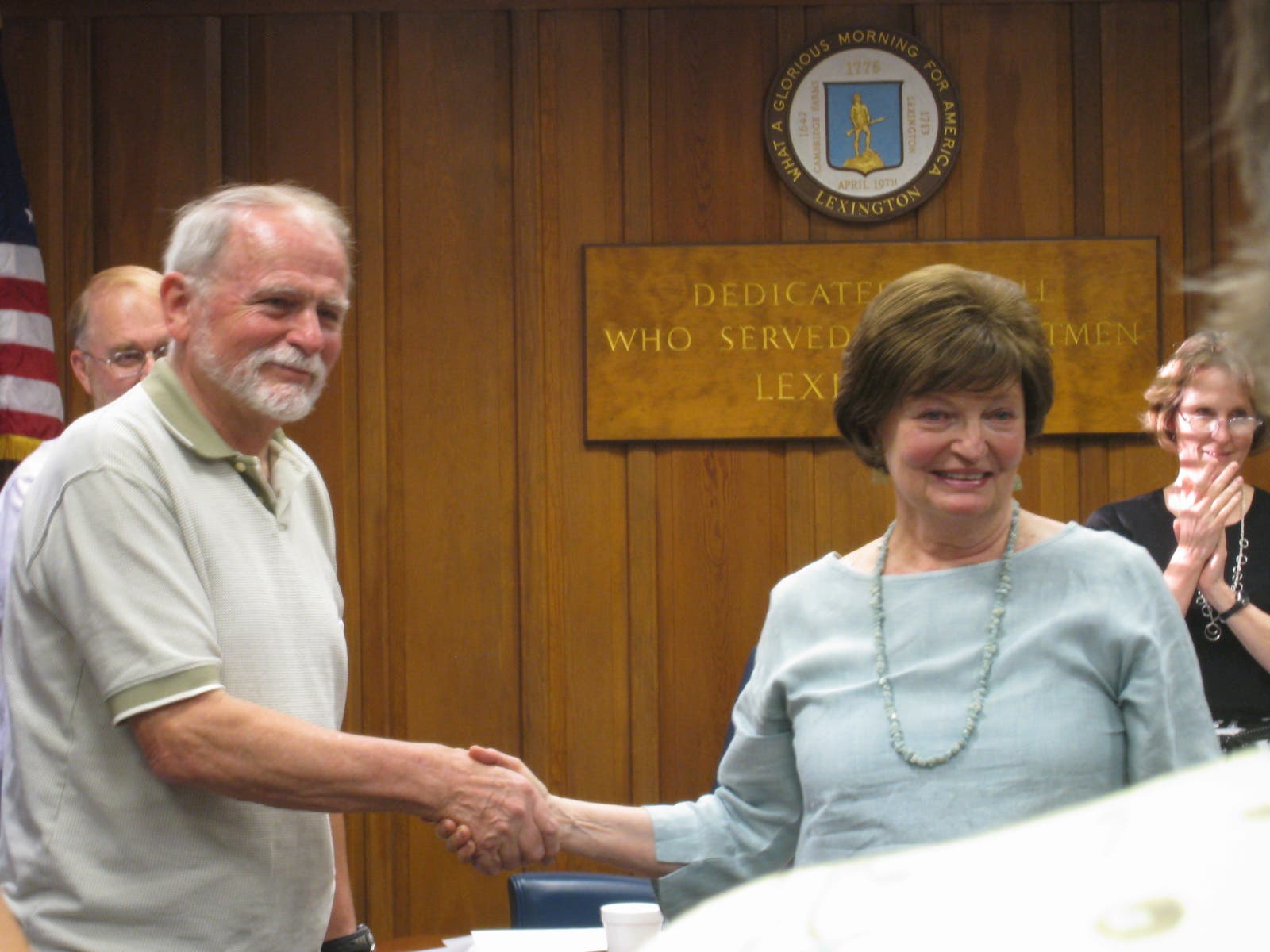

Lexington resident Anne Andrus Grady has twice in recent weeks been recognized for her more than 30 years of work on historical sites in Massachusetts - receiving the 2010 Massachusetts Historical Commission (MHC) Lifetime Achievement award in May, and during last week's Board of Selectmen meeting.
"It's just fantastic," Grady said about the state recognition, which was presented by Sec. William Francis Galvin on May 18. "I never would have thought of myself in the category of people who have received the award in the past."
Others were not so modest when speaking about Grady's accomplishments.
Find out what's happening in Lexingtonfor free with the latest updates from Patch.
"Anne's work for the Lexington Historical Society has been invaluable," said Paul O'Shaughnessy, society president. "She's very open with her information, very easy to work with, very well informed and overall just a very pleasant person."
Grady's biggest contribution to the field of historic preservation in Massachusetts has been her emphasis on dedrochonology, a process that uses tree-ring dating on wood cores taken from houses to determine the date they were built. Although dendochronology has been used across the country, Grady has been credited by the MHC with bringing it to Massachusetts.
Find out what's happening in Lexingtonfor free with the latest updates from Patch.
In total, Grady has studied and written historic structure reports on more than 100 buildings, including well-known landmarks such as Boston's Old South Meeting House, the Harrison Gray Otis House and the Spencer-Pierce Little House.
She has also left a lasting impression on her own community of Lexington, including by creating the first cultural resources survey of Lexington, and through her work on the Hancock-Clark House, the Munroe Tavern and the Stone Building. She also did volunteer work toward saving the Garrity House from demolition.
"People said it would have been like a smile with a tooth missing," she said.
Born in 1932 in New York City, Grady grew up in Bronxville, N.Y., and attended Smith College. She married her husband, George, in 1962, and the couple soon moved to Lexington to be closer to his work in Boston.
The couple has lived in the same house in Lexington since 1965, raising three children – Beth, Kate and Jen. After raising her family, Grady returned to college, getting a degree in historic preservation from Boston University. Her long-time interest in architecture served as a base for her passion in historical sites, and she credits her very first class at BU and very first professor, Abbott Lowell Cummings, as her inspiration and mentor.
"I was very quiet and had been out of the job market and education scene for 10 years, but he inspired me," she said.
She served as chair of the Lexington Historical Committee from 1976 to 1981 and on the state Historical Commission from 1993 to 1999. Most recently, in 2009 Grady completed a historical structure report of Munroe Tavern in Lexington.
Grady lists her work on the East Lexington Library as her favorite project in Lexington. The building had previously been identified as a church or a school, but Grady proved it was actually a place for lyceum lectures, which was a national movement that focused on adult education in the early 19th Century.
Most of Grady's historical work has been as an employee of Historic New England or as an independent consultant. She has dated 52 buildings in Massachusetts, and prepared dozens of historic structure reports, which are detailed histories of buildings used as a basis for future preservation decisions.
"It's been a lot of fun," she said. "I like climbing around in old buildings. When I was doing a report on the House of Seven Gables I scaled the roof with the architect involved. I've also spent a lot of time in ceilings and attics."
Grady said that through all her years of service, she never lost enthusiasm for the work.
"I was just promoting dendrochronology, and I learned an incredible amount by doing all these projects," she said. "It's just great to be recognized for what I did because – I liked it."