Politics & Government
Supreme Court Rules 5-4 in Favor of Gay Marriage
U.S. Supreme Court decided one of the most contentious civil rights issues of modern times in consolidated cases from four states.

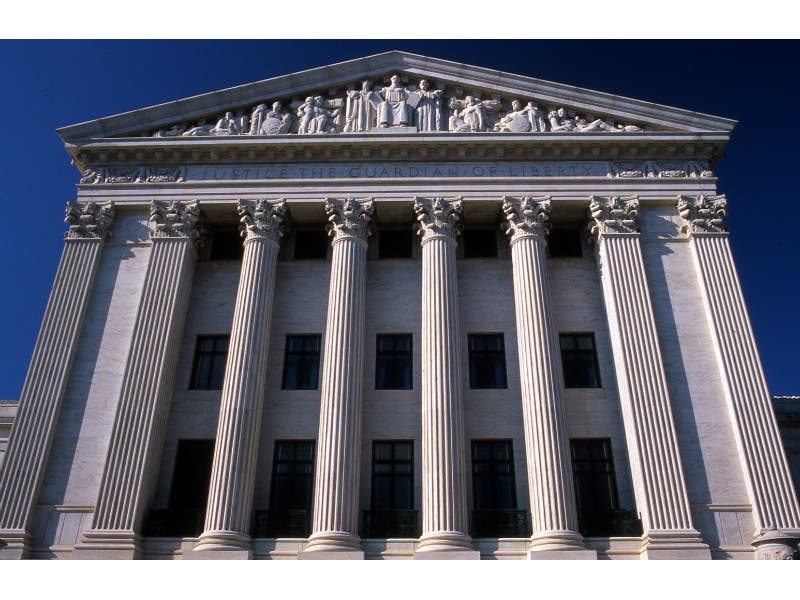
The U.S. Supreme Court issued a watershed ruling Friday in favor of gay marriage, resolving the legal issues surrounding one of the most contentious civil rights issues of modern times and ending a decades-long battle for marriage equality fought in state legislatures, courts and at the ballot box.
The ruling was 5-4.
Find out what's happening in Lynnfieldfor free with the latest updates from Patch.
Justice Anthony Kennedy wrote for the majority: “No union is more profound than marriage, for it embodies the highest ideals of love, fidelity, devotion, sacrifice and family In forming a marital union, two people become something greater than they once were.”
The dissent, written by Chief Justice John Roberts, characterized the decision as an affront to democracy.
Find out what's happening in Lynnfieldfor free with the latest updates from Patch.
Friday’s decision comes during a time of historic support for same-sex-marriage, and thousands of people camped outside the Supreme Court building for days cheered wildly, waved gay and U.S. flags, hugged and cried when the decision was announced.
Attitudes across the country have shifted swiftly and dramatically in the last decade, according to public opinion polls. Only 27 percent of Americans thought gay marriage should be legal when the Gallup Poll began posing the question in 1996; last month, support had soared to 60 percent, up from 55 percent just a year ago.
“Today is a big step in our march toward equality,” President Barack Obama tweeted within minutes of the ruling. “Gay and lesbian couples now have the right to marry, just like anyone else.”
Hillary Clinton’s campaign twitter account said simply: “Proud.” She has also changed her account photo to reflect her support for the decision.
Mike Huckabee, a GOP presidential hopeful and one of the most visible members of the Republican party, issued a scorching criticism of the decision.
“This flawed, failed decision is an out-of-control act of unconstitutional judicial tyranny,” he tweeted.
Jeb Bush, another GOP candidate for president, also criticized the decision.
“Guided by my faith, I believe in traditional marriage,“ Bush said in a statement. “I believe the Supreme Court should have allowed the states to make this decision.”
The case before the justices – Obergefell v. Hodges, a consolidation of cases in Michigan, Ohio, Kentucky and Tennessee – pitted states’ rights against individuals’ right to marry, and traditional marriage against more modern iterations of the union.
The split ruling was met with cheers among throngs who have gathered outside the Supreme Court building by groups that have camped out for days, and a stinging dissent by Chief Justice John Roberts, who called it an affront to democracy.
“Understand well what this dissent is about: It is not about whether, in my judgment, the institution of marriage should be changed to include same-sex couples,” the chief justice wrote. “It is instead about whether, in our democratic republic, that decision should rest with the people acting through representatives, or with five lawyers who happen to hold commissions authorizing them to resolve legal disputes according to law. The Constitution leaves no doubt about the answer.”
The justices agreed in January to hear the case. A three-judge panel of the 6th U.S. Circuit Court dealt gay marriage advocates their first federal appeals court defeat last fall, upholding the bans in the four states and setting the stage for the Supreme Court showdown.
The cases involved 12 couples and two widowers. They cases are:
Michigan: On March 21, 2014, U.S. District Judge Bernard Friedman ruled against Michigan’s voter-backed ban on same-sex marriage in DeBoer V. Snyder. The case was filed by a lesbian couple who wanted to jointly adopt children, but were prohibited from doing so by the 2004 voter-backed ban on same-sex marriage.
Kentucky: On July 1, 2014, U.S. District Judge John G. Heyburn III ruled in Love v. Beshear against a provision forbidding the commonwealth from performing same-sex marriages. That ruling followed a Feb. 12 ruling in Bourke v. Besher that said the Commonwealth could not refuse to recognize valid same-sex marriages performed in other states.
Ohio: Two Ohio cases were consolidated in the appeal before the 6th Circuit. On Dec. 23, 2013, U.S. District Judge Timothy Black ruled in Obergefell v. Hodges that Ohio’s refusal to recognize a same-sex marriage performed in another jurisdiction was unconstitutional. The case was filed on behalf of Jim Obergefell and John Arthur, who wanted their Maryland marriage to be recognized on Arthur’s death certificate before he died. The court ordered the state to recognize the marriage when Arthur died in October 2013.
Tennessee: On March 14, U.S. District Judge Aleta Trauger ordered Tennessee officials to recognize three same-sex marriages performed in other jurisdictions. The ruling was later stayed by the 6th Circuit.
Get more local news delivered straight to your inbox. Sign up for free Patch newsletters and alerts.