Community Corner
DeSorgher: Artists of Medfield: Dennis Miller Bunker
Editor's note: This is the second in a three part series on the artists of Medfield. Part One was last week on George Inness. This week is Dennis Miller Bunker.
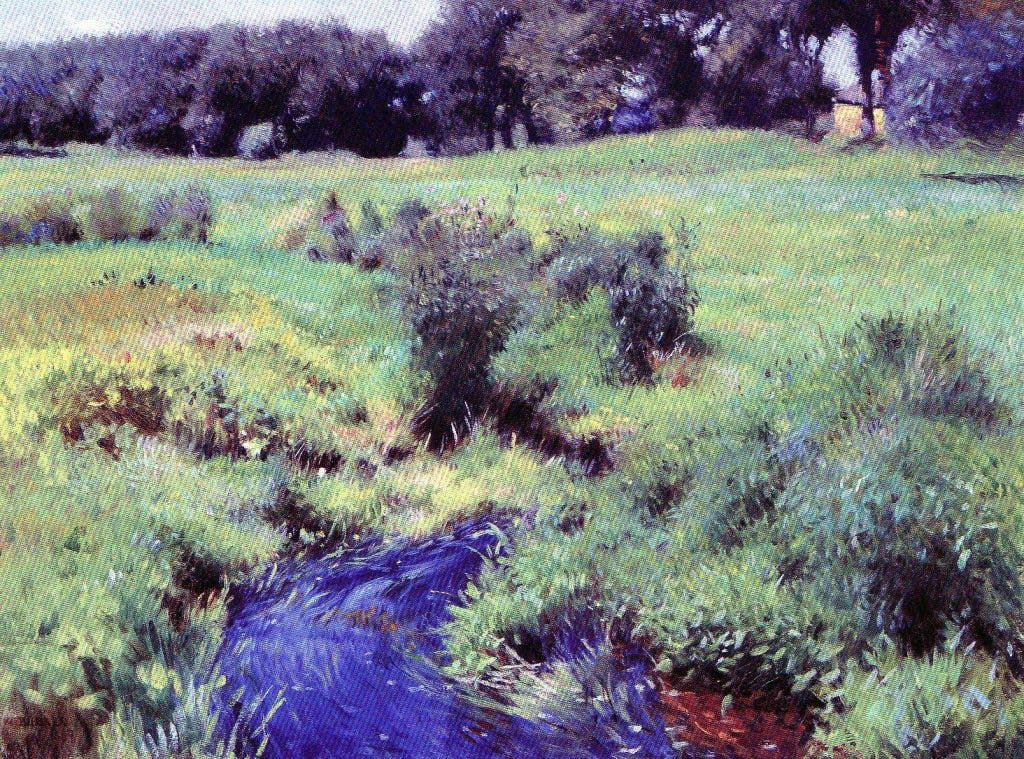


Just as they flock to Giverny, France to see the French setting where Claude Monet found inspiration for his paintings, art lovers may some day make a pilgrimage to Medfield to view landscapes immortalized on canvas by the likes of George Innes, John Austin Sands Monks, Dennis Miller Bunker and John J. Francis.
While Medfield was not an artist community as such, the artists did come here.
Part II: Dennis Miller Bunker
Find out what's happening in Medfieldfor free with the latest updates from Patch.
Dennis Miller Bunker was one of the most promising Impressionist painters of his time. Bunker’s introduction to Medfield came from world renowned composer and concertmaster with the Boston Symphony Orchestra, Charles Martin Loeffler and Loeffler’s patron, Isabella Stuart Gardner.
Loeffler moved here to Medfield and Gardner brought the whose-who of Boston Society out to the concerts he held at on Main Street. Loeffler at the time was renting the cottage at 661 Main St. and Miller boarded next door at Sewell’s Tannery Farm. Bunker liked it here in Medfield because Medfield resembled the Thames countryside outside London and the country side near Giverny, France, where the famed Impressionist Claude Monet painted. The flat land’s willow and apple trees were common elements to English, French and Medfield landscapes.
Find out what's happening in Medfieldfor free with the latest updates from Patch.
Impressionism took hold in a number of American cities, but especially in Boston. By 1887, a group of Boston painters had become great followers of Monet. Bunker studied with William Merritt Chase at the Art Students' 'League in the late 1870' and later in Paris. Bunker learned his impressionism in England with John Singer Sargent and while spending a summer painting with Monet.
Isabella Steward Gardner also became Bunker’s patron. It was she and Loeffler who guided him around the local cultural scene and directed him to Medfield. She felt a special fondness for the dashing 23-year-old. Their relationship had another dimension. Gardner had lost a young son, who had he lived would have been Bunker’s age. Gardner introduced Bunker to the people who would most influence his art. The following summer when Bunker could not afford to return to Europe to be with Sargent, Gardner told him about Medfield.
Gardner’s friend, Alice Sewell, operated the boarding house in Medfield, now known as the Tannery Farm on 663 Main St., just past Tannery Drive. Here Bunker stayed in 1889 and 1890. Not only were the summers of 1889 and 1890 in Medfield his most productive but the artist developed such a close relationship with Loeffler that Loeffler later served as best man at Bunker’s wedding.
In Medfield, Bunker found his stride. According to Bunker, “no other place had affected him like Medfield.” He felt an immediate emotional tie for the land and the light. The Medfield landscape inspired him to do his best work. He could hardly contain his excitement when he wrote to Gardner “You should see the Charles River, it has dwindled almost to a brook—and has lost all its Boston character. It is very charming—like a little English river—or rather a little like an English river. It runs here through the most lovely meadows, very properly framed in pine forests and low familiar looking hills — all very much the reverse of striking or wonderful or marvelous, but very quietly winning and all wearing so very well that I wonder what more one needs in any country. … The calmness of everything here — its roughness and simplicity is to me most charming and restful — and I feel more happy and in better courage”
When he returned to Medfield in the summer of 1890, he wrote “I have been going about recognizing every brush and field and all the things about the place." The Medfield landscape provided Bunker with endless opportunities to explore techniques and subjects.
He produced serious paintings of Medfield marshes, capturing changes in the light at different times of the day, much like Monet. Bunker painted a portrait of Loeffler, which today hangs in the Isabella Steward Gardner Museum in Boston. (The museum, by the way, has just re-opened with a beautiful new addition.) He also painted Loeffler’s violin. Loeffler was busy too, composing a string quartet; Bunker wrote to Mrs. Gardner “I even hear Loeffler working downstairs on the same phrase that he began two months ago."
Bunker titled his painting of the caretaker’s cottage by Sewell’s boarding house that Loeffler had earlier rented “Roadside Cottage,” which today hangs in the Museum of Fine Arts. Boston’s Museum of Fine Arts collection also includes Bunker’s Medfield paintings of “The Pool” and “The Brook at Medfield.” No one knows for sure where the exact place where these paintings were made.
The best guess is that they were probably in the area of the Old Tannery Farm Boarding House. Although the Tannery Drive housing development has changed the immediate area around the house, much of the area across the street and along the neighboring Charles River is wetlands and remains undeveloped and has changed little over the years.
Bunker completed more paintings in Medfield than anywhere else. As canvases piled up in his room, he was unhappy at the prospect of returning to Boston to teach. He confided to Gardner that summer was slipping away too fast. The public saw the first of Bunker’s Medfield paintings in 1890. A reviewer for the Boston Evening Transcript wrote: “The skies are represented only by reflection in these interesting freaks of painting and they may be classified as bold and original experiments in the representation to that eternal phenomenon which possesses such a powerful fascination for all painters—sunlight.”
It is interesting to note that Bunker was not the first painter to appreciate the quality of light in Medfield — as George Inness captured the pastoral setting in his atmospheric painting “Medfield Meadows.”
The summer of 1890 was an especially happy one for Bunker. He was in love and his work was going well. The Metropolitan Museum of Art in New York City had offered him a teaching post, so at summer’s end he left Medfield for New York.
In October he married Eleanor Hardy, daughter of a prominent Boston family. The couple moved to New York City. There on Christmas Day, Bunker suddenly became ill. He died of the influenza three days later. He was just 29 years old.
Bunker was called the most promising Boston artist of his generation. The “what if’s” that surround Bunker’s life are limitless. But this we know, he loved his time in Medfield and from that time came his best and most successful work.
To read part one of this series, profiling George Inness, .