Community Corner
DeSorgher: The Famous Medfield Artists
Editor's note: This is the first in a three-part series looking at the famous artists in Medfield. Part I profiles George Inness.


Part I:
Just as they flock to Giverny, France to see the French setting where Claude Monet found inspiration for his paintings, art lovers may some day make a pilgrimage to Medfield to view landscapes immortalized on canvas by the likes of George Innes, John Austin Sands Monks, Dennis Miller Bunker and John J. Francis.
While Medfield was not an artist community as such, the artists did come here.
Find out what's happening in Medfieldfor free with the latest updates from Patch.
George Inness
First, George Inness—One day in 1859, the stagecoach that ran between Needham and Medfield crested the Dover hills. Landscape artist George Inness peered out the window at the broad meadows, trees and marshlands that he would immortalize in so many of his paintings. Traveling with him were his wife Lizzie and their five small children. They had left their home in Brooklyn, N.Y. to move near Boston.
Find out what's happening in Medfieldfor free with the latest updates from Patch.
Since studying and painting in the art centers of Europe, the then 34-year old Inness had begun to develop his own unique style, which broke all the traditional rules for landscape painting. He had been unable to sell his works in New York and he hoped Bostonians would be more appreciative.
The Inness family rented the house, which still stands today at 406 Main St. and Inness set up his studio in the barn, which also still stands, behind the house. He became a familiar sight about town, walking the one and a half miles down Main Street to sketch along the Charles River. His long hair flowing in the breeze, Inness rarely painted directly from nature. He spent weeks doing minute studies of various scenes about town, then retired to his studio, where he would paint like a man possessed.
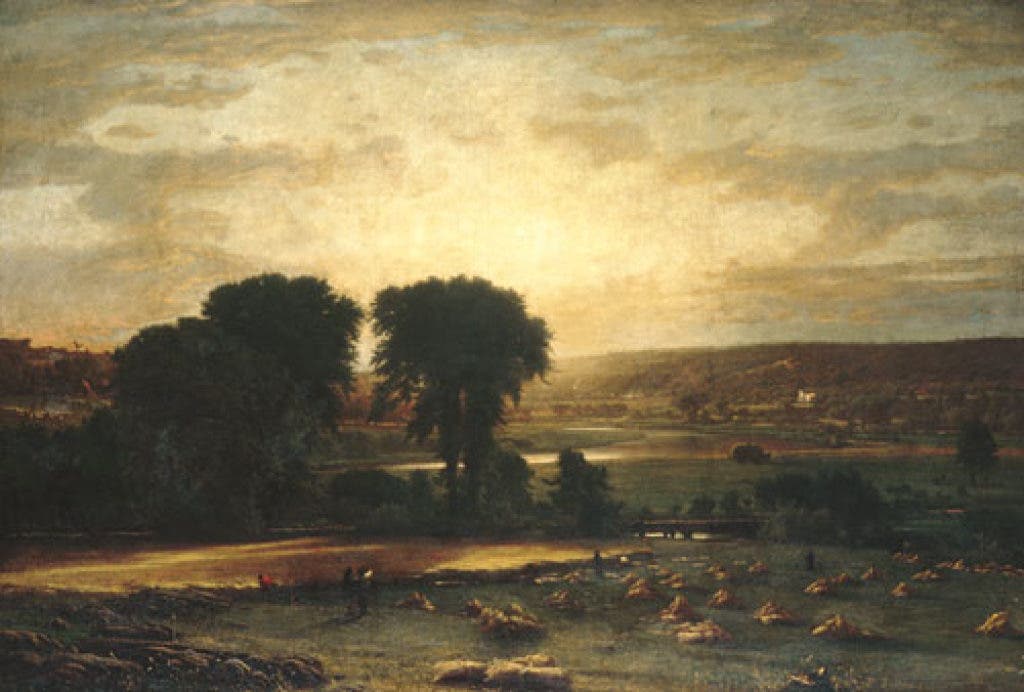
One of the paintings he did here, during what Inness called the "Medfield Period" of his life from 1859-1864, was a landscape entitled “Summer, Medfield, Massachusetts” It is a remarkable example of this particular period of Inness’ work.
Inness was noted for independence of thought and a willingness to cast off whatever he felt was superficial. From this point on, his work was given considerable recognition during his lifetime. Inness objected to being called an Impressionist. He did not follow the out-of-door painting methods of the French Impressionists.
He sketched out of doors and then painted from sketches and from memory in his studio. His work is represented in the collections of many American art museums. Other paintings he did here in Medfield include: “Evening at Medfield,” “Old Elm at Medfield,” and “Medfield Marshes.” Perhaps his most famous work, “Peace and Plenty,” is a painting of the meadows and trees surrounding the Charles River.
When New York or Boston art dealers met a young person who had promise, they would suggest that they go to Medfield and study under George Inness. In 1864, Inness left Medfield for Eagleswood, N.J., where Inness used the sale of his painting “Peace and Plenty” as payment for a new house.
Medfield, he said, was the "peaceful haven which allowed me to develop my own individual style from the ideas and inspiration of my European studies."
Inness died in 1894. At the time of his death and immediately after, Inness works were highly praised.
Recently, five of the nation’s major art museums exhibited Inness’s paintings. There is a great deal of pride in Medfield’s art history knowing that Inness spent four years of his life in our community and that so many of his paintings show the “peace and plenty" he found in our town.