Community Corner
DeSorgher: The Landmark House Where History is Contagious – 505 Main St.
Town historian Richard DeSorgher shares the history of 505 Main St., currently known as the Butterfly Tree Store.
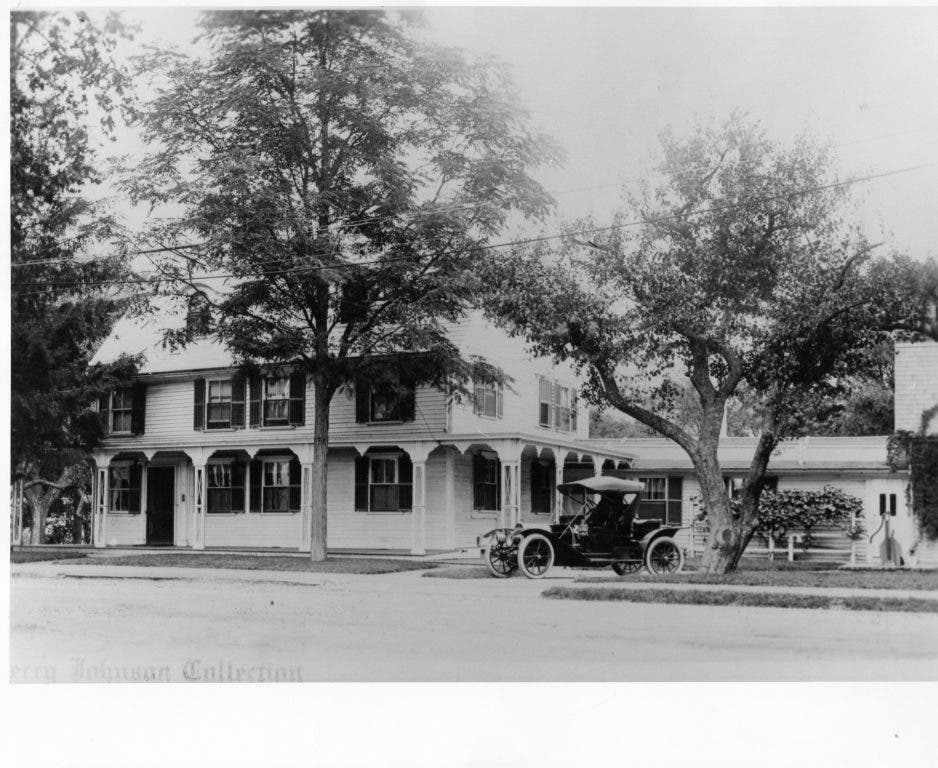


The house lot and surrounding property are the oldest in town, as it was that of Ralph Wheelock, the Founder of Medfield, who was given the honor of the first lot after Medfield broke away from Dedham and became the 43rd town of the then Massachusetts Bay Colony.
The area, running along Main Street from North Street down to about Upham Road, was all Wheelock land back in 1651, when Medfield was laid out and settled by those first 13 settlers from Dedham.
The historic house itself, now on 505 Main St., was built by William Plimpton about 1725, some seven years before the birth of George Washington. Plimpton, then a clothier by trade, had married Kezia Dwight that same year and the young couple moved into their newly built 505 Main St. house. Plimpton also received a grant from the town for the right to build a dam across Vine Brook for the purpose of building a fulling-mill, needed in the process of making clothes; a process of using water power in removing the dirt and oils left on the sheep’s wool after it was sheared.
Find out what's happening in Medfieldfor free with the latest updates from Patch.
The result of damming the brook to provide the mill’s water power also resulted in the creation of what is today Meetinghouse Pond, formerly known as Baker’s Pond. He and his wife, Kezia, raised eight children in the house, with several of them later moving to Sturbridge when that town was first settled.
The house and property was sold shortly after William Plimpton’s death in 1770 to John Green and he in turn sold the house and property to Dr. Timothy Sheppard from Sherborn. Dr. Sheppard sold the house in 1793 to Artemas Woodward. Across Main Street, Woodward built a barn. Here in the late 1820’s a lean-to was added that served as the site of the town’s first fire station. With that first engine came the first engine company. This would begin the date of the start of the .
Find out what's happening in Medfieldfor free with the latest updates from Patch.
The property next went to John Wickliffe Adams. Here Adams started a brush making business. The house remained in the Adams family from 1842-1888. John’s brush manufacturing business took off and he soon moved the business into Boston where he became the top brush manufacturer in New England. He continued to use the 505 Main St. house as his summer home.
Expanding his business still further into New York City, Adams became quite wealthy but never lost his love for his native Medfield. Leaving the 505 Main St. house to his father, Adams bought the Lowell Mason house on North Street, divided the house into sections with the part where Lowell Mason was born, moved to 25 Adams St. Adams then built a substantial mansion on the original Lowell Mason site.
In 1888, the house was sold to Mary Sewell, the daughter of famed Medfield minister Rev. Charles Sewell. In 1892, Mary sold the house to Dr. Arthur Mitchell, who arrived in Medfield after studying a year at Dartmouth and four years at the then Boston University Medical School. At the age of 23, Mitchell would become Medfield’s beloved doctor for the next 48 years until his death in 1934.
Wherever Dr. Mitchell went, along his side, was his dog, “Jack,” who had saved the doctor from drowning in a raging river. Dr. Mitchell, made his house calls, at first in his horse and buggy, with Jack always by his side. His coachman was Alexander Beckwith who, said Dr. Mitchell, “faced with me without complaint bitter cold and cruel stormy nights for so many winters.”
Beckwith was the father of William and Wesley Beckwith, who died during WWI and for whom the Medfield American Legion Post 110 is named. Local lore has it that Dr. Mitchell was the first one in Medfield to own an automobile, which he parked in the large barn that was attached to the house by an ell.
Dr. Mitchell died July 24, 1934.He was cremated in Boston and his ashes were interred in the Mitchell Cemetery of his hometown of Temple, Maine. In Dr. Mitchell’s will, he stipulated that “Jack” was to be buried beside him in the family plot. The inscription on Jack’s stone reads: “Jack, a faithful friend and companion of Arthur Mitchell. In sunshine and in storm alike he was ever on guard.”
A painting of Jack had been completed by famed local artist John A.S. Monks, on Dr. Mitchell’s request, and it hung in Dr. Mitchell’s 505 Main Street office. In Mitchell’s will, the painting was left to his housekeeper, Mrs. Mary C. Haskell. It was later donated to the Medfield Historical Society. Also donated was Jack’s dog collar, which can also be seen in the painting.
After Dr. Mitchell’s death, the house was rented out until August of 1940 when it was bought by Richard M. Clifton. The house was now in various states of disrepair. Clifton had the front and side porches removed and in 1947 installed the flagstones that are in front of the house today. In 1941 Clifton started a family jelly business in the house and barn.
The business was called “Cape Cod Kitchens.” With the outbreak of WWII, sugar was hard to come by and people were turning to jelly. In addition to jelly and jams, Clifton also manufactured cider. Beach plum jelly was the main product but many flavors of natural fruits were manufactured. The company logo was “Wild Fruits Have More Flavor.” He hired local Medfield youths to pick apples, berries and plums.
Transportation was via an old 1938 school bus with the seats removed. He sold the products all over New England. It was very much a family business with all five of the Clifton children working on the production line. At its high point he was also employing about 15 people. By 1950, Clifton was the largest producer of beach plum jam in the world. The business lasted until 1954; when production began to slow due to severe price competition, price fixing and a legal fight with Ocean Spray.
Clifton's brother Theodore, later won a monopoly charge against Ocean Spray and was awarded $500,000 in damages. Moving from the Jelly business, Clifton then opened up a Renault Dealership called “Clifton Motors,” located in the barn next to the house. It was the first foreign car dealership in Medfield. However, the business did not last long since no repair work was done on site.
The grounds of 505 Main St. under the Clifton’s became quite beautiful, thanks mainly to Clifton’s wife, Marion. The house was surrounded by maple and horse chestnut trees. In front of the house was a green picket fence that extended from Main Street right down Upham Road.
A seven-foot high lilac hedge also followed down Upham Road, giving them a great deal of privacy. Behind the current Mitchell Construction Office was a 100 year-old spruce tree, a stately Norwegian spruce and a row of five very tall white pines. The backyard was beautifully terraced and contained a large fieldstone-lined gold fish pool filled with over 200 beautiful fish of all sizes. Rose bushes and other flowers dotted the grounds.
The Clifton’s sold the property in 1955 and the house and grounds took a condition for the worse. The house was converted into apartments and in 1960 the Snow White Coin Laundry occupied the barn. The grounds fell into disrepair and the goldfish died. The entire backyard was filled in with large boulders and gravel to form the present asphalt parking lot. A fire in October of 1972 destroyed the barn and the ell but the house survived untouched. The current two-story stucco-type office building was then constructed by Mr. Gross on the site of the barn.
Today the historic 505 Main St. landmark is owned by Tom and Mary Mitchell of Mitchell Construction Company and it is the site of Medfield’s newest store, “Butterfly Tree.”