Community Corner
Meet the Candidates for School Committee - Part 3
This is Part 3 of a 5 Part Series, giving the voters in Medfield an opportunity to learn about the candidates running for 2 seats on the SC.


Meet the School Committee Candidates (Part 3)
This is Part 3 of a 5 Part Series, giving the voters in Medfield an opportunity to learn about the School Committee candidates.
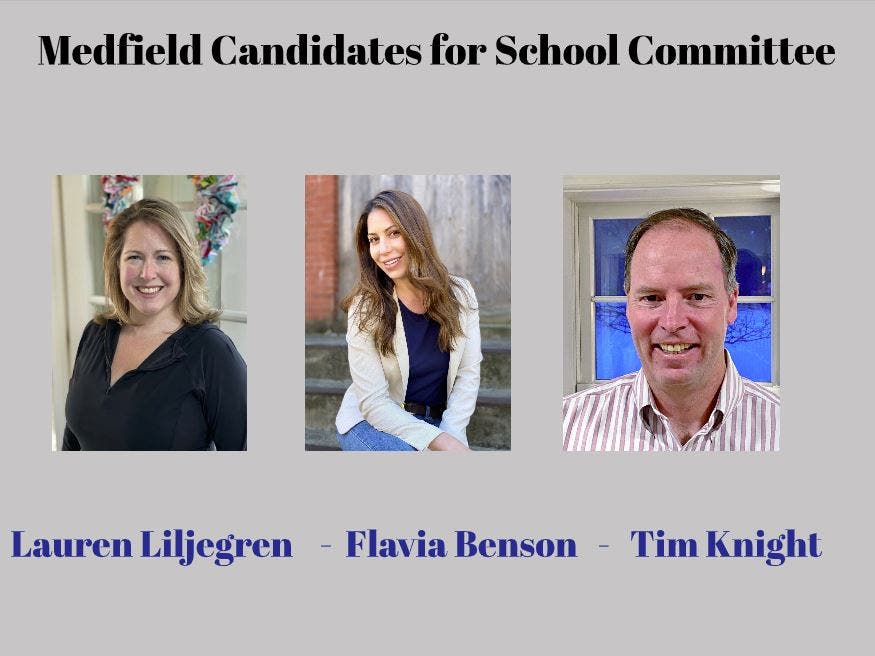
The School Committee Candidates Flavia Benson, Tim Knight (incumbent), and Lauren Liljegren have answered Part 3 questions below:
PLEASE NOTE: Question Number 1 was kindly prepared by the Medfield Environment Action Committee MEA as it relates to all boards and committees in Medfield .
Find out what's happening in Medfieldfor free with the latest updates from Patch.
1. In May 2021 the Town of Medfield voted to encourage all boards and committees to support a net zero 2050 goal for Medfield. How do you envision Medfield Public Schools will support this goal and the implementation of the TOMCAP (Town of Medfield Climate Action Plan) in curriculum (education), operations and facilities?
Lauren Liljegren: The Medfield Energy Committee identified the highest priority areas as passenger cars and residential homes, the sources of most emissions. Municipal buildings were identified as responsible for 3% of emissions. Our school district can have the greatest impact in educating and bringing awareness to students, staff and families of the TOMCAP objectives. Curriculum, always within the state frameworks, should include environmental awareness and teach the practical skills needed to be a good steward of our planet.
As we repair and replace our infrastructure, renewable energy sources should be chosen. Our new school should be constructed to a net zero energy standard. As we move to electrify town vehicles, we should pursue opportunities to electrify school transportation as well. As a member of your school committee, I will advocate we pursue creative funding sources and grants. Our new school’s location should be walkable/bikeable for the largest number of students, to reduce single occupancy transportation.
Find out what's happening in Medfieldfor free with the latest updates from Patch.
In addition to the stated action plan, our schools are uniquely positioned to create a culture of sensible, frugal habits to support the environment. Supervised “Green” locker/sporting equipment clean outs, programs to encourage and reward students for walking or biking to school, reusable event supplies for school or community sponsored events and “Sharing” tables to reduce food waste are some of the practices our neighboring communities have adopted. A culture of swapping, donating and “up-cycling” leads to creativity and self-reliance. Good for the environment and good for us!
Finally, the School Committee is responsible for the documented policies of the district. Our community has identified the TOMCAP objectives as a priority and the policies for our district should reflect them.
Flavia Benson: I’ve had the pleasure of working with built environments and LEED buildings to address carbon reduction and whole building health in the past few years. To reach a Net Zero Energy (NZE) goal there must be community involvement, and school engagement is paramount. We have an incredible opportunity within the schools to make changes in curriculum, operations and facilities that gets us closer to that goal.
I support educational programs that allow students to address the environmental impact within their own community. Through hands on programs students can monitor what is going on around their own environments and design projects that address sustainability. Collaborative and experiential learning provides invaluable learning tools and teaches students how to navigate through the challenges of implementing programs/projects, now, and, in the future.
In the U.S., more than 7 billion school meals are served each year. This is an area where students of all ages could devise plans addressing sustainability of their school meals. This can include sourcing food from sustainable networks (and school gardens) to disposal by composting.
Within operations and facilities there are immediate opportunities for sustainable changes. For example, addressing food waste, improving sustainable waste prevention and management, reduction in paper use, purchasing sustainable products (including cleaning and disinfecting products that are safer for the environment and not detrimentally affecting staff and students exposed), and review of HVAC systems and air quality. As we investigate building and designing a new school, we should include the goal of NZE in design – balancing sustainability, educational goals, and cost effectiveness.
Tim Knight (incumbent): The schools must take a leadership role supporting Net-Zero 2050. Before addressing curriculum, facilities, and operations, there are some themes that encompass all areas:
- We can embed Net-Zero into the culture of the schools through strategic planning, professional development, policy, budget, and educational events.
- Collaboration across student clubs, formal organizations supporting the schools, and local partners such as Sustainable Medfield, MEC, and MEA, with a goal of awareness and education.
- Drive accountability at the leadership level, with metrics to ensure goals are met, and exploration of a sustainability task force.
As our curriculum evolves, we must balance adherence to DESE standards with opportunities to incorporate sustainability where appropriate. We should incorporate age-appropriate activities across all subjects, and leverage our platform to drive awareness across the community.
With regard to facilities, we have completed LED installation at all schools and automated controls at Blake and the High School. We are exploring projects such as the installation of charging stations & solar canopies in the parking lots while assessing our heating and cooling systems so that we can maximize efficiencies, electrify, and incorporate renewable energy sources when possible. As we push for a new school, NetZero must remain a priority.
Relative to emissions, we must explore cleaner options for our school bus vendors, and encourage habits that reinforce low carbon alternatives through improved bike racks, safety measures to support our walkers/bikers, and ride-sharing options.
Finally, we must always consider the potential impact, community values, and evolving town-wide plan as part of all decisions.
2. Of all the candidates, why should YOU be elected to the Medfield School Committee?
Lauren Liljegren: I have spent a great deal of time the last two years becoming familiar with the role of a School Committee, Medfield’s polices and spending compared with those of similar districts, and the governing and oversight bodies to which our district is accountable. I am well versed in open meeting law and able to help our district avoid future violations. I’m ready for this work.
I believe in our schools and my actions as a member of our School Committee will affect my family directly. Unlike the incumbent, I have a child attending school in our district. My professional background is in employee benefits, analysis and project management. I will never vote to ratify a contract that is not in the best interest of students, parents and our taxpayers.
I am committed to transparency. For example, the task force formed for diversity, equity and inclusion (DEI) is not an official subcommittee of our school committee. Meetings are closed to the public, open meeting law does not apply and the ultimate recommendations made by the task force will not be publicly presented to the school committee. Other critical projects, such as the social-emotional learning task force, have also been set up in this way. Important projects should exist under in the public domain, with the oversight of the School Committee. These are issues I will raise during public meetings.
School Committee is made up of five voting members. I am the right person because I am committed to raising questions and encouraging constructive and effective dialogue. Consistent unanimity on the School Committee has proven ineffective and expensive for our district. In a recent special election, 51.8% of our town voted against a proposed school plan, yet 100% of our elected School Committee voted for it. Our community deserves to be represented by a diverse school committee, to ensure all our interests are represented. It’s time for a change.
Flavia Benson: I am a working mom of three children who attend Medfield Schools. We’ve faced unprecedented challenges in our district since 2020. I believe we’ve shined in some instances, but I also believe that we’ve failed epically in others. It was evident that community engagement and transparency was lacking during this time.
Elected School Committees have a responsibility to bring community together. I stated in last week’s Meet the Candidates that “actively listening is an essential part of understanding differing viewpoints” and achieving cohesiveness. In the past couple of years, residents do not feel that they have transparency or a voice in the process. I want Medfield residents to engage, have a voice, and to never feel as if their concerns are being dismissed. Most importantly, however, I want to ensure that the priorities of the larger community match those of the School Committee. As an example, my priority, and those of other Medfield residents, is to address the academic fallout of pandemic.
New studies show that about 1/3 of children in the 1st-3rd grades are not hitting reading benchmarks. In the Boston areas, students identified with reading problem doubled since the pandemic. Unsurprisingly, those students not fluent in English or having disabilities have fallen behind even more. We have a responsibility to address these issues within our district.
Our priority must be to boost literacy and provide a learning environment for kids to gain the skills that they need to succeed within the full curriculum. These efforts should also include providing professional development for teachers. If elected, I will prioritize community engagement and addressing the educational delays caused by pandemic measures.
Tim Knight (incumbent): I think it is important to consider the following as you evaluate candidates:
- Why is the candidate running?
- Do they have the leadership, character, and experience needed to drive change & continuous improvement?
- What are their priorities?
I will try to provide a brief summary to address these questions and will schedule meet & greet session(s) for follow-up before the election.
Volunteering to support K-12 and local youth has always been a passion of mine based on the example my parents set. I had the opportunity to volunteer as a tutor and coach while in my 20’s, and worked extensively on K-12 related projects professionally before becoming active with the Medfield Schools. I am motivated to continue to serve on School Committee because I love working with the schools and think I can drive positive change for our students.
Relative to experience, I have a long track record of professional success based on establishing trust, exceeding expectations, and bringing teams together. In Medfield, I have been a coach for the last 15 years, and while there have been more losses than wins, I have always focused on modeling positive values as a priority. As an SEL Task Force & School Committee member, I have successfully managed difficult union contracts, Covid related operational changes, policy, social/emotional challenges, and constant change.
I am committed to respectfully working with the community to deliver a world-class educational experience for all students, and ensure our district is a source of pride for the Medfield community.