Community Corner
The October Significance – Inside St. Edwards
The chronology of the Catholic faith in Medfield and St. Edward Catholic Church.


Today in Medfield, over 6,000 residents list their religion as “Catholic.”
It is by far the largest single religious denomination in town. The history of the Catholic Church in Medfield had a much humbler beginning, however, and the month of October has played an important role in the history of the Medfield church.
Before the dedication of St. Edward Catholic Church in 1893, Catholics living in Medfield held Mass in various homes and halls in town. The very first Catholic Mass in Medfield took place in 1854 when James Griffin, who was then living in the Peak House on Main Street, invited the 20 Medfield Catholics to a Mass in his house. Father O’Beirne of Tommy’s Rock Parish in Roxbury came out and said the Mass.
Find out what's happening in Medfieldfor free with the latest updates from Patch.
From that point until the building of St. Edward on Main Street, across from Town Hall, which started with the groundbreaking in 1892, Masses were said in the Clark Tavern (353-355 Main St., next to the Peak House), Frost’s Block (16-20 North St. – above what is now ), Chenery Hall () and private homes at both ends of town, including for an extended period John Sullivan’s on Pleasant Street (41 Pleasant St.).
Soon, Medfield Catholics were put under the jurisdiction of parishes first in Dedham and then in South Natick.
Find out what's happening in Medfieldfor free with the latest updates from Patch.
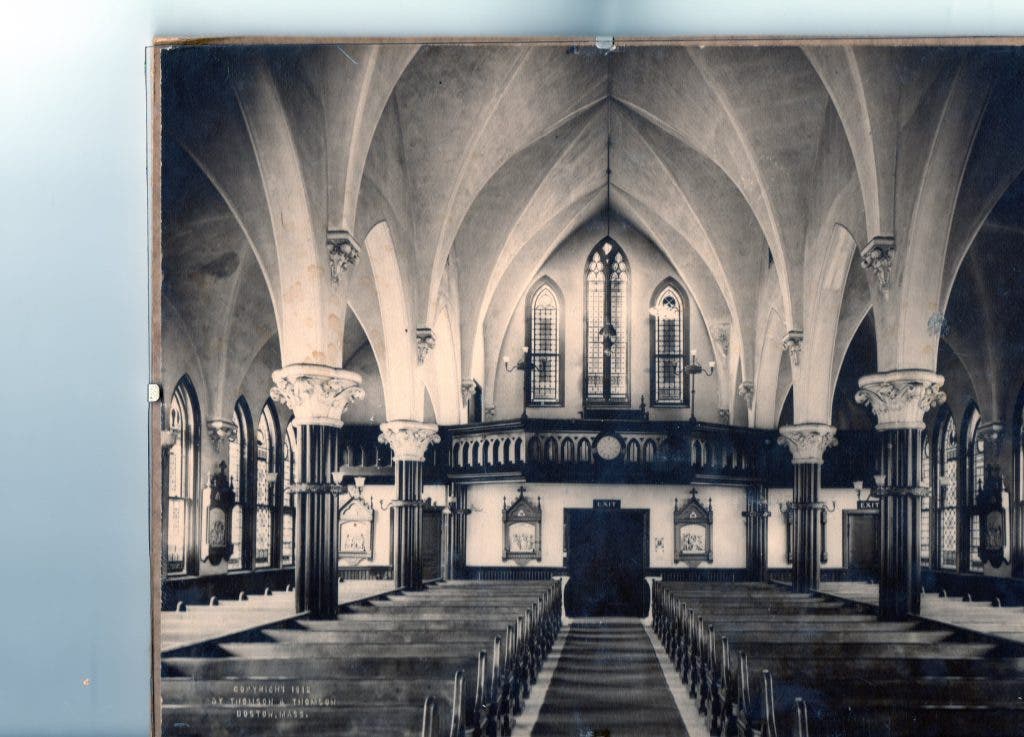
It was the pastor of Sacred Heart in South Natick that helped to make it possible for St. Edward Church to be constructed on Main Street in Medfield. Ground was broken for the Church and the cornerstone was ceremoniously laid on Oct. 23, 1892. A box inside the cornerstone contained coins, copies of the local papers, and the names of the president of the United States, the governor of Massachusetts, the pope in Rome, the pastor of the church (Rev. John A. Donnelly, also pastor of Sacred Heart in South Natick), the architect and builder, as well as the Medfield Board of Selectmen. The Church was dedicated on Oct. 15, 1893.
The gothic style wooden church had a seating capacity of 350, including a balcony above the vestibule. The altar was separated from the body of the church by a massive oak railing. Above the altar were three stained glass windows with St. Edward the Confessor in the center. The nave contained 30 stained glass windows arranged in groups of three, which were gifts of members of the parish. Upon its completion, the local press called it the “handsomest church in town.”
In December of 1900, the 1,300 pound bell was hung in the tower of the church. The bell was dedicated on Dec. 22, 1900 and rang for the first time on Christmas morning. The inscription on the bell reads: "Dedicated to St. Catherine, presented to St. Edward's Church, Medfield, Rev. John A. Donnelly Pastor, A.D. 1900, by a friend. Gloria in Excelsis Deo." This is the same bell that exists in the .
St. Edward Church was initially considered a mission church. On Feb. 10, 1901 Rev. Daniel H. Riley, pastor of Blessed Sacrament Parish in Walpole, was appointed as the first pastor of St. Edward Church. The first resident pastor of St. Edward Church was Rev. Hugh Malachi Smith. He was pastor from 1903 to 1923 and was extremely popular and active in town affairs.
Within 10 years of the arrival of Rev. Smith, it was necessary to increase from one to two services each Sunday. During the time that Rev. Smith was pastor, sacred concerts to benefit the parish were given under the direction of Prof. Charles Martin Loeffler, the distinguished composer and concert-master violinist with the Boston Symphony Orchestra. These concerts were attended by the social ”who’s who” of Boston.
In 1923, Rev. John McCool became pastor. It was Fr. McCool that had the interior of the church decorated and the confessionals built. He also raffled off the old wooden rectory (currently at 42 Green St.) and had a beautiful new brick rectory built. The brick rectory later became part of the Medfield Town Library, before it was torn down to make way for the .
Over the next several decades, the parish continued to grow. The exterior of the church was refinished and St. Edward hall was built in the lower level of the church. In 1940, Rev. Francis Shea became pastor. He erected a statue in honor of St. Joseph which was placed in the rear yard of the church. It has since been relocated to the front of the rectory on Spring Street. He also erected a grotto to Our Lady of Lourdes in memory of the boys serving in World War II, which now stands in front of the new church.
By 1944, there were three Sunday Masses. During the 1960's, there was a large increase in the town's population, which led to another increase in the number of Masses being said each weekend. By the end of the 1970's there were two Saturday Masses and eight Masses on Sundays at 7:30, 8:30, 9:30 (upper and lower church), 10:30 (upper and lower church), and 12:30 (upper and lower church).
The Dominicans from St. Stephen Priory in Dover assisted in the celebration of the Masses. Under Pastor Rev. Lawrence M. Ryan, Curate Rev. John Mark Hannon, began an active C.Y.O. program for the youth of the parish and eventually CYO baseball and basketball teams were formed. Fr. Hannon also began the first Folk Masses, which were also popular with the church’s youth.
Following Fr. Hannon's departure from St. Edward Parish, Rev. Gerald McGann was assigned to the parish. Fr. McGann began a building fund for the parish since it had become apparent the existing church structure was becoming overcrowded.
Upon the death of Fr. Ryan in 1978, a Team Ministry was assigned. Rev. Philip J. DesRosier and Rev. Charles P. Weber were appointed to St. Edward Parish. During this time the Archdiocese purchased property on Spring Street and began plans to develop a new St. Edward Church.
The transition was not an easy one for the parish and conflicts occurred, resulting in many leaving the parish for neighboring churches. On Oct. 13,1980 (the feast of St. Edward the Confessor), the dedication of the new church took place. The Town of Medfield voted to purchase the old church and rectory on Main Street for future library expansion. On Oct. 15, 1985, ironically on the anniversary date of the church’s dedication, the old church was torn down and the rectory was incorporated into the public library expansion project.
The bell and cornerstone were transferred to the new church. On Nov. 11, 1989, the dedication of the new parish center and gymnasium occurred. The original cross from the steeple of the old church had been stored in the basement of the Town Hall. When reconstruction began on the Town Hall, a number of parishioners donated the funds to have the cross brought to its current location on the knoll alongside the new church.
Today, St. Edward Parish is under the leadership Fr. Leroy E. Owens, who joined the parish as pastor in 1996. Rev. Owens has been active in the Medfield community, especially with our veterans during Memorial Day and Veterans’ Day events and can be seen as a regular customer at lunch counter.
Recent improvements to the church have included the planting of a number of donated maple trees in front of the church, landscaping, the complete re-shingling of the church and rectory and interior improvements, especially to the altar area of the church.
Today, the church includes a vibrant religious education program, an active music ministry and a growing youth ministry. In addition to the hundreds of parishioner volunteers who assist in numerous ministries, Deacon Fred Horgan and Rev. Dennis Yesalonia, S.J. assists Fr. Owens, especially with the five weekend Masses.