"Anger in many ways is a feast...The chief drawback is that what you are wolfing down is yourself. The skeleton at the feast is you." - Frederick Buechner
"The highest patriotism is not a blind acceptance of official policy, but a love of one's country deep enough to call her to a higher plain." - George McGovern
Find out what's happening in Melrosefor free with the latest updates from Patch.
Shark Week notwithstanding, we are over ten times more likely to be killed by lightning strikes than by sharks in the United States. Debaters use sound bites and talking points to incite passion, not critical thought. Honesty matters. Facts matter. Understanding proportion matters. Consistency matters. How our children learn to think matters...a lot.
Find out what's happening in Melrosefor free with the latest updates from Patch.
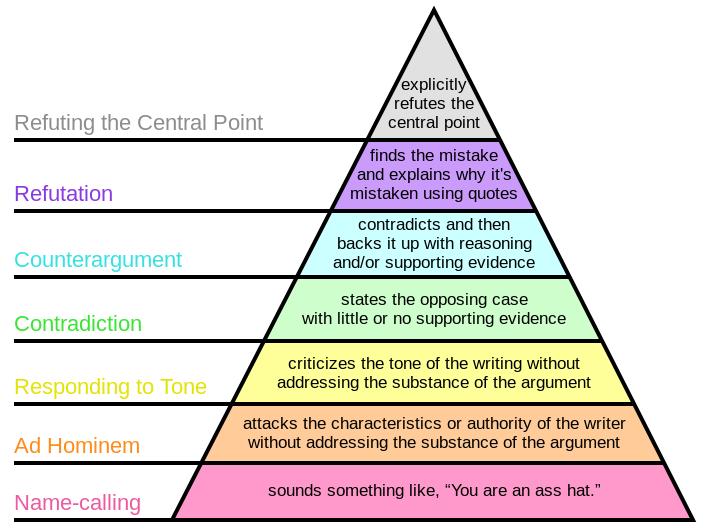
Paul Graham's Hierarchy of Disagreement gives us a tool to calibrate the strength of an argument. Near the bottom are name-calling and Ad Hominem attacks. "_______" is a communist/Marxist/progressive/conservative twit. At the top are counter-arguments, factual corrections, and especially refutations of the core argument.
Critical thinking uses clarity, accuracy, precision, logic, breadth, depth, point-of-view, alternatives, and fairness. What constitutes critical thinking seldom comprises good politics. Unfortunately, good politics and good policy intersect less and less. Democracy suffers at argument's hand.
On a lighter side, consider the statement from the Sunday paper "arguably the Red Sox are the best team in baseball." They have the fourth best record in baseball, the fourth best run differential, have scored the most runs, and are sixteenth in earned run average. In the American League since the all-star break, the Sox are third in runs scored, tied for third in wins, and sixth in earned run average. Although the Red Sox may have our undivided loyalty, the facts (arguably) yield championship possibilities but not probability.
Politics stretches our vanities even more. The platitude that "politics stops at the water's edge" gets trampled by whomever, whenever we find it convenient. Every administration suffers foreign policy embarrassment. Camelot fanciers forget the Bay of Pigs and military "advisers" in Vietnam. Reaganites dismiss state and defense department infighting and Iran-Contra. Nobody negotiates durable Middle East peace. "An 'eye for an eye' and pretty soon the whole world is blind."
Humor reflects contemporary irony. A "compassionate conservative" favors capital punishment with a soft mattress. A conservative is a liberal who was mugged yesterday. Democratic strategist James Carville extolled GOP barbecues. "The food was a lot better." We simply find it easier to apply labels, biases, and heuristics than to parse "the facts". It's too much intellectual work.
Sometimes we dispute the facts. Is global warming a trend or an exaggeration of cyclical swings? The core problem recalls the six-foot tall man who drowned in a river with an average depth of five feet. Swings around the mean can kill you...even when you are right.
But arguments don't exist in a vacuum. We present our arguments to effect or to nullify change. We humans act unpredictably well and badly. We are charitable and selfish. But outstanding leaders are recognized because they find solutions not problems. Maybe that's why we have so few. Hunger and poverty aren't media creations. Blaming the poor for unemployment isn't an answer. Neither is eliminating the minimum wage. Denying women equal pay and other rights isn't "justice for all." All citizens need affordable healthcare. If everyone tightens their belts (austerity), their economy collapses. Sometimes we just choose not to find solutions because we can't stomach the pain.
Analyzing the validity of an argument doesn't discredit it...it encourages writers to raise the level of the discourse, to double check facts, and maybe even consider the structure, fairness, and consequences of their position. As Paul Graham writes, "Most people don't really enjoy being mean; they do it because they can't help it."