Arts & Entertainment
Needham Natives Selected for Top High School Jazz Competition
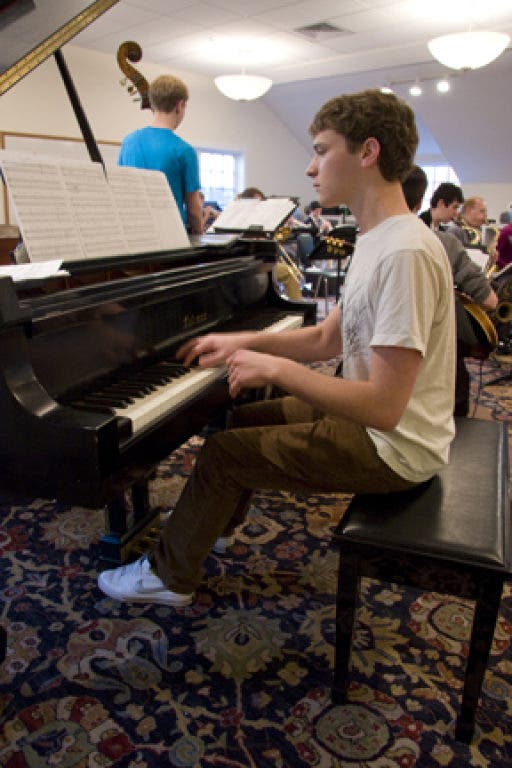
Needham residents, and Rivers School students, Aaron Behr and Colin Beagan will be competing in the Charles Mingus High School Competition and Festival.

On the weekend of February 18th, jazz educators, musicians and enthusiasts will converge on the Manhattan School of Music in New York for the third annual Charles Mingus High School Competition and Festival, where top student groups from around the country go head-to-head performing works by the eponymous jazz legend.
For the third year in a row, the jazz program at the Rivers School in Weston has earned a place on the competitive stage, thanks in part to the talents of two Needham natives.
Seniors Aaron Behr, piano, and Colin Beagan, guitar, are members of the Rivers Select IA Jazz Combo, one of the three finalists in the combo category. This will be Beagan’s second year in the competition, and Behr’s third.
Find out what's happening in Needhamfor free with the latest updates from Patch.
“It’s definitely an honor,” said Beagan, noting that during the event last year, they had the chance to interact with a number of professional musicians. “It’s nerve-wracking, but a lot of fun.”
Rivers jazz program director Philippe Crettien said Beagan and Behr are exceptional students, both playing at an advanced level. But beyond just their playing ability, he said the competition will showcase their aptitude for arranging. Meaning adapting a piece of music to be played with instruments other than those it was written for.
Find out what's happening in Needhamfor free with the latest updates from Patch.
In order to qualify for the competition, high school big bands or combos must arrange three Charles Mingus scores, and then submit a CD of their performances to the competition judges for screening. The students selected Mingus’s “Self Portrait in Three Colors”, “So Long Eric”, and “O.P.”, which are available to download on the Rivers website.
“The kids were responsible for thinking about it, being creative, and taking the lead,” said Crettien.
Behr said the musical scores they chose were just the starting point. For example, he and bassist Elliot Berman re-harmonized the entire melody for one of the pieces.
On top of creativity, the process can require some logistical problem solving. Beagan described Mingus’s pieces as “extremely complex” with “a lot of things going on.” As Behr explained, this means they are particularly well suited for a big band, which can have around 20 musicians.
For a combo, he said, “It’s more difficult to reach that level of intensity because you have fewer players.”
And this year, the Rivers combo had an added challenge: the group features piano, guitar, bass and drums, but no horns.
“With no sax or trumpets, we had to figure out how to do the parts with what we had,” said Beagan. “So we record ourselves, see how it sounds, and try to stay close to the original while being creative.”
Behr also emphasized the importance of experimentation. “We’ve had to adapt, because there are definitely things we can’t play. So the arranging has been more important this year. You have to be innovative or else people will say, ‘There are no horns in this band. What are they doing?’”
The size of a combo means at least one advantage over a big band: consensus. “We disagree on some things, but it hasn’t been hard to work together,” said Beagan. “As a group, we make decisions based on our strengths musically.”
In addition to the competition, which takes place on Sunday, Feb. 20, the weekend of festivities includes lectures, workshops and performances by professional Mingus bands.
“It’s a very special thing for the students to connect with the people who play this music,” said Crettien. During the weekend clinics, he said, “The musicians will become coaches.”
For many, Charles Mingus is viewed as one of the most important figures in American music, let alone jazz. He was a skilled bassist and pianist, an innovative bandleader, and a prolific composer.
Living in New York in the 1950s, he recorded with other jazz giants like Charlie Parker, Miles Davis, and Duke Ellington. He started his own recording and publishing companies, as well as the “Jazz Workshop” to provide opportunities for young composers to record their work.
Although Charles Mingus died in 1979, his widow Sue Mingus has spearheaded initiatives like the high school competition as a tribute to his passion for music, and his dedication to promoting young talent.
“His music is an amazing vehicle for students to learn jazz and to learn to express themselves,” said Crettien.
For Beagan, it has also been influential. He has applied to the Manhattan School of Music to study jazz next fall.
Behr has been accepted to Brown University, where he plans to study engineering, but he said he hopes to find opportunities on campus to continue playing piano.
For now, they both get more than enough playing time during the combo’s four weekly meetings.
“The students have been preparing like crazy,” said Crettien. “They are totally living the music. That’s the best thing you can see as a teacher.”