Politics & Government
Residents Speak Out Against Stricter Building Code
Builders, homeowners worry adopting the Stretch Energy Code would be costly and potentially create "sick" homes.




Several residents and builders are not sold on the idea of in Needham—worried about building delays, hidden costs and the possibility of creating “sick homes” by making them too air-tight.
The Board of Selectmen held a public hearing on the matter Tuesday evening, inviting people to ask questions and share their thoughts about the code adoption—one of five steps required to make Needham a Massachusetts Green Community.
The Green Communities Study Committee has recommended that selectmen support the measure and place it on the Nov. 7 special Town Meeting warrant. Selectmen did not decide the issue Tuesday but agreed just to listen to citizens and to take action at a future meeting.
Find out what's happening in Needhamfor free with the latest updates from Patch.
If approved, the Stretch Energy Code would require residential and commercial builders in Needham to meet stricter energy efficiency guidelines with new construction and major renovations.
However, as Selectman Jerry Wasserman pointed out on Tuesday, the Stretch Energy Code was approved at a time when the state's base energy code was an older model, the 2006 version. Today, builders must meet stricter standards set in the 2009 code that are not that far off from what is required by the Stretch Energy Code. And a new base code is expected to be released in 2012—one reason several builders said Tuesday that Needham should wait to adopt the stretch code.
Find out what's happening in Needhamfor free with the latest updates from Patch.
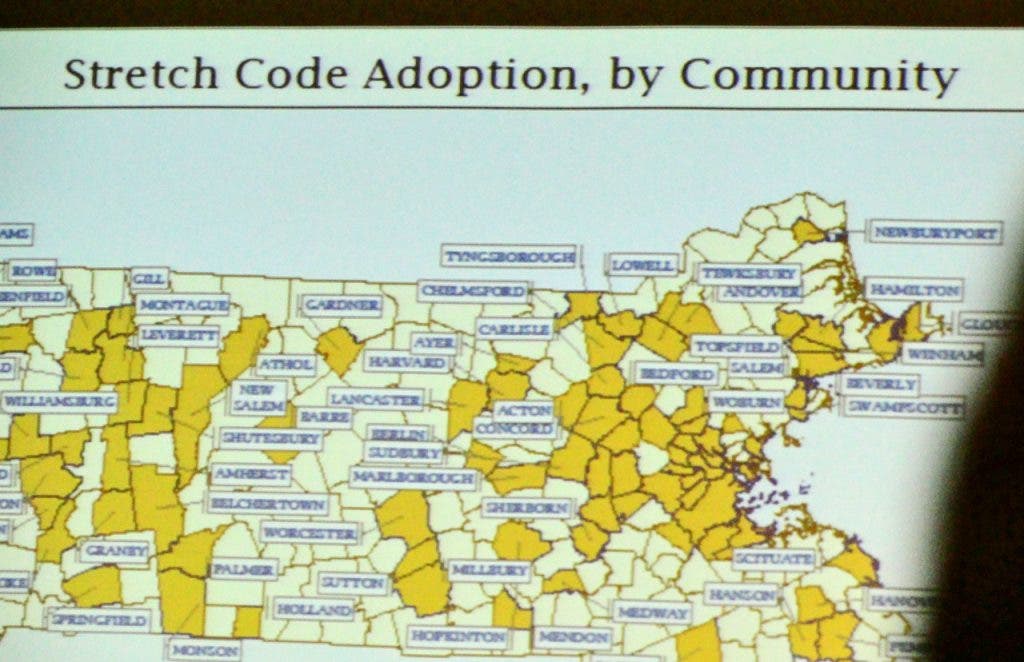
Ninety-seven communities in Massachusetts have adopted the code, including all of the towns surrounding Needham, Wasserman said.
A member of the study committee, Wasserman began the public hearing by listing some of the possible benefits and challenges of adopting the code.
“It reduces energy consumption both in town-owned buildings and for homeowners,” he said, sharing an estimate that homeowners could see their initial investment in energy-saving measures paid back in lowered energy bills in six to eight years.
“Obviously, it reduces greenhouse gas emissions, and if you’re somebody who believes that we are experiencing climate change right now, that’s important,” Wasserman added.
Other pros he mentioned: It would help reduce reliance on fossil fuels; it could help ensure homeowners get a “better quality project” overall; and having a HERS rater involved in the project—someone who can test and confirm a home meets the Stretch Energy Code—could help relieve the workload of the town’s Building Department.
As a Massachusetts Green Community, Needham would be eligible to receive grant funding for energy efficiency projects—possibly between $150,000 and $200,000.
But Wasserman also shared some challenges.
“The building inspectors we’ve talked to and others have said that there was a lot of uneasiness when they started out among some of the developers that has been helped by educating them as to what to expect, how the town is going to enforce it,” Wasserman said.
The stricter rules also could require more work from building inspectors, increase construction costs by about 2-4 percent and cause minimal delays in the permitting process, Wasserman said.
Eaton Road resident Gary Kaufman kicked off the public portion of the hearing, saying, “Green is good. There’s nothing wrong with green. But I think the key thing everyone’s not talking about is choice.”
Kaufman worried about “inevitable legal challenges and costs” as residents or developers fight the building inspectors’ “interpretations” of the Stretch Energy Code, people not bothering to pull permits because they didn’t want to face the extra costs and “more depressed homes” because people chose not to renovate.
John O’Leary of Edwardel Road said he and his wife had been saving up to build a new home but the adoption of the Stretch Energy Code could undermine those plans.
“We’re hoping to be able to build our dream house here,” O’Leary said. “[The Stretch Energy Code] is going to limit our choice of architect, it’s going to limit our choice of materials and it’s going to significantly raise our costs. […] It’s putting a huge burden on me and my family.”
O’Leary said he felt the costs would fall disproportionately on residents living in smaller, older homes who were looking to renovate or rebuild and that the perceived benefits of adopting a stricter energy code were not worth the hassle.
“Is OPEC really worried about us passing the stretch code? Are we really going to move the needle on our reliance on foreign energy?” he asked.
Several people questioned whether stricter requirements designed to keep heat and a/c from escaping would result in “tighter” homes that might trap odors and potentially dangerous gases or force builders to install air exchangers at an extra cost to the homeowners.
“It’s my opinion that this is going to create a lot of sick homes,” said Bruce Ricciardelli, a Webster Street resident.
Greg Krantz, of ICF International, who was hired by the state to attend the hearing and answer questions about the Stretch Energy Code, said the code did not actually require homes to be any tighter than they must be under the 2009 base code.
Though much of Tuesday’s discussion focused on concerns, several residents were in favor of the move.
Clayton Schuller, a Melrose Avenue resident who works for a company that pushes for more energy-efficient homes, said he didn’t think the code would limit homeowners’ choices but would encourage them to make better choices.
“I’d be proud to have Needham as a stretch code town,” he said.
Greendale Avenue resident Eleanor Rosellini also supported the adoption, saying many of the code’s requirements were “inevitable”—likely to be included in the 2012 base code anyway.
Rosellini did ask whether the town could opt out of the Stretch Energy Code in the future if it became more stringent.
Wasserman said the committee had been trying to get that issue clarified but that, ultimately, Town Meeting could vote to go back to the base code if they were not comfortable with changes to the stretch code.
Selectmen will continue the discussion at their next meeting, which is scheduled for Tuesday, Oct. 11 in the ’s Community Room. Both October meetings will be held at the library while town offices are in transition as employees move back to the .
Get more local news delivered straight to your inbox. Sign up for free Patch newsletters and alerts.