Business & Tech
Stressed Out? There's an App for That
Needham resident Mike Zhang's Stress Tracker app aims to help people manage their busy lives.


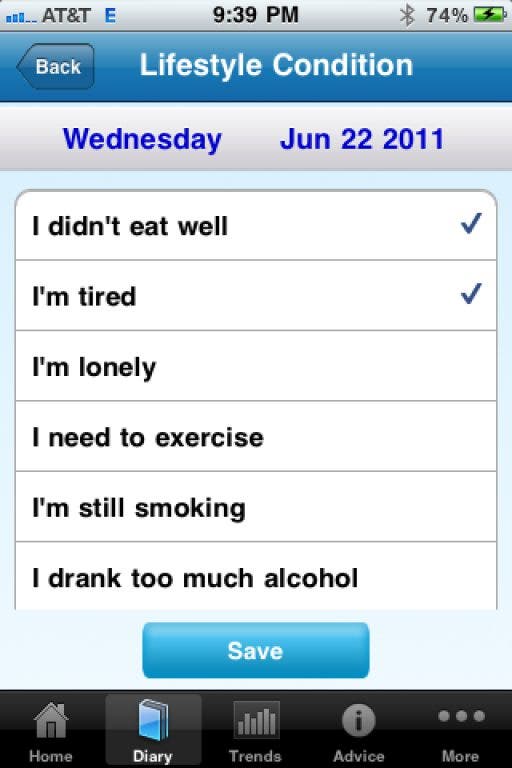


With technology making it even more difficult these days to escape all of life’s demands—now arriving via text, e-mail, phone call, Tweet or Facebook post—a cell phone may be the last place a person would think to turn when stressed out.
Mike Zhang hopes to change that.
The Needham resident and CEO of AboveStress Inc. recently introduced a new iPhone application that helps people identify, track and manage stress in their lives. Stress Tracker, now available for $5.99 from Apple’s App Store, allows its members to document sources of stress at any point in the day with just a few taps. The information is linked to a person’s account on AboveStress.com and can be viewed in chart form over the course of a day, week or months to help people gain insight into what exactly is stressing them out—and how to deal with it.
Find out what's happening in Needhamfor free with the latest updates from Patch.
“Most people think reducing stress is something they’ll do when they get time to do it, and you never get time,” Zhang said. “We thought one of the most effective tools we could offer is something that is integrated with a mobile phone and helps people become aware of things related to stress—to document their stress levels throughout the day, the source of the stress and symptoms of stress they experience.”
The former CEO of diet.com, Zhang said he decided to start AboveStress Inc. because he felt there was a lack of support and information about stress—though it can be as important to a person’s overall health as nutrition and exercise.
Find out what's happening in Needhamfor free with the latest updates from Patch.
“There are a lot of fitness and diet companies out there, but when it comes to stress, people are a bit lost about how to deal with it because stress is so personal,” Zhang said.
He launched AboveStress Inc. in September 2010.
The iPhone app, the company’s first major venture, was designed with the help of health professionals such as Zhang’s business partner, Dr. Lyle Miller, a stress management expert and a founding member of the Biobehavioral Institute of Boston.
“This is made by psychologists, so it’s based on the psychometric instrument, what means that it includes statistically significant items [symptoms and other stress-level data] versus just random thoughts,” Zhang said.
The device works like this: A user logs in ideally at least once a day and follows a series of prompts to document his or her stress level, symptoms and various conditions. With a swipe of the finger, a user can pinpoint his or her stress level on a sliding scale of 1 (not-so-stressed) to 10 (extremely stressed out). The user than follows a series of screens, inputting things like source of stress, lifestyle conditions (such as “not eating well” or “feeling lonely”) and mood (expressed by selecting the most appropriate “smiley face” character).
The time and date are automatically noted, so the user can check back to see trends of stress in chart or list form over a period of time, learning more about their stress and related habits—such as whether Monday really is the most stressful day or why nothing seems to get done after 2:00 p.m.
The Stress Tracker also offers tips along the way based on stress-level prompts. Sometimes it can be as easy as taking a moment to “just breathe” or being prompted to “take a walk.” The app also has a separate advice section with additional help.
“It seems to be very simple things, but when people get really stressed out, they cannot even think straight, so we give them tips of what they should do,” Zhang said.
The Stress Tracker also can come in handy if stress turns into a serious health concern—which, for many, it can.
“According to a study by the American Academy of Family Physicians, 43 percent of all adults suffer adverse health effects related to stress,” Zhang said. “I have heard all kinds of stories about people who have had to go to the doctor’s because they are so stressed out.”
But when faced with a physician's questions of when and how exactly stress manifests, people often don’t have the answers, Zhang said.
That’s where the Stress Tracker can help.
“[Stress] affects your heart. It affects your immune system. It reduces productivity for organizations and reduces quality of life for individuals,” Zhang said. “We’re not really looking for people to get to zero, because you need to have a certain level of stress to get motivated, to get things done. But if your external demands or pressure exceed your own personal resources, that’s when a problem starts.”
By taking stress-tracking from pen and paper to a mobile app, Zhang and his partners have made it that much easier for people. But Zhang thinks they can make it even easier.
“We’re thinking about integrating it with a calendar, so you know exactly what events are at that time [when stress is documented]. We also want to integrate it with the location—are you at work, etc.,” Zhang said. “And we want to add other things related to stress—how to get personalized advice and suggestions right on the spot for your specific situation and providing a way for you to reach out to doctors.”
Just about 10 months in, Zhang said his business is still in the early stages.
“I think from the scale of 1 to 10, right now we’re like 1.0,” he said. “Our goal is to make this a gold standard in the industry and also for consumers to feel that there is a tool to help them reduce stress, because I don’t think there are many out there. People usually have to wait until they get to 9 or 10 [in their stress level], and then they think they have to get help. This can help you not get there.”
Get more local news delivered straight to your inbox. Sign up for free Patch newsletters and alerts.