Arts & Entertainment
My City, 'Tis of Thee: Newton's Ties to Patriotic Songwriters
Did you know that the writers of "America the Beautiful" and "My Country, 'Tis of Thee" both lived on Centre Street in Newton?


This Fourth of July, people around the United States will celebrate the birth of our nation. Fireworks, barbecues, and parades are all part of the national tradition, but so is song. Two major songs in our patriotic songbook, “America the Beautiful” and “My Country, ‘Tis of Thee”, have ties to Newton.
Katharine Lee Bates wrote the first draft of lyrics for “America the Beautiful” on a hiking trip in Colorado in the summer of 1893. Reaching the summit of Pike’s Peak, Bates was struck by the beauty of the landscape before her. Quickly, she jotted down the first draft of four stanzas of poetry that Americans still sing today.
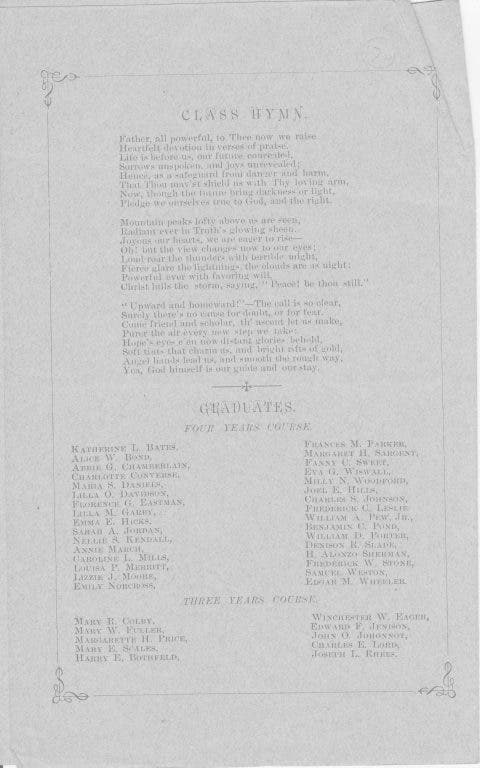
Bates was born in Falmouth, Massachusetts on August 12, 1859. Her father died when she was an infant, but her family continued on in Falmouth until moving to Wellesley when Katharine was twelve years old. Katharine went to school in Wellesley but ultimately graduated from Newton High School. She enrolled at Wellesley College, graduating in 1880 and later became a professor of English literature at the school. For much of her adult life she lived on Centre Street in Newton.
Find out what's happening in Newtonfor free with the latest updates from Patch.
Published officially in the Boston Evening Transcript on November 19, 1904, "America the Beautiful" was an instant hit. Bates wrote scholarly works as a professor, but also poetry and literature for children and adults. Today, her remains are buried in the family lot in Falmouth. There are two elementary schools named in her honor, one in Colorado Springs, Colorado and one in Wellesley, Massachusetts, as well as a student dormitory at Wellesley College.
Samuel Francis Smith was born in Boston on October 21, 1808. He attended Harvard, graduated in 1829 and later went on to become a Baptist minister. With a keen interest in music, Smith was inspired by a German patriotic hymn, and decided to pen down a tune and lyrics based on the German song. This hastily written song is now known as “My Country, ‘Tis of Thee” or “America” as Smith preferred to call it. First performed in Boston on July 4, 1832, the song is still a major patriotic hit today.
Find out what's happening in Newtonfor free with the latest updates from Patch.
After travelling around a bit, Smith finally settled down in a home at 1181 Centre Street in Newton. After being destroyed by fire in the late 1960s, the home was never reconstructed. Today, a bronze plaque on a large stone facing Centre Street honors the man who resided there for so many years.
In addition to writing numerous other hymns, Smith also wrote “History of Newton, Massachusetts,” a comprehensive history of the city which is still used as a source by many historians (myself included) today. Smith passed away on November 16, 1895, and his remains were laid to rest in .
This Fourth of July holiday, take a moment to appreciate, and maybe even sing, these two songs that are part of our national songbook. And take pride that the talented individuals who created the mellifluous tunes you are singing chose Newton as their adopted home.