Politics & Government
Solving Newton Public School System’s Structural Spending Problem
How to improve fiscal stewardship in Newton's Public School System.

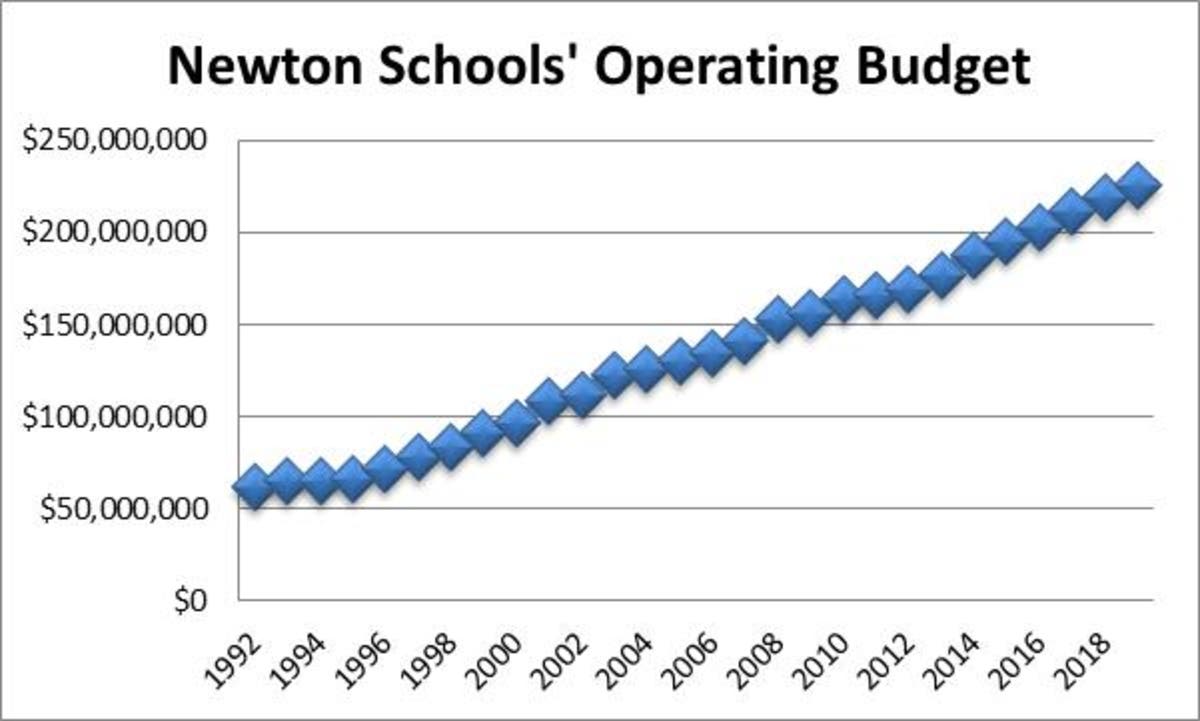

The Newton School Committee recently rubber-stamped Newton Public Schools Superintendent David Fleishman’s $227.6 Million Fiscal Year 2019 school budget. We at the Newton Taxpayers Association have written TAB columns exposing the Newton Public School System’s structural spending problem in years past by identifying the lavish pay raises paid out to the unions and bureaucrats. Now that Newton has a new Mayor, four new elected school committee members who began serving on the committee this year and a recent mayoral transition report identifying the challenges associated with operating the school system, we have decided to share our solutions to solve the Newton Public School System’s structural spending problem.
Our principals attended last year’s budget hearing where we heard parent and teacher groups bewailing budget cuts resulting in teacher staff reductions. This year, the Newton Schools will be facing the need to make new labor contracts with its seven union bargaining groups. Given that the last labor contracts gave out 6% annual cash pay raises only to cut teacher staff levels two years after giving out those lavish pay raises, we need our School Committee and City Council to limit annual cash raises in the next union contracts to 1%. One percent annual cash pay raises reduces spending growth by up to $5.5 Million citywide annually, ensures the city can underwrite the aggressive 9.6% annual growth in pension contributions and the school system can underwrite school infrastructure projects such as new Lincoln-Eliot, Countryside and Ward Elementary school buildings, avoid having to cut teachers, and avoid having to burden Newton taxpayers with an override/debt exclusion tax increase.
Newton’s Special Education program is in need of reform. The school system spent $90,000 on a consultant’s report in 2010 to evaluate the state of the program. One year later, the consultant found that there was $19 Million in annual overspending in Newton’s Special Education program due to overstaffing for student yet the program underperformed dozens of other districts in MA. Unfortunately, Newton’s political class sent this report to the memory hole as it did not tell them what they wanted to hear. Fortunately, we at the NTA saved the report to archive.org and downloaded a copy of it.
Find out what's happening in Newtonfor free with the latest updates from Patch.
Newton also incurs a $9.7 Million annual cost net of state aid to educate 599 students who do not live in Newton, but attend Newton Public Schools. Newton has at least four programs that allow for non-resident students to attend Newton Public Schools at taxpayer expense. The state used to fully fund these programs in the 1970s, but state funding has failed to keep up with our school system’s soaring spending budget since then. As the Commonwealth of Massachusetts owes $124 Billion in debt and other obligations, we expect them to continue to shortchange these programs.
We remember former Newton School Committee Chairman Al Mandell fought against METCO funding cuts in the 1970s when it resulted in an $82,000 annual deficit for Newton. Now that Newton incurs a $9.7 Million annual cost for these programs, we at the NTA unanimously believe it is time for our Newton School Committee to go to the districts that send us their children and tell them that they need to make up the difference between state funding and the cost to educate their kids. If those school systems are unable or unwilling to do so, then Newton must not accept any additional non-resident students in our school system.
Find out what's happening in Newtonfor free with the latest updates from Patch.
The Newton Public School System cost too much money as it current operates. The reason why Newton Schools cost too much is that we have a Superintendent and School Committee who have a mindset that education is free to give away, and that there are no limits to expectations by parents for services and by unions and bureaucrats for compensation. But I think Village14 blogger Karen Nacht said it best after the 2013 override when she said “it’s time to strike more balance between resolving Newton’s $1.36 billion debt problem, maintaining buildings, moving educational excellence forward and investing in children versus the financial advancement of government unions”. We at the NTA will always put the needs of our children ahead of financially enriching unions and bureaucrats.