Business & Tech
The Godfather of Newton Highlands
Mario Boccabella talks about his thirty-five year love affair with Newton and how his newest restaurant embodies his own spirit.
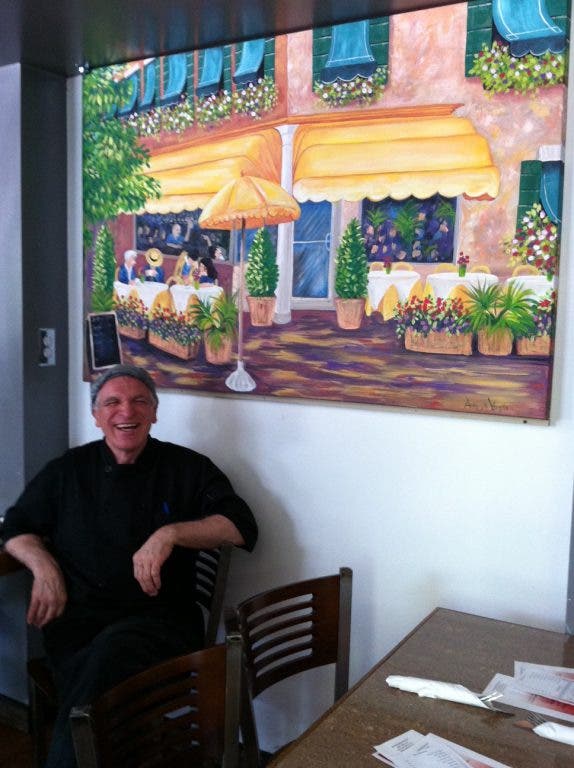


If you enjoyed this past weekend’s in Newton Highlands, or even if you just enjoy shopping, eating and strolling in that village of our lovely city, you should stop by in Auburndale and thank Mario Boccabella.
His four Newton Highlands businesses, and his love of Newton as a city, were the driving forces behind the regeneration of the Highlands.
“Back then, the Highlands was a difficult place,” states Boccabella. “It was really destitute, we had burnt down stores. All the other stores had closed. We made it fun, we brought a lot of people along with us. We wanted people to come, we wanted other businesses to do well, and they did.”
Find out what's happening in Newtonfor free with the latest updates from Patch.
Boccabella came to the United States from Abruzzi, Italy as a very small boy. He grew up in the melting pot of Brooklyn, NY where he learned to appreciate not just the many different cultures to which he was exposed but also their foods.
“I grew up on knishes,” Boccabella laughs.
Find out what's happening in Newtonfor free with the latest updates from Patch.
At the age of eight, Boccabella would accompany his mother Angela to the markets of Schenectady Avenue, Brooklyn. Here she taught him how to bargain with the merchants to get the best deal.
When they got home, Angela would make food for her family. But she didn’t just stick to Italian recipes; she learned from the many cultures around her- and from her own Abruzzi cooking background. You could “take all of the throw-aways, all of the things that weren’t used for other dishes, and turn them into something delicious. That is the Abruzzi way,” explains Boccabella.
A Start in Newton
When he moved to the Boston area, Boccabella brought this philosophy of food, and the underlying respect for cultural differences, with him.
Around 1976, he opened Dom and Mario’s Deli in Newton Highlands. The cornerstone of their fare was the famous Schmulke Bernstein cold cuts he’d travel to Brooklyn to procure weekly.
This new business endeavor caught the eye of then-mayor Theodore Mann.
“We were open for three or four days, and Ted Mann came in,” Boccabella recalls. “He goes, ‘Who’s got the nerve to open up an Italian-Jewish deli in MY city? Who’s Mario?’ And he goes, ‘I knew it couldn’t be a Newton boy- had to be a New Yorker!’”
And thus began a lifelong friendship that was based on mutual respect and a shared belief that Newton could blend and celebrate the “97 cultures” (a phrase Boccabella says Mann used frequently) that inhabited their beloved city.
Back in the late 70s, in addition to the deli and a fruit and vegetable market, Boccabella also owned a bakery called Bread and Chocolate (Boccabella notes that he is not affiliated with the current Newton bakeries with that name but that owner is “a sweetheart!”).
On Sunday mornings, when Boccabella was at his bakery before the sun rose, Mayor Mann would come by and pick him up “just to go for a drive.” But they would really end up going around to make sure that the streets were clean before folks set out to go to church. And on these drives, Mann and Boccabella would talk about what was needed to make the city, and the Highlands in particular, flourish.
“We developed the plaza that is there,” explains Boccabella. “We put up lights, we put up the benches. People were asking’ Who can sit here?’ and we said, ‘Everyone! Everyone can sit there!’ And everyone did.”
Newton Highlands Village Day and Beyond
When Boccabella opened Cantin’ Abruzzi (in the spot where is now) in 1978, he had decided to focus on more than the sandwiches and take-out that had been the staples of the bakery, deli and market he’d owned.
After a year in business, Boccabella wanted to thank his customers for their loyalty and “get a little free advertising.” So, building on the parties he’d seen thrown by Chinese restaurant owners back in Staten Island, Boccabella had his first “block party” in 1979. Over the course of the next 15 years that Cantin’ Abruzzi was in business, Boccabella saw the shindig grow from a handful of loyal patrons to “a couple thousand residents,” according to Boccabella, from all over Newton. And thus Village Day was born.
But Mayor Mann wanted the whole city to get to appreciate this feeling of community and asked Boccabella to help set up an even larger Italian festival that would eventually become a multi-cultural success in Newton Centre.
A New Generation of Boccabella
After Cantin’ Abruzzi shut its doors in 1994, Boccabella was ready to be done with the restaurant business. He was happy to consult with friends as they opened their own endeavors ( of Tango Mango cites Boccabella as an influence, for example).
But a little over a year ago, former patrons and friends saw him working on a building on Lexington Street in Auburndale and, according to Boccabella, kept asking, “Are you opening a new restaurant? Is this going to be your place?”
Never one to disappoint his patrons, Boccabella placed a call to his daughter and son-in-law who lived in New York at the time. Shortly after, he received a call back stating that “the kids” would not only be coming- they’d be staying and were eager to help Boccabella re-enter the Newton restaurant scene.
On November 17, 2010 Bocca Bella Café & Bistro opened its doors (like the bar, the tables and the kitchen area, these doors were crafted or refinished by Mario and his son-in-law, Anthony Vega).
Unlike most eateries, Bocca Bella Café doesn’t have a fixed dinner menu; it literally changes every night based on the availability of products and the creative whims of Boccabella, his patrons and his staff.
“The menu develops as people tell you what they want,” explains Boccabella. “We always have a fish, we always have a meat. We always have a chicken dish. The elements are there. We even have gluten-free pasta and things for the vegetarians.”
Boccabella is known for not writing down his recipes and for not sticking with just traditional Italian fare, in spite of his background. But he is writing a cookbook now, one he hopes to complete by the end of summer. He also hopes to help Auburndale businesses copy their Highlands neighbors in putting together a street festival.
In the meantime, Boccabella is just enjoying providing a menu of culturally diverse foods to his loyal customers. He knows that in order to keep people coming in, he has to constantly change the restaurant’s offerings.
“Water, if it’s still, doesn’t look very nice,” analogizes Boccabella. “It doesn’t taste very nice. You can’t drink it, you can’t enjoy it. Water needs to move and flow. That’s my way, too.”