Community Corner
Travel Back in Time: 10 School St.
Travel Back in Time with the Wednesday Patch Passport to discover the history and roots of Northborough.




Story submitted by Robert P. Ellis of the Northborough Historical Society.
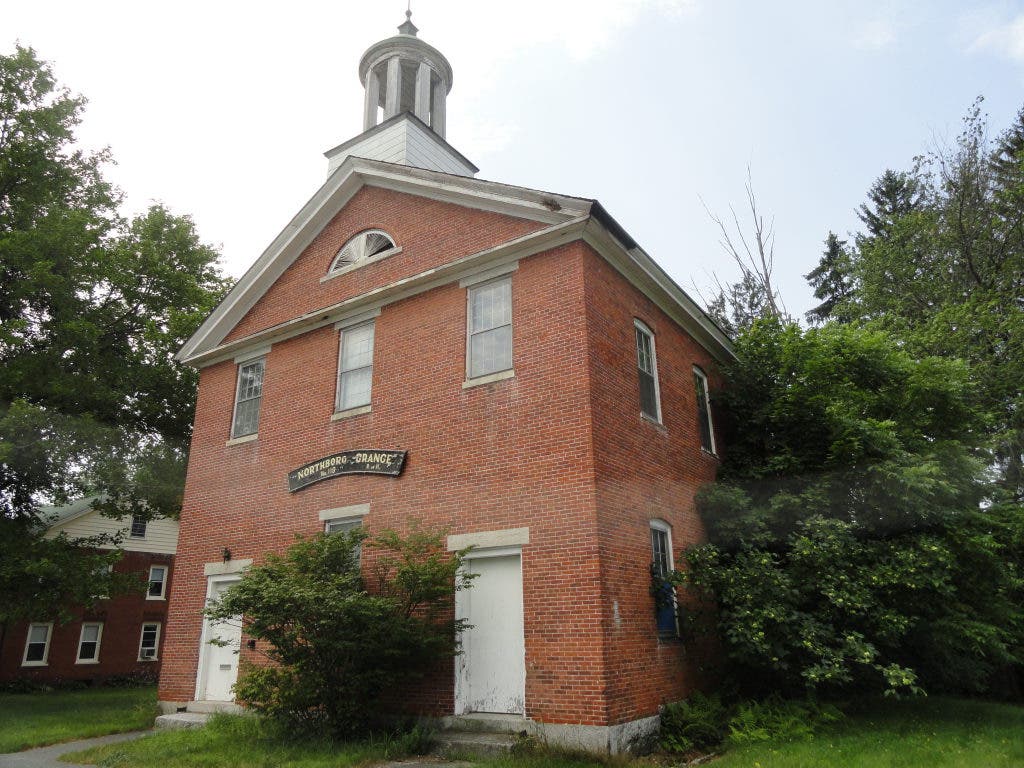
Could the brick building at 10 School St. be called the most historical building still standing in Northborough? Isn’t the house at 312 Church St., for example, more historical? There at a meeting in 1744 one section of Westborough (itself a former part of the earlier town of Marlborough) was formally designated as that town’s new North Precinct. This decision led to the independence of the precinct in 1766 and the status of Town of Northborough in 1775.
Probably only the Town Hall, which burned in 1985, however, held more significant community events.
The fact that it originated as one of Northborough’s district schools explains the name of the street. Northborough’s district elementary schools date from 1770, and this building was the first of three
brick schools from the 1830s and 1840s, all of which survive. When a centrally-located school on Main Street a little west of the later White Cliffs became vastly overcrowded, the School Street building was
erected in 1837 and ’38. It cost the town $1,835.81; private individuals paid for the the belfry, which cost $97.44.
Is the bell still there? To my knowledge the belfry has not been carefully examined in many years. If anyone knows differently, I would be happy to hear about it. In its original form, for there has been one addition, the building was 42 feet long, 32 feet wide, and two stories high—presumably as high as a schoolhouse ought to go. The bricks came from Stephen Howe’s brickyard on Main Street (approximately opposite the present Jehovah’s Witnesses church).
In 1849, a committee proposed the building of “a stone wall around the school house in District No. I, the same to be of large stones and narrow on the top so that the scholars cannot throw it down,
nor run on the top of it, and that it be built about three-and-a-half feet high.” Learning that the wall would be too expensive, the committee recommended “a suitable board or picket fence instead.” The fence actually divided the boy and girl students from each other, and the feature of the two front doors also signifies a separate entrance for each. Early pictures of Northborough schoolrooms indicate that this division did not necessarily persist in the classroom.
The most important institution of adult education in nineteenth-century Northborough was its lyceum. Lyceums in the United States featured evening lectures, often by nationally influential people, and
debates. At the Central District School the students supplemented their own education by establishing their own student lyceum which discussed serious issues “at intermission” (lunch hour, perhaps?).
In the fall of 1852 Northborough’ s first high school was established on the second floor of the building. Its principal and teacher was nineteen-year-old Robert C. Metcalf, who later would have a distinguished educational career. Among Metcalf’s students were Edwin P. Seaver, later the superintendent of schools in Boston, and John Minot Rice, eventually the head of the mathematics department at the United States Naval Academy. Few Massachusetts towns had public high schools at the time, and Northborough rejected the continuation of this high school, which closed abruptly the following February. A few years later the town proved ready to countenance a permanent high school at another location.
For nearly 60 years, however, children attended the elementary school. In 1895, a new school rose on Hudson Street, and most of the district schools were closed. The District No. 1 building was saved
from destruction by the Northborough Grange for $125 and began its second career, which lasted more than a century. The Grange, already ten years old in 1895, was part of a national organization of farm families. Many of its members over the years were not farmers; more importantly, they were members of a farming community.
Activities varied widely. In addition to the practical problems of farming (“What are the best crops for farmers to plant, and how shall we plant them?”), many cultural programs were held. In one late
nineteenth-century year music was performed by individuals or singing groups at nearly every meeting.
Find out what's happening in Northboroughfor free with the latest updates from Patch.
Social entertainments and suppers were common, on one occasion the Grange held “an Evening with the Poets,” and at another meeting “each member to be prepared with a reading or recitation, and a
failure to be present and respond” resulted in a five-cent penalty.
A heavy schedule of events continued for most of the twentieth century. In 1901 the Grange contributed to the establishment of rural free mail delivery. By 1932, the building had to be lengthened
to accommodate its membership and activities. The Grange performed much charitable work, presenting gifts to such organizations as the fire department, the high school, and a county 4-H camp.
In the 1940s the Grange Dramatic Club sprang into being and sponsored plays, card parties, and other forms of entertainment. Older Northborough people today fondly remember dances at the Grange Hall.
Nor did one have to be a member to participate in events. At the Northborough Grange’s 95th birthday in 1980, for instance, Janice Parmenter (who has just recently passed away), then a recently retired town clerk, although not a Grange member, received the Grange Community Citizen Award for her many services to the town.
The national Grange and some individual chapters still exist, but changes in society have diminished it. A few years ago the building at 10 Church St. was sold. A lack of parking added to the difficulty of
finding a suitable use for it. A plan to make it into apartments failed. Its present owner has not revealed his plans for it, but it is to be hoped that it will in some fashion continue its tradition of usefulness.
Find out what's happening in Northboroughfor free with the latest updates from Patch.
For more in our Patch Passport,
Get more local news delivered straight to your inbox. Sign up for free Patch newsletters and alerts.