Health & Fitness
BLOG: 'What Did People Think Caused Earthquakes in the Olden Days?"
Before there was plate tectonics, people relied on the ancient art of storytelling to make sense of their world.


On Monday, The Five-Year-Old asked her Daddyo what people used to think caused earthquakes back in the olden days. "Like when you were born."
Turns out she meant the really olden days, when instead of seeking scientific explanations for natural disasters, people relied on the ancient art of storytelling to make sense of the traumatic upheavals reshaping and in some cases, completely devastating entire civilizations.
And that's a really fun question, because the ancient explanations are all over the map. Literally.
Find out what's happening in Norwoodfor free with the latest updates from Patch.
Ancient Rome and Greece
Most of us are familiar with the ancient explanations blaming earthquakes on angry gods. The Greeks may have pointed the finger at Poseidon, the god of the sea, and the far more theologically pragmatic Romans at Vulcanus (the god of lava and smoke) or sive deus sive deá (the spirit of which roughly translates to "whichever god or goddess is mad at us right now"), but the basic storyline remains the same. Humans angered the gods, so the gods smote the earth with a mighty rage that destroys the humans' homes and otherwise wreaks great devastation upon them.
Find out what's happening in Norwoodfor free with the latest updates from Patch.
The Maimas of Peru
The Maimas of Perus also blamed their god for earthquakes, but in his case, it wasn't because he had anger management issues. It was just his way of taking a headcount.
The Maimas believed that when the earth shook, it was because their god was walking the earth, taking a census of his true-believers. Which is why they responded to earthquakes by running out of their homes, shouting "Here I am, here I am." They wanted to make his job easier so that things could get back to normal.
Perhaps not precisely the reaction you and I would have today, but all things considered, a fairly sensible one, as their homes weren't known for their structural soundness. Exiting quickly would at least prevent the Maimas from getting hurt when the roof collapsed.
Ancient Japan
In ancient Japan, the rumor was that earthquakes were caused by a very large and very twitchy catfish named Namazu who lived in the center of the Earth.
Namazu caused such devastation on the Earth's surface with every thrash of his tail that a demigod was assigned the job of forcing the catfish to keep still. The demigod, Kashima, did this by squishing the catfish's head with a giant rock.
This worked wonderfully, while Kashima's strength held out. Unfortunately, every now and then Kashima wanted a break and allowed the stone to roll off Namazu. The earth quaked as a result.
Norse Mythology
The Vikings attributed earthquakes to a terrible beastie as well, in their case, the Fenris Wolf. In Norse mythology this giant wolf is destined to bring on Ragnarök, the end of the world. Knowing this, the gods tricked Fenris into wearing a magic chain forged from the roots of the mountains, the sound of a cat's footsteps, the breath of fishes, the tendon of bears, the spittle of birds and a woman's beard. Naturally, Fenris was furious at being tied up like this. His roars shook the mountains, ripping open deep fractures in the Earth and raining rocks down the mountainside.
The Algonquins
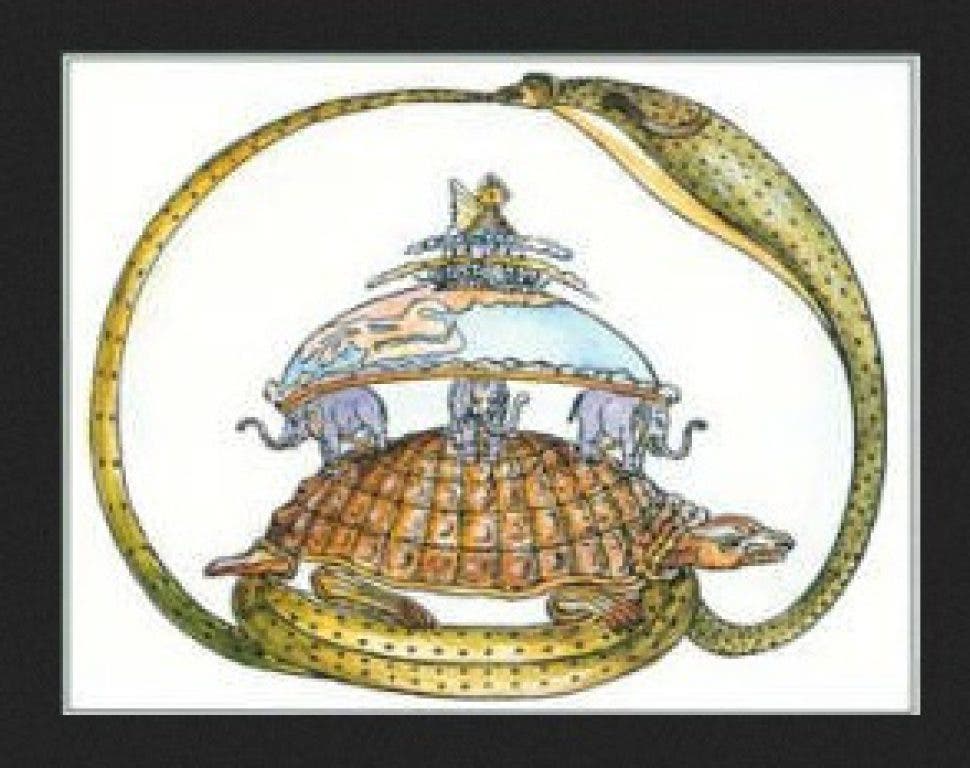
The Algonquins were a far gentler people than the Vikings, at least in their story-telling. In Algonquin mythology, the Earth is supported by a noble tortoise. Earthquakes happened when the tortoise's legs tired of carrying the Earth's great weight and it shifted around to find a more comfortable position.
Aristotle
To my way of thinking, Aristotle's explanation for earthquakes comes the closest to modern understanding. He believed that wind currents within the Earth's surface were to blame. When glossed over by the very broad science-y brush we are so fond of using here at Caterpickles Central, Aristotle's winds can be made to sound very much like the convection forces of modern plate tectonics.
Ok, so you have to use such a very broad brush to make the analogy work that really you're in danger of using the very same sort of magical thinking that caused generations of Maimas to dash out in the streets when an earthquake struck. Still, the point is Aristotle was at least trying to base his theory on his observations of how the natural world worked. And in that he was centuries ahead of his peers.
If you or your Five-Year-Old would like to read more about how ancient cultures explained earthquakes, the San Jose Unified School District has posted a lovely summary of world earthquake mythology here.
Related Links:
- Ancient civilizations shaken by quakes (Space Daily)
- "What did people think earthquakes were in olden days?" (Caterpickles)
- Earthquake Mythologies (San Jose Unified School District)
- An Ancient Earthquake (Richard Armstrong)
- Earthquake myths - The Terrible Fenris Wolf (History of Geology)
- Namazu: The Earthshaker (History of Geology)
- Myth 101: The Animal-Rumblings of Earthquake (OPUS Archives and Research Center)