Politics & Government
City Owed Excise Taxes for School Buses; Zoning Issue Still Unsettled
The city of Peabody will be receiving an undetermined amount of excise taxes on 36 school buses stored off Pulaski Street by the Salter Transportation Company. First Student will also likely be paying for the buses it stores nearby.


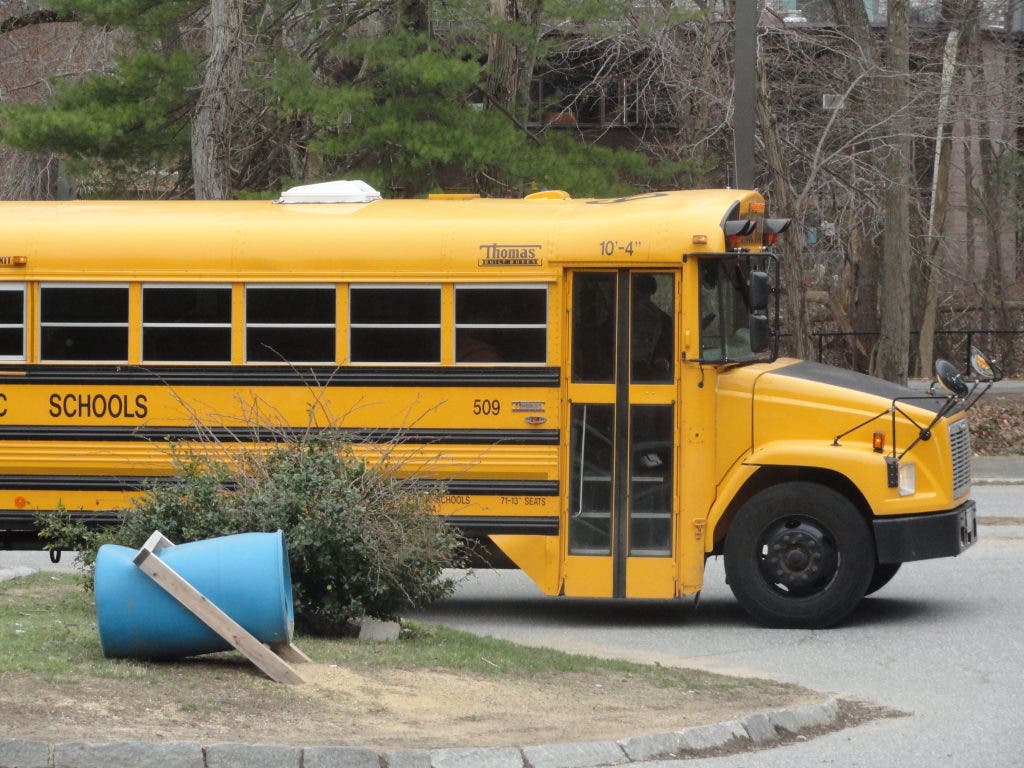
The city of Peabody is going to be receiving excise taxes on at least 36 school buses, and potentially more, which are parked throughout the school year off Pulaski Street. It’s just the latest development in an ongoing complaint regarding activities at 60R Pulaski St.
“The tax issue is one aggravating piece of a puzzle,” said City Council President Anne Manning-Martin last Thursday as councilors looked to get clarity on . Attorney John Keilty confirmed that the property owner is also currently making payments on $200,000-$300,000 in back taxes on the land.
“[The owner] doesn’t seem to be playing by the rules and asking as an average citizen would, what you could do with your property,” Manning-Martin said, adding further that it seemed there was basic lack of awareness of “how to do things the right way.”
Find out what's happening in Peabodyfor free with the latest updates from Patch.
The owner, 60 Pulaski St. LLC, ran afoul of the Conservation Commission earlier this year after cutting down some greenery along the waterfront side of the property, which would be protected under a buffer zone. Keilty argues, however, that the land is in a historic mill district and thus not subject to the same conservation restrictions on riverfront property.
Last month, the buses, which are operated by the Salter Transportation Company, were too loud, emitted too many fumes into the neighborhood and contended that storing the buses there was in violation of city zoning anyway. Councilors agreed, even though First Student has garaged school buses on a nearby lot for several years.
Find out what's happening in Peabodyfor free with the latest updates from Patch.
The neighbors and councilors want to remove those buses as well.
Where to register?
The zoning issue has yet to be resolved, but in the meantime, city councilors believed Salter and also First Student owed the city excise taxes for storing the school buses in Peabody.
Salter won the Peabody Public Schools contract for bus transportation last year and began leasing out the Pulaski Street site last August. The company, however, is based out of Newbury and registers its fleet there, not Peabody. Newbury then gets the excise taxes.
It turns out the council was correct, according to Deputy Police Chief Martin Cohan.
Cohan appeared before the council’s Legal Affairs Subcommittee on Thursday to report that Peabody is in fact entitled to excise taxes from Salter.
Cohan said he checked with state authorities, including the Registry of Motor Vehicles, which confirmed that state law dealing with the motor vehicle excise tax refers to where a vehicle is principally garaged for most of the year, and that’s where it should be registered.
The RMV told Cohan the registry documents for Salter could be amended to reflect the change in address, he said.
Keilty, who represented Salter and John Thomason of 60 Pulaski St. LLC last Thursday, said his clients were willing to pay the excise tax. Keilty said that all but eight of the buses, which would be used for summer programs, would return to Newbury for the summer and come back in the fall.
The amount of money in question wasn’t discussed Thursday night and would depend on the valuation of the vehicles.
First Student, which stores buses nearby at 58R Pulaski St., was not represented last Thursday.
Keilty acknowledged that Salter was also in talks to expand the number of buses stored on-site. That amount would most likely be 60, as Salter seeks to win the bus contract for Danvers, Keilty said.
He added, however, that Thomason doesn’t necessarily plan to store school buses at the site indefinitely – it was an interim solution to bring in some income. The lease is just for two years and hopefully the economy will come back within another couple years, Keilty added.
The site is under a longstanding cleanup order from the state Department of Environmental Protection. Asbestos and heavy metals have already been removed and site monitoring will likely continue for another two years, ending with use limitations imposed on the site.
Definition of an ‘automobile’
As for the zoning issue on the buses, the contention is actually over the definition of a school bus, said Keilty.
The property is zoned for light industry and Building Commissioner Kevin Goggin had viewed the language allowing “automobile” storage as inclusive of school buses, but upon further appeal, the argument went before the Zoning Board of Appeals, which offered a much narrower view of what “automobile” meant and that definition didn’t include school buses.
The matter is back before the ZBA, and depending upon that ruling, court action may be next, Goggin said in a previous interview.
An exact definition to the contrary could affect outdoor storage of motor vehicles across the city, Keilty pointed out.
Get more local news delivered straight to your inbox. Sign up for free Patch newsletters and alerts.