Community Corner
The Training Green: From Training to Temperance to Art
Boston may have its Common, but Plymouth has its Training Green.
For almost 400 years, the green space just south of Town Square had been used for the public benefit—from training militia to grazing cattle, from temperance lectures to art shows. While its appearance has changed a bit over the centuries, it remains a welcoming green space for people to walk, play Frisbee, or just sit on a bench in the shade.
The Training Green first appears in the town records in 1711, when the selectmen officially set the plot of land aside. Since 1620, the colony and then town government strictly controlled the allotment of land. By the early 18th century, the town was growing rapidly, and the selectmen decided to review town-owned land. The plot between what is now Sandwich and Pleasant streets was public, unofficially used by citizens as a muster field. In 1711, it was voted that the land "shall be for a perpetual common or training place, never to be granted any part thereof, but be perpetually for public and common benefit." Five years later, the following parcels were designated as public land, never to be sold: the Training Green, the Great Gutter (Courthouse Square), and Cole’s Hill.
Land held in common for the public good was a custom brought from England. In an era when people frequently owned scattered parcels of land, having a central place for grazing cattle or sheep was practical. People who didn’t have enough land for grazing could also use the common land. According to Plymouth historian William T. Davis, most people in Plymouth kept a cow, or obtained milk from neighbors who did. In 1748 there was about one cow to every four residents. Cattle grazed on pubic land, including Stephen’s Lane, the Training Green, the vacant land behind Market Street, or on Burial Hill.
Having a place to train a militia was important in times of uncertainty. In England, “trained bands” of men between the ages of 16 and 60 served as a reserve army. They met several times a year, bringing their equipment with them to see if it “passed muster.” Men were fined for bringing faulty weapons. In 17th-century Plymouth, men mustered about six times a year. Training and drills, led by an elected captain, followed the muster. The town provided pikes (until the 1670s), as well as banners and a drum.
The use of the green as a muster field continued into the 19th century. Davis recalled from his boyhood in the 1830s that men between the ages of 18 and 45 met annually for the militia muster on the Green. After inspection, they were usually dismissed, although Davis relates an occasion when an overly-conscientious drill leader marched the men all the way to Robbins Field in North Plymouth.
In 1820, the town permitted the state to construct a gun house on the northeast corner of the Training Green for use by the Plymouth Artillery Company, founded in 1777. The building stood about thirty years—around 1850, the gun house was purchased by Henry Whiting, Jr., for a residence, and moved to Sandwich St. near Winter St.
The Green had a safety function in addition to its military use. The Town of Plymouth invested in fire engines in the 1830s, and constructed a building to house the suction-engine Fountain in 1831 on the southwest side of the Green. A reservoir to supply the engine was added three years later. The firehouse was dismantled when steam-powered fire engines replaced the old suction engines.
In spite of the official structures located on the Green, townspeople used it for a variety of purposes. Davis recalled that children who lived on “t’other side” (south of Town Brook) played on the Training Green (Davis, Octogenarian, 204). The Temperance Society held lectures there as early as the 1820s. In 1853, the Town held a Pilgrim celebration on August 1, the date the Pilgrims left Delftshaven for London. A dinner was held on the Green for 2500 participants and a speaker under tents.
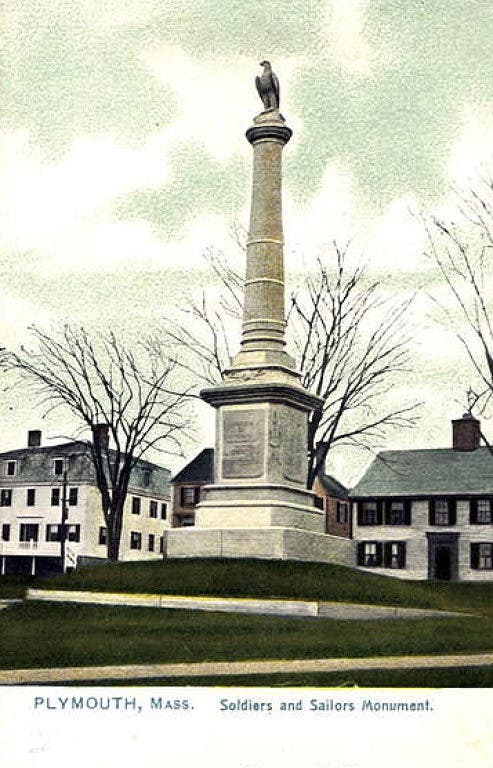
Following the Civil War, the Training Green became the spot to memorialize the servicemen killed in action in the conflict. The Soldiers’ and Sailors’ Monument was built in 1869, bearing the names of those who died. The 58-foot statue of Hallowell (Maine) granite was designed in the shape of a column with a globe on top, surmounted by an eagle. The corners are ornamented with sculpture of spontoons, flags, and rifles.
In 1889, the Town commissioned the well-known firm of F. L. Olmsted and Company to improve the park. They designed pathways leading from the corners of the field to the monument in the center, and recommended that the Town increase the size of the Green by taking a few feet of land from Pleasant and Green streets. A collection of 17 plans exists at the Olmsted archives in Brookline.
The appearance of the Training Green changed little over the 20th century. The Soldiers’ and Sailors’ Monument and the Olmsted pathways are still maintained by the Town. No other permanent structures have been erected, although tents have been set up for a week or two to house events like the Plymouth Guild Art Show. Private citizens still use the Green every day, although dog walking has replaced cattle grazing.
The year 2011 marks the 300th anniversary of the official designation of Plymouth’s Training Green. It is still used “for public and common benefit.” While not quite as old as Boston Common, the Green is one of the nation’s oldest parks in continuous use, and one of Plymouth’s treasures.