Arts & Entertainment
Faces of Halloween: What Does it Take to Play Bridget Bishop?
A former cast member offers personal thoughts on her role in the popular play, which encourages audience participation.
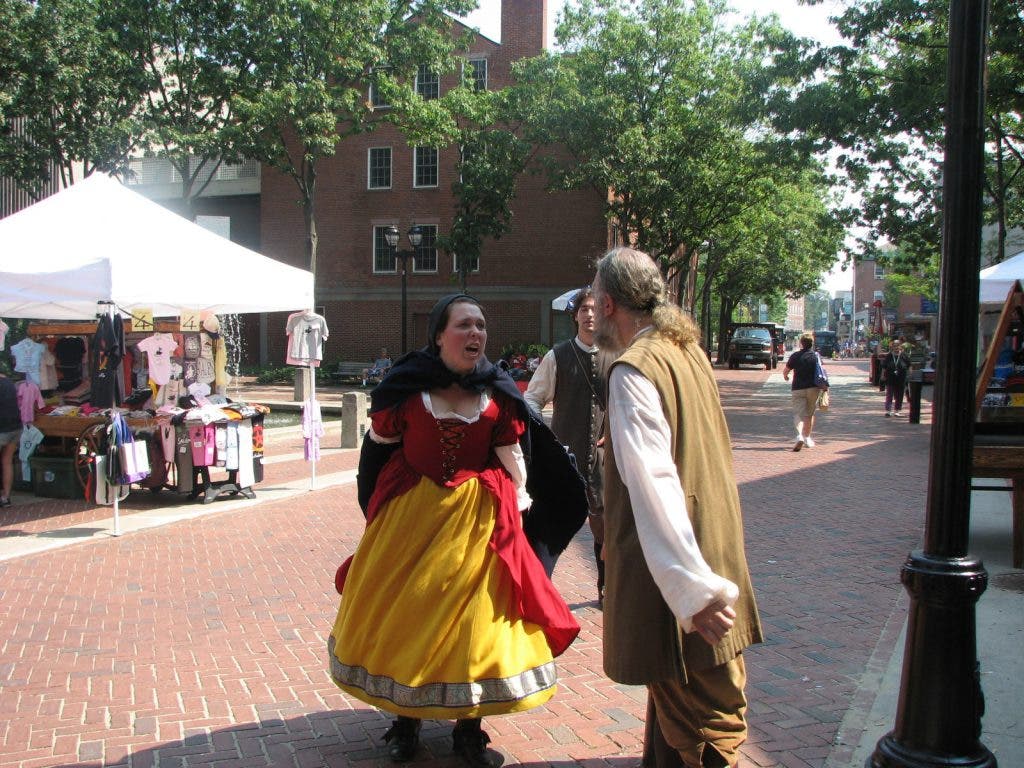


Bridget Bishop, outcast and outspoken, died in 1692, but lives today through the interpretation of , as presented by the Gordon College Institute for Public History.
But what does it take to mount this interactive production? What motivates the actresses that have played Bridget since it was first performed in June, 1992 to mark the 300th anniversary year of the Salem Witchcraft ordeal?
Salem Patch caught up with Gordon graduate and Salem resident Natalie Miller, who portrayed Bridget during the summer/fall seasons of 2008 and 2009. She is now the new Director of Theatre Education for the Northshore YMCA.
Find out what's happening in Salemfor free with the latest updates from Patch.
“A lot of it comes through historical information. You basically take a class in history of 1692. That is a huge part of the rehearsal process. Actors learn about who these people were. Then practice questions and answers. Then [we] debrief why an answer was strong or weak.”
Audience participation is encouraged, including questioning witnesses and allowing particpants to act as the jury passing judgment on Bridget Bishop when the action moves from the Essex Street Pedestrian Mall to .
Find out what's happening in Salemfor free with the latest updates from Patch.
Miller says, “If you were an outcast in society what might be the reasons for it? It is up to you to interpret why that is, because people will ask Bridget ‘why don’t they like you?' And you have to decide in your interpretation, and different actresses will vary [as to] why that was.”
Was it because she missed church on X amount of days? Or was it because she was such good friends with too many men in her community (unheard of back then)? Perhaps she was thought to be a shrewd businesswoman?
“You don’t really know what contributed to her being the first executed of the 19 to be hanged,” remarks Miller.
“So you, as the actor, get to choose. I went for a sassy approach; I thought that was a more modern interpretation, as a modern woman trapped in 1692," Miller says. "She [Bridget] was infamous in her community for wearing a red bodice, the idea being that she dressed above her station.”
“I interpret characters as a part of myself and so Bridget was an embittered version of me if I had been told ‘no’ all my life," Miller explains. "Whenever I’ve said I want to do this or that, I have been allowed to do it. But Bridget — she was constantly told 'no you can’t dress the way you want,' no you can’t be outspoken.”
One of Miller’s favorite aspects of Cry Innocent is being dragged through the streets, heralding the trial to come. At this critical point, she felt she could unleash Bridget in a way to convince the audience that this woman would have been thought to be a witch legitimately.
“I would say ‘I can speak for myself.’ Then laugh with the audience or make fun of other characters. People could say Bridget is funny, but she is also really mean. They would think Bridget is a clever woman, but also think she is guilty.
In fact, Miller believes her Bridget tally sheet would show more guilty verdicts than acquittals.
But she points out that the enduring goal of the play is to give attendees a perspective on the Witch Trials that they haven’t seen before. It is an effort to help the jury understand that in the context of 1692, this all made sense.
“We ask them to enter 1692 where people actually believed that evil spirits could come and visit you," Miller says.
Judge for yourself — .