Politics & Government
Salem Mayoral Candidate Visions Compare, Contrast In Video Interviews
Mark Steele Productions conducted the topic interviews with Neil Harrington and Dominick Pangallo ahead of the May 16 special election.


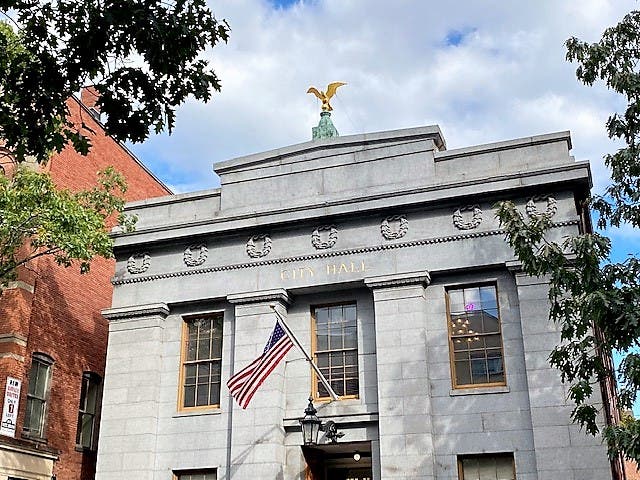
SALEM, MA — Salem mayoral candidates Neil Harrington and Dominick Pangallo expressed similar optimism for the future of the city while sharing some contrasting ideas on how to move toward and maximize that future, during a pair of video interviews recorded ahead of the May 16 special election.
Mark Steele Productions sat down with both candidates for a series of Q & A shorts with both candidates asked the same six questions. Pangallo and Harrington were the top two finishers in the March 28 preliminary election to fill the final three years of five-term mayor Kim Driscoll's term after she headed to Beacon Hill as the state's 73rd lieutenant governor.
Both stressed their experience in being able to jump into and do the job right away — Harrington as the former Salem mayor from 1990 to 1997 and with his 20 years as Salisbury town manager, and Pangallo with his 10 years as the City Hall chief of staff with Driscoll as mayor and his long career in public administration.
Find out what's happening in Salemfor free with the latest updates from Patch.
Yet, while Pangallo largely spoke about moving forward with the progressive programs and ideals of the Driscoll administration and said "the path we're heading on was largely the right one," Harrington touched on some areas where the city may not be as responsive to residents' desires as it could be.
"What (the next mayor) really needs to focus on are the people of the city," Harrington said. "What they're saying, what their hopes and desires are. It's not about programs, it's about people. ... I am less focused on the bureaucratic side of government."
Find out what's happening in Salemfor free with the latest updates from Patch.
Pangallo said the main issues facing Salem are affordability, building on the public schools' gains in recent years amid post-pandemic challenges and the climate crisis that he said "is the existential threat of our time." He said affordability goes beyond housing and includes food security and making sure the aging population can stay in their homes.
"This city can do a lot more when it comes to affordability," he said. "We need to make sure that we have the affordable housing that serves the needs of the community while growing more of the human services opportunities that right now Salem exports to a lot of our community partners and that I believe city government has the responsibility to take ownership."
He said that a push for building electrification, adding solar panels on city and school buildings and increasing the availability of electric vehicle charging stations should be a priority as well as building off diversity initiatives and advancements of all kinds in recent years.
"That is the type of community that we want to be," he said. "Not a sleepy place that tries to turn back the clock or be somewhere we are not.
"It's important that we continue to be a place that welcomes everybody and says that no matter how long you've lived here, what language you speak, how you identify, Salem belongs to you."
Harrington agreed that it is a "badge of honor" to be a diverse community, and that "the older generation — of which I am a member — needs to be cognizant of the fact that the future belongs to the young people," while allowing that "transitions take time" and require some understanding.
"There is a little bit of tension involved in them and there is a little bit of uneasiness," Harrington said. "The important thing to keep in mind, from my perspective, is that you need a steady hand in the mayor's office. You need someone with experience who is willing to bring all parties together, blend ideas and blend hopes and aspirations, and look at what Salem can be in the future for all residents."
One other area where the perspectives differed in the video interviews was when it came to the vision of downtown.
Pangallo said more housing opportunities downtown and near the MBTA commuter rail station will result in more sustainable downtown businesses while lessening traffic getting in and out of the city each day, while Harrington said the downtown needs a "metamorphosis" after becoming too tourist-oriented in the years since Essex Street was turned into the pedestrian mall.
"I really do think, particularly in talking with people who live around the downtown, that they enjoy the restaurants, they enjoy the nightlife, things like that," Harrington said. "But the convenience of being able to shop at a retail business is not there. The mix of retail businesses on the mall — which, unfortunately, in my opinion, tends to center around the witch, or Wiccan, the tourism-related businesses, is not something that I think in the long run that casts a good image for the city, and is not something that is good for the downtown or good for the people who want to live in the downtown in the future."
The full Neil Harrington interview can be found here.
The full Dominick Pangallo interview can be found here.
(Scott Souza is a Patch field editor covering Beverly, Danvers, Marblehead, Peabody, Salem and Swampscott. He can be reached at Scott.Souza@Patch.com. Twitter: @Scott_Souza.)
Get more local news delivered straight to your inbox. Sign up for free Patch newsletters and alerts.