Arts & Entertainment
Then & Now: Survivor
This building provides a rare glimpse of what the tannery industry looked like in the 1800s.
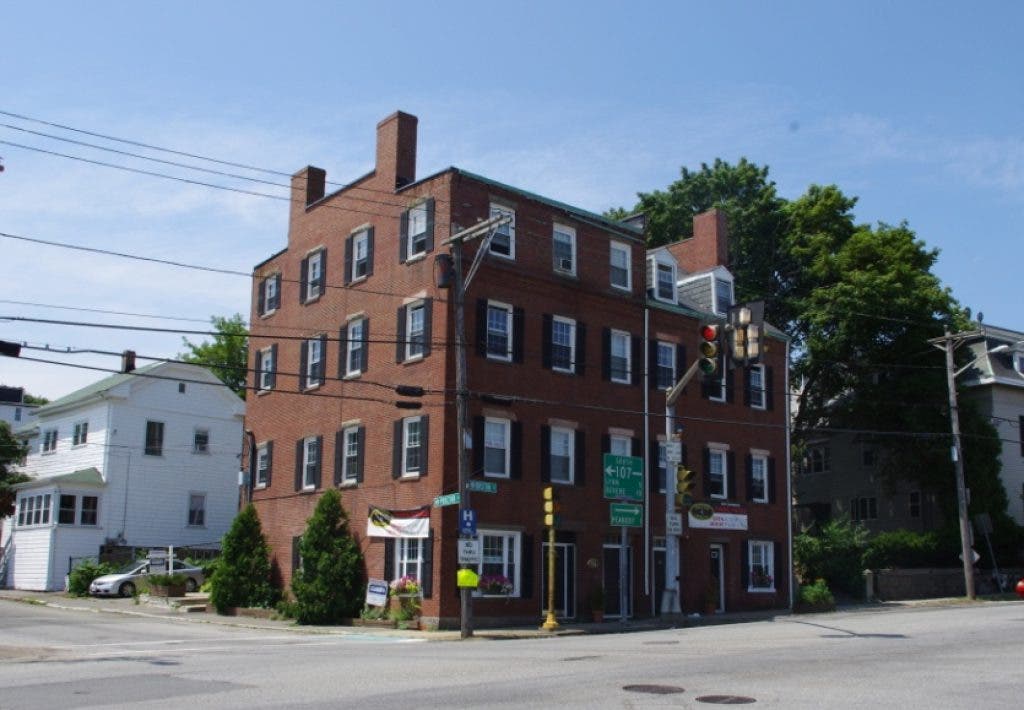


The above photos show a building that has a long history as a survivor in Salem.
Only steps from the Korn Leather Company where the fire and explosions took place in June 1914 that began the Great Salem Fire that devastated the city, this building was one of the survivors. It is the oldest building associated with the Blubber Hollow Leather Business of the 19th century that still stands.
For many years, people pointed out that the discoloration of the bricks on the first floor was caused by the intense fire that partially damaged the building.
Find out what's happening in Salemfor free with the latest updates from Patch.
Built in 1851 for Jacob Putnam in the Greek Revival style, it is a rare survivor of the early leather industry of Salem. Its distinctive parapet design probably helped its survival since this addition covers the wooden roof.
Jacob Putnam was born in 1780 in Danvers. Having little education, he sought to make a living in the maritime trade. In 1805, he shipped out for a two-year voyage to Calcutta. Upon his return he went into the leather business. Rather than just the manufacture of leather, he became involved in all aspects of it including importing, tanning, currying and marketing products. As his business grew he continually expanded it. He engaged in the South American trade by importing hides and rubber.
Find out what's happening in Salemfor free with the latest updates from Patch.
As the maritime trade expanded into the east he became a ship owner and merchant for the Sumatra trade while maintaining his leather business. By the 1850s, his leather business was the largest in Salem with two tanneries on Goodhue and Grove streets not far from this building.
From early records it is unclear what the building’s original role in his leather business was. It appears that the building was probably used for currying and production of leather goods. Once the leather is “tanned” a currier then dresses and finishes the leather making it flexible and waterproof. It is then ready for the manufacture of leather products.
In 1866, Jacob Putnam died and his youngest son George Putnam took over the business. This building at 63-65 Boston Street during the period of 1866-1884 was used exclusively for the leather business. It appears that the currying of tanned hides took place at 63 Boston St. while George Putnam maintained his office here to oversee his large company.
Around 1885, part of the large building was converted into apartments. The city directory lists a few leather workers living at 65 Boston St. This was the first of many changes for the building.
George F. Putnam ran the business from 1866 to 1897, when Frank Winchester took over the business. While Winchester was also a tanner and currier, he expanded the use of this building. He rented space to the Sheridan Club in addition to his apartments while still operating his factory at 65A Boston St.
The Sheridan Club held Sunday afternoon meetings here until 1901, when the space was listed as vacant. In 1903, further changes were made to the building when J. Kiely & Company opened a liquor dealership here.
By 1906, parts of the building including empty apartments were used as storage facilities while the factory then called P. Lennox & Co was manufacturing Moroccan leather. From 1906 to 1911, there was only one apartment being used. The factory became vacant in 1910 and was given over to storage. In 1914, half the building was storage while the two apartments were occupied by a leather worker and a fireman.
In June 1914, when the great Salem Fire took place, it started at 57 Boston St. just across Proctor Street. As the chemicals exploded and the fire grew in intensity, the Quinn Block to the east and the Creedon factories to the west immediately caught fire. The fire then jumped Proctor Street and burned half of this building, destroying the areas the factory and Sheridan Club had occupied, according to Arthur Jones in his book on the Salem Fire.
With the restoration of the building came remodeling so that Mrs. M.T. Ryan/Lyons could open a restaurant here in 1915. Once again, tenants were listed for all apartments. The restaurant/luncheonette continued to operate until 1926 at which time the entire building became vacant.
In 1927, the building was sold, and while the store remained vacant, all the apartments were rented out. At this time, five apartments are listed. In 1930, the City lists the Hollow Market as having opened here. The store remained here through the 1930s. In 1939, once again, the store is listed as vacant.
In the early 1940s, there were two stores listed at this address. One was vacant while the other lists the Salonette Beauty Shoppe at 65 Boston Street. Many readers may recall this beauty shop since it stayed in this location until 1972.
From 1950-1952, in addition to the beauty parlor, there was the Pat Mar Dairy Bar at 63 Boston. In 1952, the dairy bar was replaced by M. Haroutian Barber Shop that remained next door to the Salonette until 1968.
In the intervening years, while stores came and went, tenants who mainly worked in the leather industry lived here. At one point, when an apartment was empty, space was rented to a tenant who was also a fruit dealer so he could store bananas here.
By 1970, the building was no longer offering commercial space and had been given over to apartments. This has continued until recently when the apartments have been converted to condos, some of which are currently for sale.