Health & Fitness
Should 197 Washington Street Be Saved?
How do we steward the neighborhood's historic assets while balancing a clear, viable vision for the future of Union Square? The redevelopment of 197 Washington Street asks us to choose.
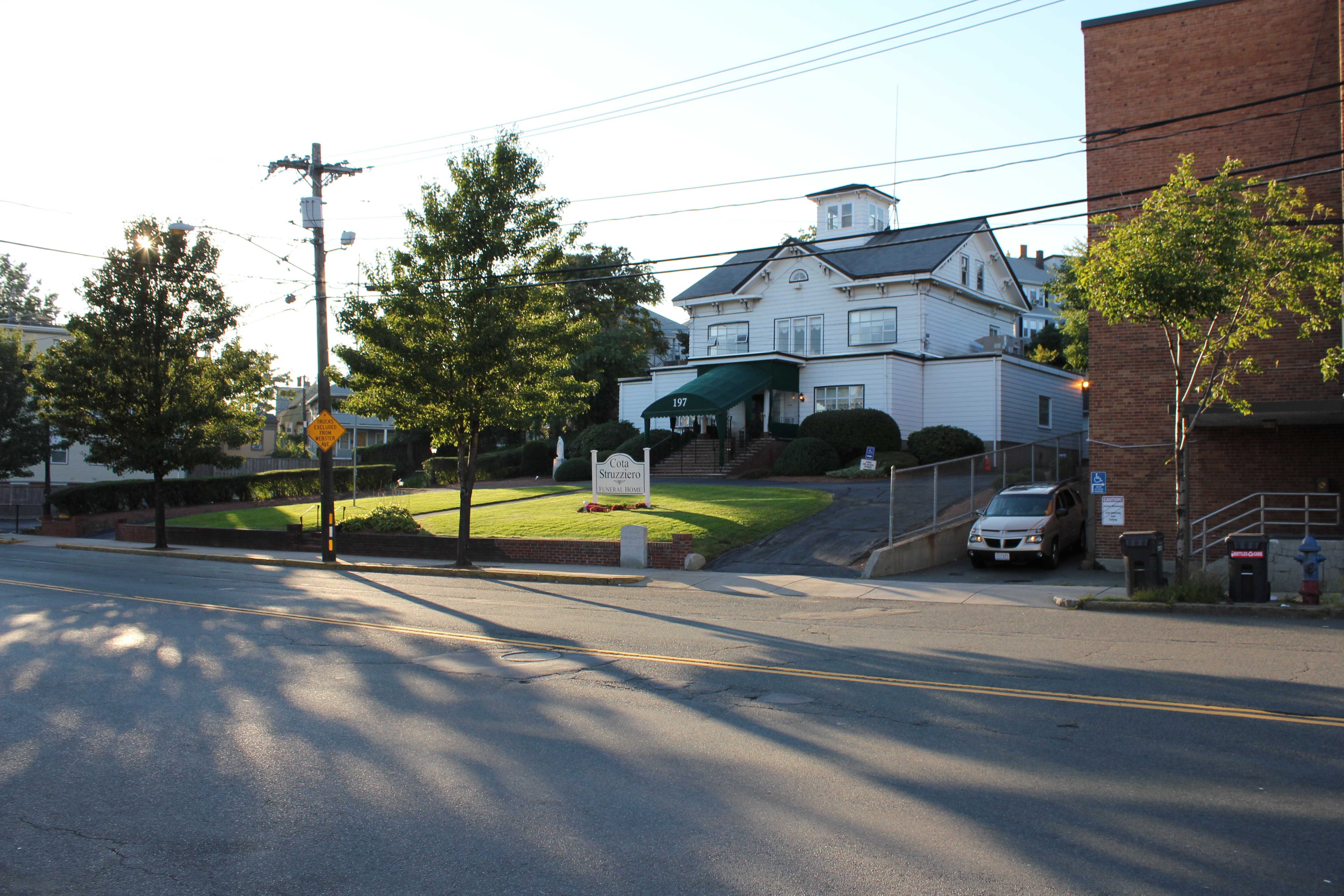
As change comes to Union Square we’re called to balance community interests. Making the best long-term decisions for this community will take all of us to be informed in the public process and to assist in thoughtfully weighing the community impacts. In seemingly every project we’re seeing a complicated mix of choices and compromises, each one different.
Take the current proposal for 197 Washington Street, the current location of Cota Funeral Home, as an example. There’s no easy answers here, and for Union Square Main Streets this is a particularly complex issue that directly touches on our value of historic preservation and our mission to advance the economic vitality of the square’s commercial district. How do we best preserve our heritage and steward the neighborhood’s historic assets while balancing a clear, viable vision for the future of Union Square? We’re hoping to engage you, members of the community, in this conversation both for this specific challenge and for the other projects that are ever more steadily proposed for the neighborhood. 70 Prospect Street, 237 Washington Street (the current post office) — these two are already right in view, and many more in the works.
Here’s the 197 Washington Street case: a developer is seeking to redevelop the property, currently the Cota Funeral Home and a surface parking lot, by demolishing the current structure and building condos. Somerville Community Corporation (SCC) owns the adjoining parcel, 181 Washington Street, and is partnering with this developer. SCC has already obtained the permits to demolish the building on their site; most recently it was used by the Boys and Girls Club and, before that it was a Somerville public middle school.The developer for 197 Washington and SCC are planning a joint application for the design and permitting process with the City of Somerville. The rough idea is the construction of two buildings with a shared parking area that uses a single vehicle entrance on Boston Street. One building, to be retained by the developer, would be market rate housing, while the other, owned by SCC, would be reduced-rate, rental units for those with low and moderate incomes. Zoning regulations and design guidelines encourage active, non-residential uses on the ground level so it is anticipated that both would have retail use or offices with high-foot traffic tenants along the street edge.
Find out what's happening in Somervillefor free with the latest updates from Patch.
In January 2013, as required by the City’s Demolition Review Ordinance which calls for review of all demolition applications affecting a property over 50 years old, Somerville Historic Preservation was asked for a determination on 197 Washington Street.
There’s a three step process here. First, the Commission declares whether the property is historically significant. For a “Determination of Significance,” the building must be found to be either importantly associated with people, events or history, or to be historically or architecturally significant in itself. If the property is deemed significant the next step is a a public hearing and a determination on whether the property should be “Preferably Preserved.”
Find out what's happening in Somervillefor free with the latest updates from Patch.
If found preferably preserved there’s a 9-month delay on the permit during which time the Commission works with the property owner to find alternatives to demolition. This could be anything from finding another buyer for the building and site who would preserve it, to buying the building for a $1 (or some such pittance) to move the structure to another location, to taking photographs and gathering survey data on the parcel, to salvaging architectural elements such as moldings and fixtures.
It’s important to note that “Preferably Preserved” does not protect the property from demolition — it merely creates a delay during which alternatives can be investigated and implemented. Demolition can only be halted if the property with the special recognition of a ” Local Historic District”. Historic Designation must be approved by the Historic Preservation Commission, the Massachusetts Historical Commission and by a two-thirds majority of the Board of Alderman.
A local historic district, the strongest protection available for historic properties, creates a regulatory review process for all changes to the exterior architectural features visible from a public way. Some of the buildings in Union Square have been given this designation, including several of the the Victorian homes on Bow Street. Because it entails restrictions on private property there’s a significant process of research and approvals for properties to be given this designation.
197 Washington Street was found at the January meeting to be historically significant. The property was built sometime around 1860, before much of the rest of the neighborhood was developed. Set up on the hill, with a big yard, it gives a glimpse of the earliest days of Union Square. But the house was converted to a funeral parlor as early as 1933 so that, while many details remain like the cornice, bracket details, half-moon window, roofline and other architectural details can still be seen from the public way, along with the semi circular driveway, much of the ground floor architectural details are long lost.
What is more important is its connection with historic events. A stone marker located on the sidewalk directly in front of 197 Washington Street states, “On this hillside, James Miller Minute Man, was slain by the British, April 19, 1775, ‘I am too old to run.’” As reported by the Historic Commission, “James Miller is reputed to have been slain as the British made their way around Prospect Hill to Charlestown, retreating from Lexington.” But this isn’t specific to the building itself. The property had been the home of two prominent Union Square residents. Samuel Holt was a trustee and Treasurer of the Methodist Episcopal Church on Bow Street. In 1884 and 1885, Holt served on the Common Council, a predecessor to the Board of Alderman, as well as on the Board of Alderman from 1886-1887. Later, it was the home of William E. Plumer who launched W. E. Plumer and Company down the street at 52 Union Square, where the thriving business sold hardware, cutlery, and tools from 1905 through 1919. The Commission also noted that the 80 year span as a funeral home was significant and was part of a movement begun in the mid 1930s to reuse mansions as a fitting place to decorously send-off to one’s loved ones.
Union Square Main Streets submitted a letter in January supporting the Commission’s finding the property significant because it allows for time for the community to formally weigh-in.
For the decision on whether to find the structure preferably preserved we at Union Square Main Streets are torn.
Supporting the designation of Preferably Preserved, 197 Washington is one of the few remaining examples of the lot size and set backs on the hill that once graced a less urban Union Square. The building is in good condition and currently in active use as a funeral home. The Commission frequently has approved expansions and modifications of designated properties to enable more productive reuse. If found preferably preserved during the delay period the Commission and the property owner could explore such possible adaptive reuse.
But while Union Square Main Streets appreciates the unique contribution of the property, we have mixed feelings championing the property in the long term. Reuse of the building is limited. On a steep slope it’s a challenge to make the property affordably ADA accessible. While usable open space is desired for the neighborhood, historic designation does not allow access to a property such as with a house museum. Preservation in this case maintains the view of privately-owned open space, not admission or use of it. The set back on the hill doesn’t foster the kind of active street front that would the neighborhood’s commercial development.Here’s some of what the new development could contribute. The 197 and 181 Washington Street proposals, by designing them together, will allow for a better design of both. Removing surface parking and driveways from Washington Street will encourage pedestrians along this key corridor to the heart of Union Square’s business district from East Somerville and the future Washington Street Green Line station. The new apartment units will make a dent toward relieving market pressures on housing, and these new residents will positively contribute to the business activity in the Square. The new construction promises to strengthen the city’s tax base, as the assessments dramatically increase on these parcels that have remained depressed for decades.On Tuesday, February 19, 2013 the Historic Preservation Commission will hear from the public on a determination of 197 Washington Street as “Preferably Preserved.” What say you? If you think the City should delay the demolition, what would you recommend be done to preserve the property?