Schools
TUFTS MAKES PROGRESS ON DEALING WITH SEXUAL HARASSMENT
Watch this SNN segment to learn more about Tufts University's recent handling of victims of sexual assault.
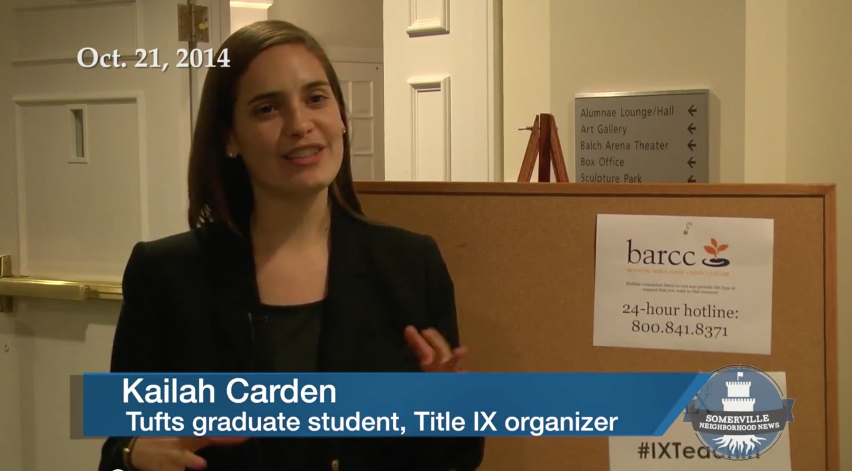
What steps is Tufts taking to address its shortcomings in dealings with victims of sexual assault? Watch the segment below or read the text article.
Somerville, MA, Oct. 21 – A teach-in and some new hires are among the changes at Tufts University, which last year came under pressure from its students and from the U.S. Department of Education for its mishandling of sexual abuse complaints.
Find out what's happening in Somervillefor free with the latest updates from Patch.
The October 3 teach-in on Title IX was sponsored by students in the Women’s, Gender, & Sexuality Studies and Educational Studies programs, the Graduate Consortium in Women’s Studies, the Women’s Center, and other programs and organizations.
“It was really a multi-institutional event in the model of a teach-in for knowledge exchange between students, administrators, and faculty,” graduate student Kailah Carden told Somerville Neighborhood News (SNN).
Find out what's happening in Somervillefor free with the latest updates from Patch.
The daylong event in featured Boston area experts from schools such as Brandeis University, Brown University, Boston University, Harvard University, and Tufts. At different panels, speakers and attendees discussed Title IX and campus sexual violence. It was open to all schools in the consortium of graduate women’s studies, including nine local institutions.
Carden, a first-year graduate student at Tufts, explained that the organizers had intended for the event to view Title IX – a gender equality law that was passed in 1972 – from an academic lens, in light of the literal uprising against the administration for how it was dealing with reports of sexual assault on campus last spring.
Last year, the Department of Education announced that Tufts was “out of compliance” with the law because of the way it was handling sexual assault cases. The university administration rejected the finding, saying it felt its policies were compliant, and on April 26, it decided to remove its signature from a previously signed Voluntary Resolution Agreement with the Department of Education’s Office for Civil Rights.
“We could not, in good faith, allow our community to believe that we were not in compliance with such an important law,” a statement on the Tufts website at the time read.
In response, on May 1 hundreds of students gathered in front of the Tufts administration building Ballou Hall in protest, forming the biggest demonstration at the university since the late 1980s. The administration backed down and re-signed the agreement and began implementing various changes.
One of them was the hiring of two new staffers trained in sexual assault, including Alexandra Donovan, the campus Sexual Misconduct Prevention Specialist.
“The goal of the position for me is really to have an active ongoing conversation about relationships on campus, so that people can become more comfortable when they’re interacting with each other,” said Donovan. “There’s more social health, there’s more social responsibility, so that hopefully people don’t get into the situations around sexual assault and they can ask for consent.”
Despite this and other changes, some at the university feel that there is more that Tufts needs to do.
“There have been good things and there have been bad things,” senior John Kelly, a survivor of sexual assault and campus activist, told SNN.
“When a school tries to revoke it’s signature from a finding of noncompliance, that doesn’t exactly breed trust among the student body, so that was pretty disheartening to see,” he added. “There are still a lot of problems that need to be fixed.”
But Kelly also noted that the teach-in is a positive indicator of change at Tufts.
“I think it really shows just how much of an issue this is, that we need to be talking about it in so many different ways,” Kelly said. “We need to be talking about it as activists, as administrators, as researchers… Another thing that I think the Title IX teach-in really showed us was that there’s some amazing research going on in the field right now and we should really be considering that in terms of policy and cultural change that we’re looking at.”
Donovan, one of the panelists at the teach-in, was also pleased.
“The Title IX teach-in was a great example of how to raise awareness on the Tufts campus,” said Donovan. “Not only did it show what Tufts is doing and what they’ve been doing in the past year – working hard about policy and definitions around this topic – but it really brought together other people who are doing work to show how [we] fit in to what else is happening in the other colleges around… the Boston area.”