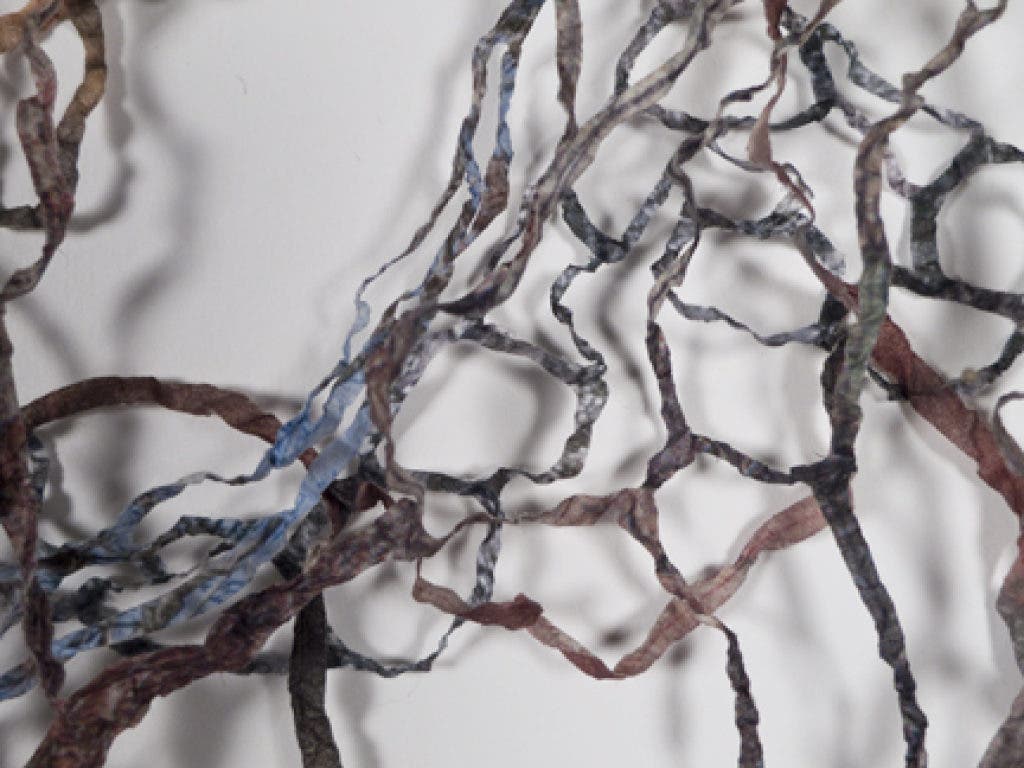
NKG is pleased to present the evocative work of Therese Zemlin.
Therese works in a range of media, including paper, light, and digital prints.She has been exhibiting her sculpture, installation, and works on paper for over thirty years, and has received numerous grants, including a Southern Arts Federation/National Endowment for the Arts Regional Fellowship, and a Pollock-Krasner Foundation Grant. After earning a BFA from the University of Illinois at Urbana-Champaign, and an MFA from the University of Texas at Austin, Therese taught Fibers and Sculpture at the University of South Carolina, Columbia (1991-1994), and Appalachian State University (1994-2000). She was a visiting artist at the School of the Museum of Fine Arts, Boston, and Wellesley College from 2000-2001. She is currently on the faculty at Phillips Academy, Andover, MA.
Therese describes her Iterations Series: "The Iterations Series evolved from the series of cut paper assemblages entitled Clusters from 2007-08. This earlier work was based largely on Ernst Haeckel's scientific illustrations from the mid-1800's of single-celled organisms and protozoa. The web structures in Iterations are derived from my own photographs of tree branches. The branching and overlapping networks are rich metaphors for many networks in our lives, from the way our brains process information, to maps and concepts we use to navigate the physical and cyber worlds. After I finish cutting a piece, I wad the piece up into a tight ball about the size of a marble. When the piece is opened up and spread out, the character of the webbed structure is transformed. Before the pieces are crumpled, they resemble some sort of cross between lace and scientific diagrams. After they have been wadded up, the wrinkles, creases, and irregularities of the previously regular pattern evoke images of the skins and husks of things that are no longer alive, but somehow still capable of movement. The cut crumpled, and stretched paper pieces have an internal tension and compression that, hopefully, begins to mimic the ubiquitous push and pull that is a part of life, and a part of all aspects of our known universe."