Arts & Entertainment
Shedding Light on the LandWave
As the LandWave project by Peter's Park nears completion we look back at the history of the site and the long developmental process.
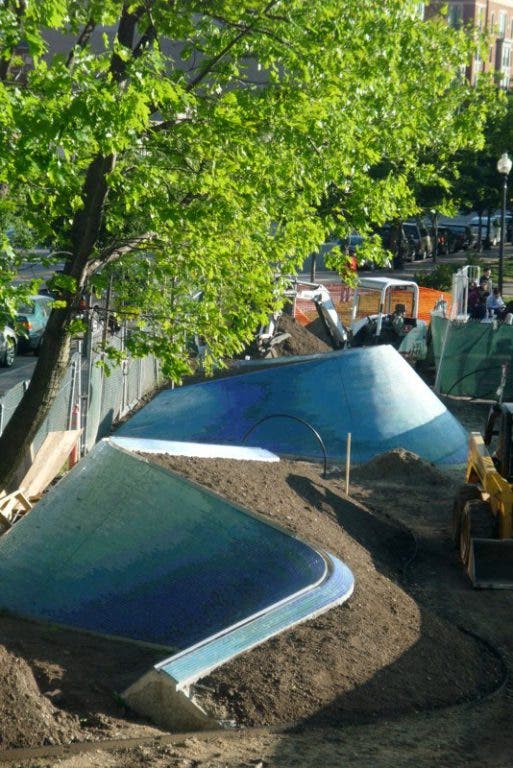


UPDATED at 3:22 p.m.
They’re calling it Neck Art, and they don’t mean pearls, fancy African trade beads or tattoos.
Within the context of the South End, Neck Art is the term coined for the city’s efforts to decoratively memorialize a specific piece of land with unusual historical import. The ‘neck’ in question is the narrow isthmus that once connected downtown Boston (then called the Shawmut Peninsula) to the mainland; the art is an expansive sculpture called LandWave.
Find out what's happening in South Endfor free with the latest updates from Patch.
From about 1630 to 1890, the neck waxed and waned between being a stretch of land and a body of water. Sometimes it proved practically impassible when springtime flooding hindered traveling horsemen. The resulting marshlands on either side became popular hunting grounds. Ironically, now we walk our dogs there.
The site is currently owned by the City of Boston and operated by the Department of Parks and Recreation, running between the Peter’s Park ball field and Washington Street as you approach the corner of E. Berkeley.
Find out what's happening in South Endfor free with the latest updates from Patch.
To inner-city dwellers it might seem more like a back door than a grand entrance to Boston, but the Washington Street Gateway was once the only major toll-free road in the area. The LandWave project seems to be about reminding and reclaiming.
And insofar as symbolism is concerned, distinguishing the neck as an entrance point makes for an attractive reflection of Boston as a place that welcomes all walks of life. The diverse ethnic and economic community that continues to inhabit the South End (despite recent grumblings to the contrary) is especially flattering to a city that's often characterized as being... less than warm.
LandWave is the collective creative vision of landscape architect/public artist Shauna Gillies-Smith, architect Michael Kilkelly and painter/landscape architect/public artist France Cormier. Referred to by the trio as, “a metaphor of land that was once water,” the project is nearing completion. A dedication is imminent.
But it’s been a long time coming… over a decade of pondering, voting, planning and budgetary setbacks. Initial meetings in 2000 gave way to a ‘visioning session’ in the fall of 2001 led by State Representative (and longtime neighborhood resident) Byron Rushing.
Nearly five years of conceptual debate followed, culminating in a community review wherein forty-or-so South End residents were presented with ideas from a pool of creative finalists. Along with her two partners, Gillies-Smith, owner of the landscape architecture design firm ground inc., was appointed in later 2005.
The final touches on LandWave include the installation of two LED light strips, one of which is already in place. The lighting will keep the contrasting mosaic tiles and green moss well illuminated at night. This is a modified version of the project which was originally envisioned as three pieces spanning 130 feet in length and thirty feet in width. Due to financial constraints the finished landmark will be 30 feet shorter and only have two ‘waves’, but retains almost everything else about the initial plan. Parks Department’s Chief Landscape Architect Ken Crasco gave his final nod to the two-wave design in early 2009 and construction began later that year.
--------------------------------------------------------------------------
Check out About Town tomorrow for some insights on the new IDS production of "Glengarry Glen Ross" at the BCA's Plaza Theater!