Arts & Entertainment
SoWa Spotlight On: David Lang
Somewhat of a Renaissance man, Lang's upcoming show at the Boston Sculptors Gallery is not to be missed.
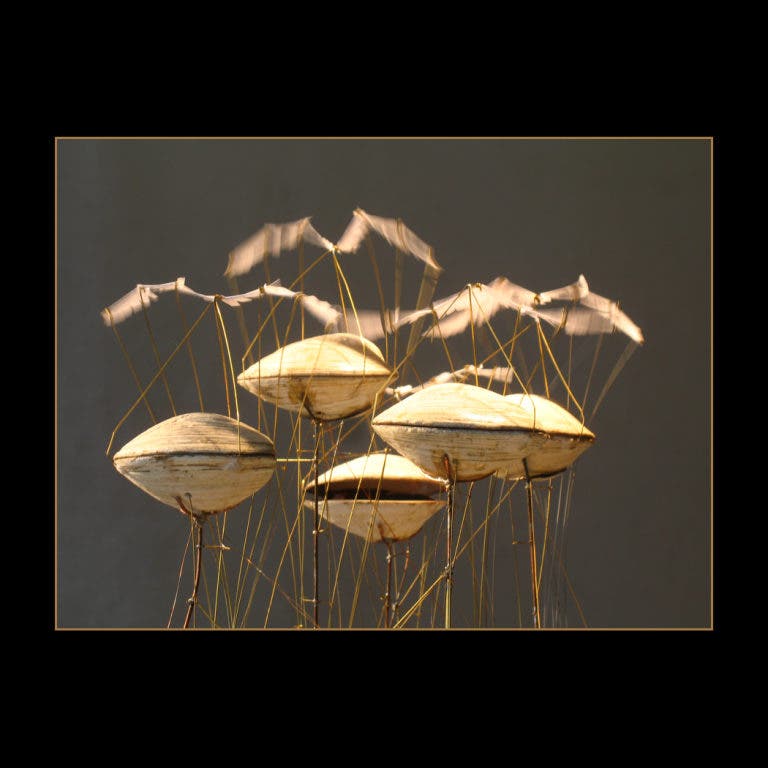


Growing up on the North Shore of Long Island amid multiple truck farms gave artist David Lang an unusual playground, from which he developed a passion for rummaging and a lifelong interest in old buildings, abandoned machinery and farm equipment. Lang and his brother learned early on that the possibilities were limitless for what could be made with their hands and a little imagination, fostered by a father that was part engineer, part inventor.
Combining a BS in Biology (Fairfield University) and some art schooling (Paier School of Art), Lang arrived in Massachusetts for graduate studies at MGH and Harvard Medical School, channeling his dual skill-set into the art of medical illustration. He went on to develop the Scientific Illustration Department at Harvard and stayed there until 1972 when he left to become the Art Department Chair at the Middlesex School. Lang retired from teaching in 2003 and opened his studio in Natick.
Lang is a watercolor painter, sculptor, photographer, writer, musician, flight instructor and stroke survivor. At the end of this month he’ll mount an innovative and unusual show at the Boston Sculptors Gallery in SoWa.
Find out what's happening in South Endfor free with the latest updates from Patch.
Patch: Tell us about this show--how did it come together?
David Lang: This upcoming show is primarily ‘KINETIC SCULPTURE.’ This all began after the stroke. I found it difficult to draw and paint for several years, but was able to conceive of and build mechanical sculpture. The wheels that appear in much of my work have come to represent the passage of time. Some are large, and others are somewhat smaller, but they’re all very delicate and quite elegant.
Find out what's happening in South Endfor free with the latest updates from Patch.
Much of the work is narrative and explores the unlikelihood of day to day events and celebrates the unexpected. For example, "The Day the Castinetti Sisters First Learned to Fly" presents five flying clams on exceedingly delicate paper wings that slowly open and drop shut suddenly, or "Hey Bob, Are You There?" which presents five barnacles debating the merits of staging an ‘evolution.’
I’ve been working on these themes for seven years now, and continually drawing from life experiences and the events that surround us on a day to day basis. Although I would not have thought so, I have discovered that quite a bit of my work has a quiet political voice.
Patch: What would you say are the predominant, recurring themes in your work?
David: Hope, buoyancy, possibilities, serious silliness, unpredictability and the richness of the commonplace.
Patch: What drew you to sculpture?
David: I was introduced to sculpture in the beginning by first studying anatomy and developing a program at Middlesex School which taught Figure and Anatomy Drawing. I came to study under a wonderful stone carver named Reno Pisano. He exposed me to the notion of "Form within a Form". We have remained good friends since 1970.
He recently told me a story about Mickey Rooney, who while returning from military service with a friend was leaning against the rail of their ship. His friend looked out at the ocean and commented, "…just look at all that water," to which Rooney replied, "Yeah, and that's just the surface.” I like that! That’s how I try to remember to look at things—beneath the surface; look any way you can besides the obvious way. There are rewards everywhere, and that’s what my art does.
Patch: What are some of the challenges you've faced in monetizing your career?
David: Staying afloat! Learning how to make things happen by unconventional means… finding the ‘open places.’
Patch: Do you feel that sculptors are lucky, in that the digitization of art hasn't had much effect on their medium?
David: Actually, yes and then again, no. I have incorporated technology into my work quite a bit recently, although you wouldn't know it right away when you look at the work. I’m a musician--and discovered that my sculpture makes and offers sounds. Much of the sound that my pieces produce would be inaudible were it not for what can be done with computers. I’m sometimes able to visualize how a piece might work by photographing my prototypes and changing what they look like, which only serves to open other possibilities.
When you come right down to it, it is as clear to me today as it was 50 years ago: Everything is connected in some way to everything else.
Patch: In tough economic times, what do you feel keeps people buying art?
David: It opens peoples’ heart and minds to possibilities. Some of those possibilities are in discovering where beauty resides. Sometimes the beauty is in the process of finding a solution, sometimes it’s in the elegance of the solution itself. Art is also a catalyst to seeing things differently from the standard perception. In tough economic times, it is often art that speaks the most truth; It has always invited people to look and to consider.
For more information about David Lang, click here. His work will be on display at Boston Sculptors Gallery, 486 Harrison Ave., from August 31 to October 2.