Like parents everywhere, Cindy can’t help bragging about her daughter, a biology major at UMass Boston. Returning to campus this fall, her daughter plans on a medical-related career, perhaps as a pharmacist.
“No Bs,” Cindy told me. “All As or A-s. I’m so proud of her.”
Cindy also talks about her son, who will start high school in the fall. “He does well, too. I’m lucky, no?”
Find out what's happening in Stonehamfor free with the latest updates from Patch.
If Cindy is lucky, it’s a luck hard won. Unlike that of most of us, hers is a story of deprivation, escape by boat and a flight halfway around the globe.
In the 1980s Cindy, then 12, her parents and a younger brother, were living in a village in Vietnam. Her father tried to make a living as a fisherman, but there was seldom enough to eat.
Find out what's happening in Stonehamfor free with the latest updates from Patch.
“Sometimes we had one cup of rice for eight people,” Cindy remembers. “Mother would keep adding water to make it go further.”
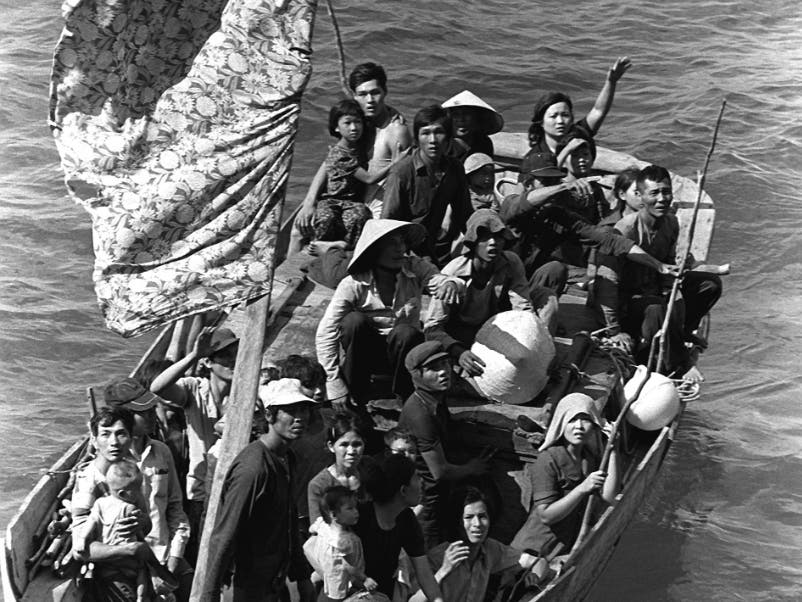
One night the parents, grandparents and children, along with two dozen other villagers, crowded into a fishing boat. They had paid the owner to take them to Hong Kong.
But Hong Kong was a thousand miles away, and there was not enough food and water for the trip. Sailing along the South China coast, they stopped at villages and begged. The Chinese people shared what they could.
After three months, they arrived in Hong Kong, where they were immediately put into a large refugee camp. “There were thousands of us in huge tents. Bunk beds stacked three high with hardly any space between them. No privacy. No place to cook.” They stood in long lines for food. “It was terrible. But it kept us alive.”
They stayed there for three years.
Cindy will never forget a fellow refugee. He had been a teacher in Vietnam. Like many from the countryside, Cindy was illiterate. Now, without pay, the teacher taught her and others how to read and write Vietnamese, then the rudiments of English. “He has a special place in my heart,” she says.
In 1990 her parents were interviewed at the British consulate. Cindy’s father showed them his dog tag from the South Vietnamese army. Two months later they were cleared for asylum in the United States. But first they were flown to the Philippines, where for seven months they received lessons in English and American culture.
Then the long flight to Boston, where Cindy’s uncle had already settled. Her uncle found them an apartment in Malden and they started looking for work. Cindy went to school to learn her profession. With her daughter and son, she lives in Malden.
Today Cindy works hard as she provides manicures and pedicures in a Stoneham salon. Business slowed during the epidemic, but it’s starting to pick up again.
She’s good at what she does, and gets new clients from word of mouth. Cheerful and friendly, she doesn’t easily talk about her past. She’d rather talk about her children. Because of her, her daughter and son will have good lives.
Although most of us cannot relate to the hardships she has experienced, we know that our ancestors, too, came to this country to have a better life. In some cases, as with my grandfather, they, too, were refugees.
Cindy’s story, I am reminded, is an American story.