Neighbor News
Another Green takes up arms for the Union cause
The first son of abolitionist parents, Henry Green responds to Abraham Lincoln's call.
Henry Wilbur Green, born in 1834, was just a toddler when his parents held the first abolitionist meeting in Stoneham at their home on Bow Street. Champions of the anti-slavery cause, Henry and Abigail braved threats of violence to welcome, among others, the noted abolitionist and editor, William Lloyd Garrison.
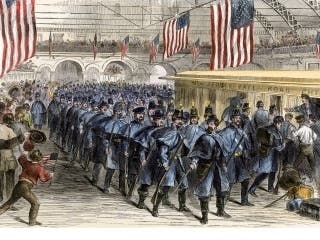
Fast forward to April 16, 1861, four days after Rebels fired on Fort Sumter, and we find their son, Henry, now 26, among the first to respond to Abraham Lincoln’s call for a volunteer army to defend the Union.
A distant cousin of the teenage sharpshooter, Stephen Hosmer Green, whom I wrote about in recent columns, Henry Wilbur Green was 26 when he joined Company L of the renowned Sixth Massachusetts Infantry, the first to arrive in Washington, D.C.
Find out what's happening in Stonehamfor free with the latest updates from Patch.
On the way, however, Private Henry Green and his fellow soldiers were ambushed in Baltimore, when a pro-slavery mob attacked the Union volunteers with bricks and bullets, killing four and wounding dozens. One of those wounded was their captain, John H. Dike. Shot in the thigh, Dike was crippled by his injury and returned to Stoneham.
Meanwhile, Henry Green, after completing his three-month enlistment, in September joined the 2nd Company of Massachusetts Sharpshooters of the 22nd Regiment. It was the same company to which his teenage cousin, Stephen, would enlist.
Find out what's happening in Stonehamfor free with the latest updates from Patch.
Over the next four years, Henry would see fierce fighting and be wounded three times, the first during the siege of Yorktown in the spring of 1862. Refusing to go to the hospital, he then fought in battles at Hanover Court House, Malvern Hill, Kettle Run, Manassas Station and the second Bull Run.
Arriving wounded in Washington in September, he was hospitalized, then in February of 1863 discharged home as disabled. By November, however, he had recovered, and reenlisted under Col. J. Parker Gould of Stoneham of the 59th Regiment. Fighting in the battles of the Wilderness, Laurel Hill, Spotsylvania, Bowling Green and North Anna—during which Col. Gould’s regiment lost over 40 percent of its men—Henry Green was again badly wounded and sent to the hospital.
Again, recovering, he rejoined his regiment in the costly siege of Petersburg. At the Battle of the Crater in July 1864, Colonel Gould was himself shot, and subsequently died from his wounds. Henry was also wounded, but not severely and refused to go to the hospital. Learning of Green’s story, General Napoleon McLaughlin, brigade commander, appointed him as his orderly, and in this role the heroic soldier from Stoneham served until the end of the war.
After the war, Henry, like his cousin, Stephen, returned to Stoneham. According to the Stoneham Independent, he, too, attended reunions of the 2nd Company of Massachusetts Sharpshooters. But unlike Stephen, Henry never married.
About his life in later years, there are only glimpses. In the Stoneham Independent on March 24, 1883, a reporter covering Town Meeting noted that Henry’s name was added to the list of town field-drivers, referring to him as “the old war-horse of the Wilderness.”
A year before a reporter described an incident in which Henry, observing a demonstration of the town’s new steam fire engine, “suddenly took to his heels, and ran up to the hose men about ten hundred feet away, saying, he wasn’t standin’ round no darned engine to be blow’d up. He had stood on the battle field, ’mid shot and shell, and came through it pretty well, and he wasn't goin’ to be killed by a steam fire engine.”
When he died on March 9, 1897, the obituary writer called the thrice-wounded veteran “one of Stoneham’s best soldiers,” an inspiration to the youth of the town.
In his lifetime, Henry Green had known the worst of war and the loss of friends and family. By the time he was 12, he had lost his father and two sisters. Four years after the war, he lost his mother.
But a brother, born two years after him in 1836, had lived and grown up with him in Stoneham. His name was Joshua Gerry Green, the Gerry name after his mother, Abigail Gerry Green. Joshua, too, had enlisted in the Army and had fought, as his abolitionist parents would have wanted, to bring about an end to slavery.
When Henry died three years before the end of the century, the funeral was held in Joshua’s home on Bow Street. One of the pallbearers was Stephen Hosmer Green. In my next column, I’ll tell the story of Joshua, the third of the remarkable Green family to take up arms for the Union cause.