One morning on Farm Hill, not far from where I live, an early Stoneham settler looked out his cabin window and saw an Indian hiding behind a log. The story is told by William Stevens in his 1891 History of Stoneham.
This was in the 1670s, and the farmer was Thomas Gery, head of one of five families homesteading in what was then Charlestown End. Stevens tells what happened next.
In the doorway Gery held out his coat and hat “in such a manner as to draw the arrow of the unwary savage.” Stevens doesn’t say if the Indian ever shot an arrow. He does write, however, that Gery then shot and killed the native. Afraid of reprisals, he buried the body in his cellar.
Find out what's happening in Stonehamfor free with the latest updates from Patch.
This wasn’t the first encounter between settlers and Native Americans in Stoneham, nor the last. In his 1870 history of the town, Silas Dean, tells of a Scotsman named Patrick Hay, who settled in what is now the town center. “It appears that he stood somewhat in fear of the Indians, although he purchased his land of them, at the rate of two coppers per acre.”
Hostilities erupted in Massachusetts when the Wampanoag Chief Metacom, nicknamed King Philip, rose up against the colonists. He protested the taking of land and the humiliating treatment of natives.
Find out what's happening in Stonehamfor free with the latest updates from Patch.
The King Philip’s War spread from Plymouth to the Connecticut River valley, and lasted two years, resulting in the death of over 600 colonists and 3,000 Indians. Although Charlestown End was not near the primary battles, the villagers feared raids, and joined in attacking natives.
Both Thomas Gery and John Gould fought Indians during King Philip’s War. As did a man named Phillips, who, Dean writes, was shot off his horse as he approached Indians in a rye field near Concord, shortly after muttering “that he was not afraid of the black rogues.”
Dean also tells of Stoneham men hunting Indians. The villagers shot and killed one, and found the packs of six others nearby. Another story is about a Scotsman named Dunton, a trumpeter. In the time “when the Indians were committing their depredations in the neighborhood,” Dunton would appear in his window and blow his trumpet to scare off the attackers.
Then there’s the story about Daniel Gould. One day, to call the militia, Gould fired his pistol into the upper floor of his house. Ironically, the bullet “set the building on fire and reduced it to ashes.”
The centuries between what happened then and now have given us a broader perspective. We see the violent clashes between settlers and natives as the tragic results of colonial dominance and aggression. We recall that the first people to be enslaved in our colony were not Africans, but Pequots. We remember that our white ancestors once hunted Indians as if they were animals.
At the same time, we have romanticized natives as great warriors, and have appropriated their names and images for our use. In athletic events throughout the Bay State, mascots have done the war dance and tomahawk chop.
This is about to end. Legislation approved by the Senate and now in a joint conference would ban the use of Native American names, images and mascots from all public schools. A companion bill would provide for a new state flag.
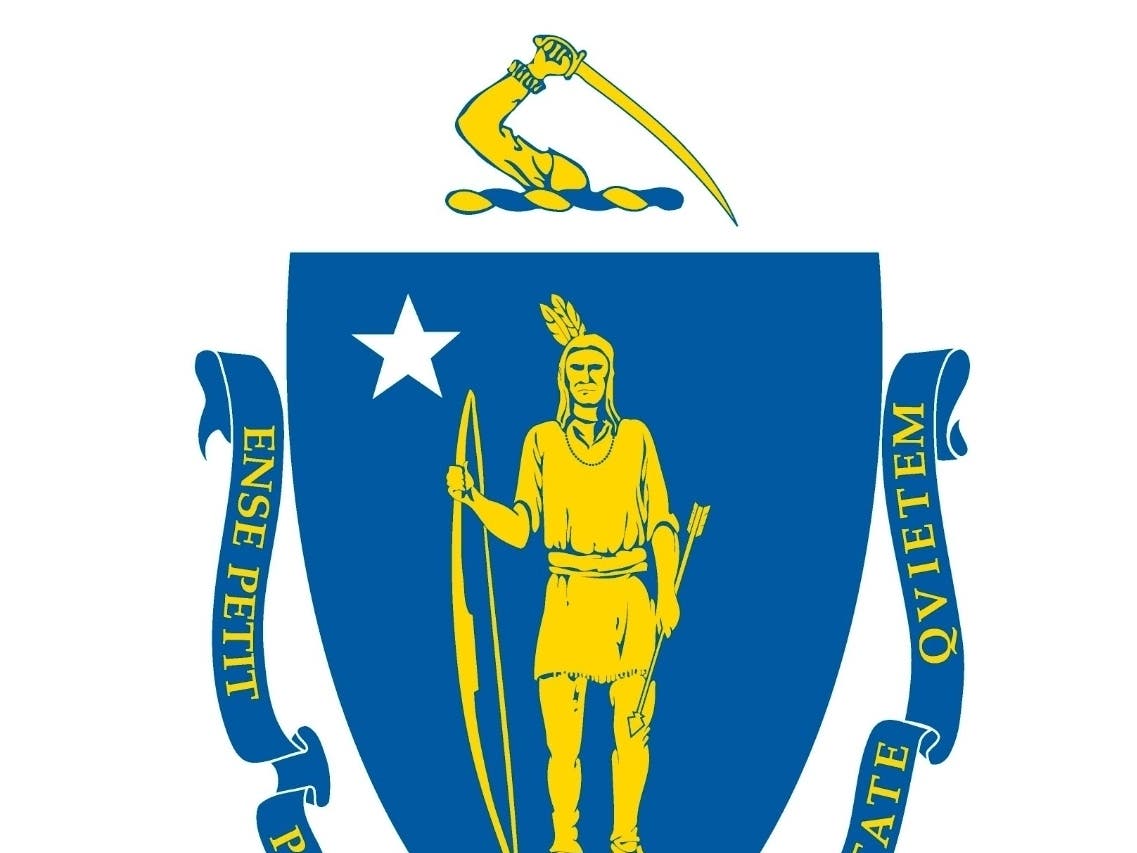
Why, you might ask, do we need a new state flag? Take a look. Centered on the flag is a native man with bow and arrows. Directly above him is an arm wielding a sword, modeled after the sword of Miles Standish, military commander of Plymouth Colony. Standish was known for his brutal killing of Indians. The surrounding motto reads Ense Petit Placidam,sub Libertate Quietem, “By the Sword We Seek Peace, but Peace Only Under Liberty.
It’s not hard to see that the Massachusetts flag demeans our native people, who have survived disease and war, loss of land, slavery and cultural debasement since the arrival of Europeans.
The poet Kenneth Patchen wrote, “… not that man do more, or stop pity; but that he be wider in living; that all his cities fly a clean flag.”
The time is now to fly a clean flag.
Note: Ben Jacques is professor emeritus of Massachusetts College of Liberal Arts. He is the author of In Graves Unmarked: Slavery and Abolition in Stoneham, Mass., available at the Book Oasis on Main Street. © Ben Jacques