In the still dark morning of Christmas, 1848, a young plantation owner from Georgia and his attendant slave are riding in a horse-drawn taxi along the streets of Philadelphia. In truth, however, the gentleman wearing a top hat and frock is Ellen, a light-skinned black woman in disguise, and her attendant is William, her husband.
For three days and nights the fugitives have journeyed, with almost no sleep, fearing detection at every step. Exhausted, they pull up at a hotel they have been told is run by an abolitionist.
At the hotel, Mr. Johnson is shown to his room, where Ellen throws off her sling and bandages, then her men’s clothing, and puts on a dress. After a quiet time of tears and prayer, the couple go downstairs for breakfast and ask to see the proprietor. Greeting them, he cannot believe Ellen is the invalid gentleman who just arrived. Eager to assist, however, he contacts members of the Anti-Slavery Society, who welcome them, then arrange for a Quaker farmer to come for the Crafts.
That evening, riding in a wagon, the Crafts arrive at a little farm outside Philadelphia. They are met by the farmer’s gregarious wife and three daughters. At first, Ellen balks. She has never known disinterested kindness on the part of white folk. Will they not turn them in for a reward? The family’s warm embraces, however, their quaint “thee” and “thou,” ease her fears, and they are taken in, given baths, and seats at the dinner table. It is Sunday evening, Christmas Day, and a fine dinner has been prepared.
Find out what's happening in Stonehamfor free with the latest updates from Patch.
For three weeks the Crafts stay with the Quaker family, resting, studying maps and building their strength. Each day the daughters tutor them in reading and writing. William tells them they have learned the alphabet, but how the letters work together is a mystery. During their stay they are again visited by Philadelphia abolitionists, who arrange for their passage to their next destination.
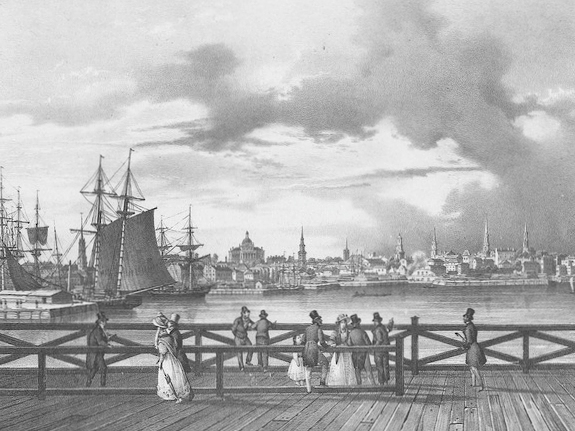
Rather than aim for Canada, the Crafts are encouraged to sail to Boston, the hub of the abolitionist movement in New England. Here free blacks, former slaves and anti-slavery whites, including William Lloyd Garrison and Frederick Douglass, have inspired men and women to action. Here in 1831 Garrison formed the New England Anti-Slavery Society and launched The Liberator, the chronicle of the abolitionist movement in the North. Here abolitionists provide safe lodging for new arrivals and ward off slave hunters.
Find out what's happening in Stonehamfor free with the latest updates from Patch.
Arriving in mid-January, the Crafts are welcomed and given an apartment. It isn’t long before William finds work as a cabinet maker, and Ellen as a seamstress. Meanwhile, they are called on to tell their stories at anti-slavery meetings in Boston and beyond. Letters in The Liberator describe their warm reception in town hall meetings across the state.
For the first year all is well. Then towards the end of the second, William and Ellen face a major threat to their freedom, passage in Congress of the Fugitive Slave Act. A compromise bill designed to prevent Southern states from succeeding, this Act puts William and Ellen Craft, and hundreds like them in the Boston area, in danger.
Mandating the return of all former slaves to their owners, the law imposes stiff penalties of imprisonment and fines to anyone providing food or shelter to an escaped slave. Further, state governments, local law officers, and even citizens are called on to aid in its enforcement.
Throughout the North, this Fugitive Slave Act will divide families, towns, political parties and churches. As governors, legislators, clergy, even the esteemed Massachusetts Senator Daniel Webster, fall in line with the law, New England abolitionists speak out in protest.
One of them is the Rev. Samuel May, who has befriended the Crafts. As an agent of the Anti-Slavery Society, Rev. May has assisted hundreds of fugitives in Massachusetts. Years later, recording the events of the abolitionist movement, he will indict the majority of clergy, including leading theologians, for their support of the Fugitive Slave Act.
Not so, however, a 30-year-old minister in the town of Stoneham, ten miles north of Boston. Here, on a cool Sunday in November, the Rev. William Whitcomb steps into the pulpit of the Congregational Church and begins his sermon. Quoting one scriptural text after another, he calls on his parishioners to disobey the Fugitive Slave Act. Rather, he states, we should obey God’s higher law, which requires us shelter the fugitive, to feed and assist him on his way to freedom.
Like Rev. May, Rev. Whitcomb sees the federal law as an attack on the freedom of all. He states: “Fellow citizens and Christian friends, the new Fugitive Law, if it is carried out to its fullest extent, will enslave you and me, as well as the black man.”
Rev. Whitcomb knows about William and Ellen Craft, and he may have visited them in Boston. In an eloquent sermon that stretches over an hour, Rev. Whitcomb speaks of the sadness he feels, learning that officers have already arrived in Boston to arrest them. To him, he states, the Crafts are like members of his own family, “flesh of my flesh, bone of my bone.”
As he is finishing his sermon, William and Ellen have again gone into hiding. In a few days they will slip out of Boston, heading north. This will be their second escape and their second long journey to freedom.
© Ben Jacques
Based on William and Ellen Craft’s 1860 narrative: Running a Thousand Miles for Freedom.