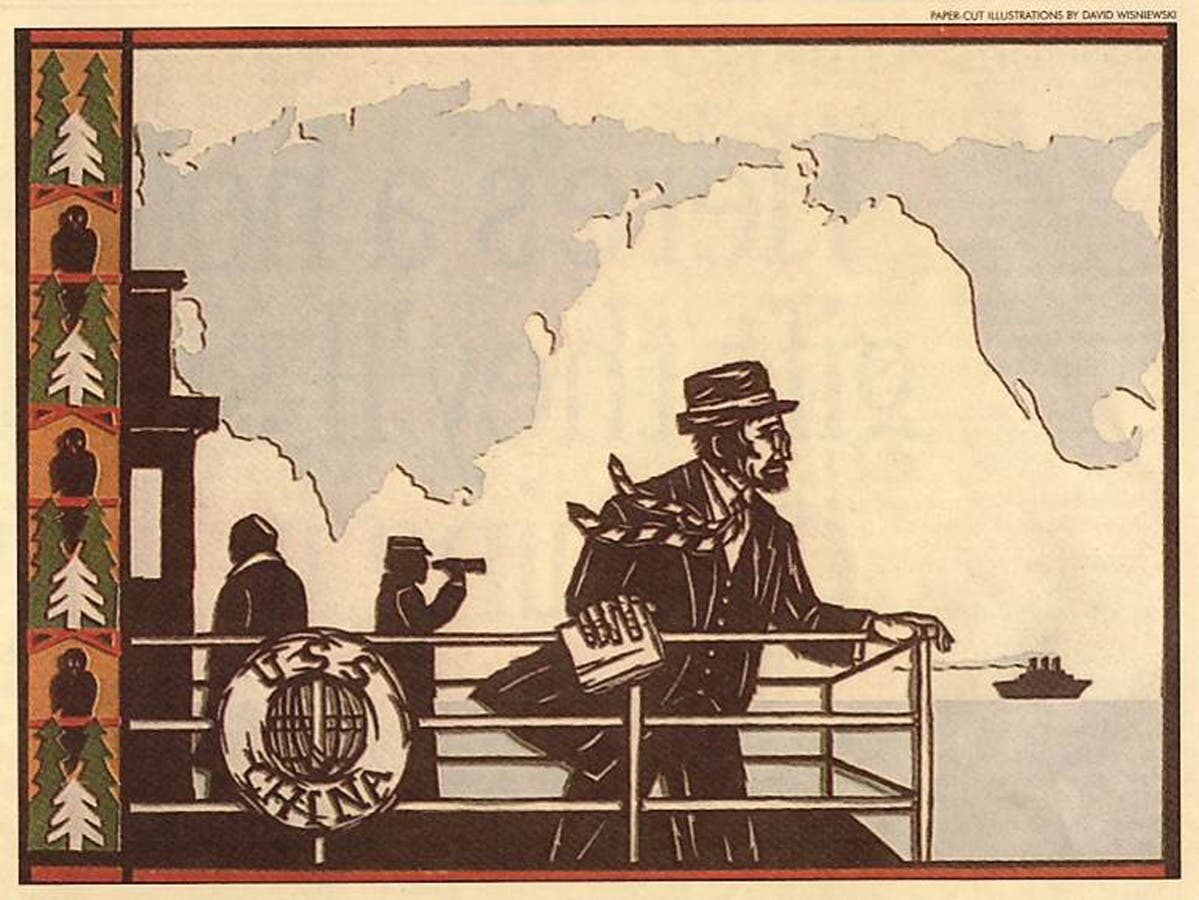
Last week I told the story of how my grandfather fled Russia in 1916, traveling in disguise through Siberia, then to China. In Shanghai, with borrowed money, he booked passage on a steamer for San Francisco.
A fugitive under sentence of the Czar, he felt enormous relief as he boarded the S. S. China. But this was cut short when, in neutral waters, an Australian warship fired shots across the bow.
The United States was not yet at war with Germany, but Great Britain and Australia were. After the second shot, the captain of the China stopped the steamer. Two boatloads of armed sailors then left the warship, boarded the China and demanded a list of passengers.
Find out what's happening in Stonehamfor free with the latest updates from Patch.
Over the protests of the captain, they rounded up 38 men with German or Austrian passports. Two of these men had wives and children with them.
They also took one man who had no passport, my grandfather. His insistence that he was not German, but Russian, was to no avail. He had come so far. Now, he was being taken as a German prisoner.
Find out what's happening in Stonehamfor free with the latest updates from Patch.
An article I found in the archives of The San Francisco Chronicle includes a photo of a British lieutenant checking passengers’ passports. Another shows family members watching as their men are taken over the side of the ship to the waiting launches.
On board the warship, my grandfather insisted he be allowed to speak with the British captain.
Grampa had always had an interest in languages. From what I can gather, he spoke German at home and Russian in the school and in his work. He could also understand Armenian and Yiddish. As a schoolboy, he had saved his money to buy a Russian-English dictionary, and had taught himself the rudiments of English.
He put this to use now with the British captain as he told him of his plight. In response, the captain called for one of the ship’s engineers, a former Russian. He would know if this man without papers was telling the truth.
After grilling him in Russian about geography and other topics, the engineer vouched for my grandfather’s nationality. A boat was again lowered and my grandfather sent back to the China, but under guard with orders that his cabin be searched for any material evidence of his Russian identity.
While he was escaping east on the Siberian railway, my grandfather had once waited at a train station, where he had noticed a stand of books for sale. One of them was the poetry of Mikhail Lermontov, a 19th-century poet and novelist. A favorite of my grandfather’s, Lermontov had lived in exile in the Caucasus, not far from my grandfather's home.
Now, searching his cabin, the British seamen found the small book of Lermontov’s poetry. They returned to the deck and signaled to the captain. Would a German be reading Russian poetry?
I imagine my grandfather, now free to continue his passage to America, standing on deck, watching the warship grow smaller, then disappear on the horizon. Two weeks later, after a stop in Honolulu, the S. S. China steamed into the San Francisco Bay.
In the years to follow, my grandfather became a naturalized citizen, taught school, then enrolled in medical school. He married and had four children. A refugee, a fugitive, an immigrant—he passed through the Golden Gate to a new life in a strange land, a land of unmatched opportunity. I know he would want to keep the gate open.